Lịch sử
The Codebreakers
Bletchley Park, 1939. How a crossword puzzle helped win a war.
TL;DR: The Codebreakers is a MindSnap History collection: the secret British cipher operation at Bletchley Park. A country house chosen for its railway junction, recruits found through crossword puzzles, a machine with more settings than there are stars in the observable sky, and the mathematics that unpicked it. Eight chapters, two minutes each, ending with the invention of the computer.
Cập nhật lần cuối: tháng 8 năm 2026
Câu chuyện
Bletchley Park, 1939. How a crossword puzzle helped win a war.
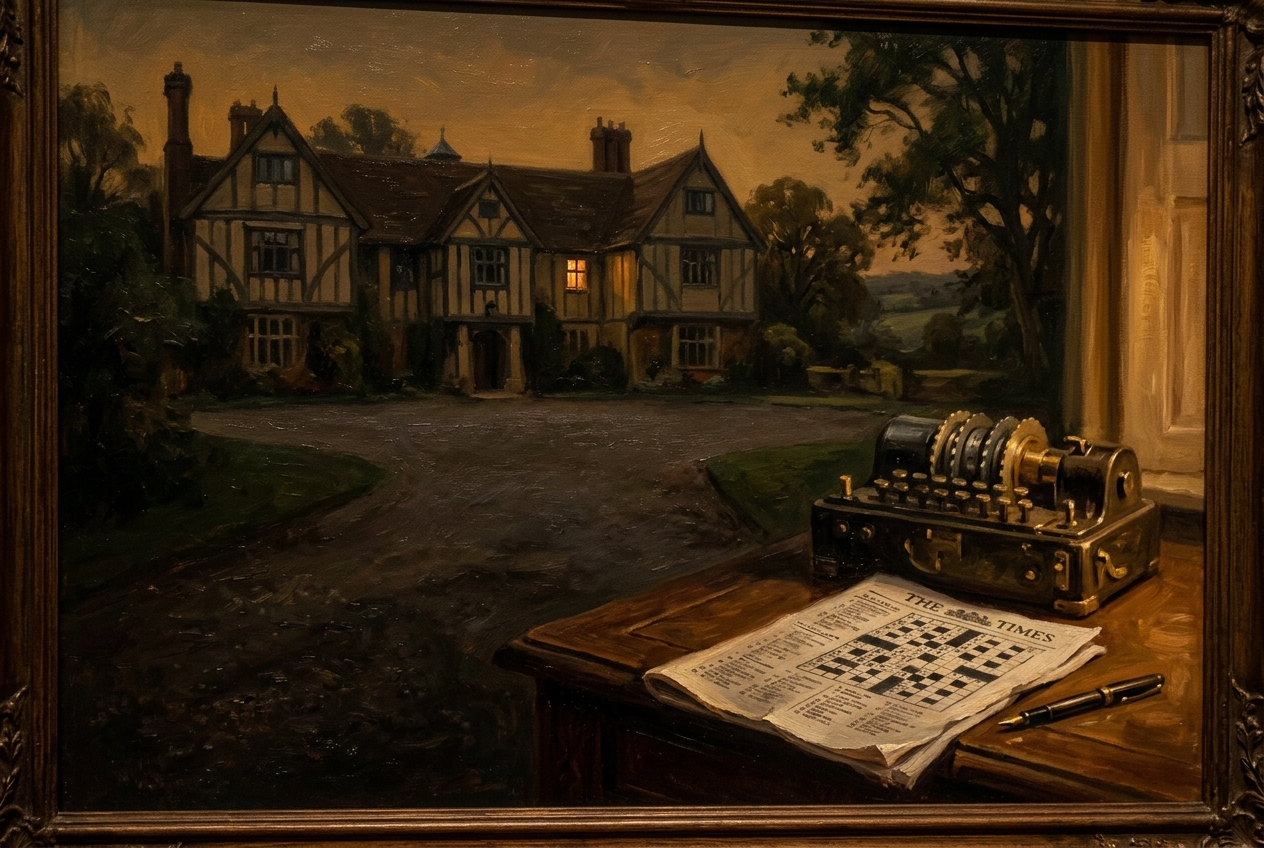
Bletchley Park is a mock-Tudor estate in Buckinghamshire, bought quietly in 1938 because it sat where the London line crossed the line linking Oxford and Cambridge. The recruits would come from the two universities. The work would be reading German military signals, and the operation grew from a few dozen people to nearly nine thousand, about three quarters of them women.
The target was Enigma, a portable cipher machine whose rotors and plugboard produced settings numbering in the order of ten to the twenty-third power, changed daily. The German armed forces considered it secure, and mathematically their confidence was reasonable. What it hid was a structural flaw: because of the reflector in the machine, no letter could ever encipher as itself, which lets a codebreaker reject huge numbers of possibilities at a glance.
Britain did not start from scratch. Polish cryptologists led by Marian Rejewski had reconstructed the machine's wiring in 1932 and read its traffic for years, and in July 1939 they handed everything to Britain and France, five weeks before the invasion of Poland. On that foundation Alan Turing and Gordon Welchman designed the Bombe, a machine that tested logical contradictions at electrical speed, and Hut 8 fought the harder naval version with statistics and with cipher documents pulled from sinking submarines.
Then the silence. Ultra intelligence was so valuable that the whole story stayed classified until the 1970s, by which time Turing was dead and Tommy Flowers, who built the electronic Colossus machines in 1943 and 1944, had spent his career unable to say what he had done. This collection tells all of it, and ends where the huts point: at the machine on your desk.
Các chương
Tám snap. Mỗi chương hai phút.
Why a Victorian country house fifty miles from London became Britain's cipher factory. The answer is a railway junction, two universities, and lawns with room for huts.
Vì sao câu chuyện này đáng kể trên bàn ăn tối
“Poland broke Enigma seven years before the war and gave the work away.”
Marian Rejewski deduced the machine's internal wiring mathematically in 1932. In July 1939 the Polish Cipher Bureau handed its methods and reconstructed machines to Britain and France.
“No letter enciphered as itself, and that flaw helped break the machine.”
Enigma's reflector sent the current back through the rotors, so A never came out as A. Codebreakers could slide a guessed phrase along a message and instantly reject impossible positions.
Tiếp tục khám phá
Những câu chuyện khác trong bộ sưu tập
Thích việc tự mình quyết định chứ?
MindSnap mang đến một ngả rẽ lịch sử 2 phút như thế này mỗi ngày, cùng một bài học, một câu đố nhỏ và một sự thật thú vị mỗi ngày.
Sự thật miễn phí mỗi ngày · giá hiển thị rõ ràng ngay từ đầu · hủy chỉ với một chạm