天文学
The Star Catalog
Rhodes, 129 BC. From Hypatia to Hubble.
TL;DR: The Star Catalog is a MindSnap Astronomy collection: how one observer on Rhodes in the second century BC decided to write down the whole sky. Sighting instruments and Babylonian arithmetic, a brightness scale still in use, the discovery that the entire sky slowly drifts, absorption into Ptolemy's Almagest, and a 2022 reading of erased parchment. Eight chapters, two minutes each.
最終更新: 2026年8月
物語
Rhodes, 129 BC. From Hypatia to Hubble.
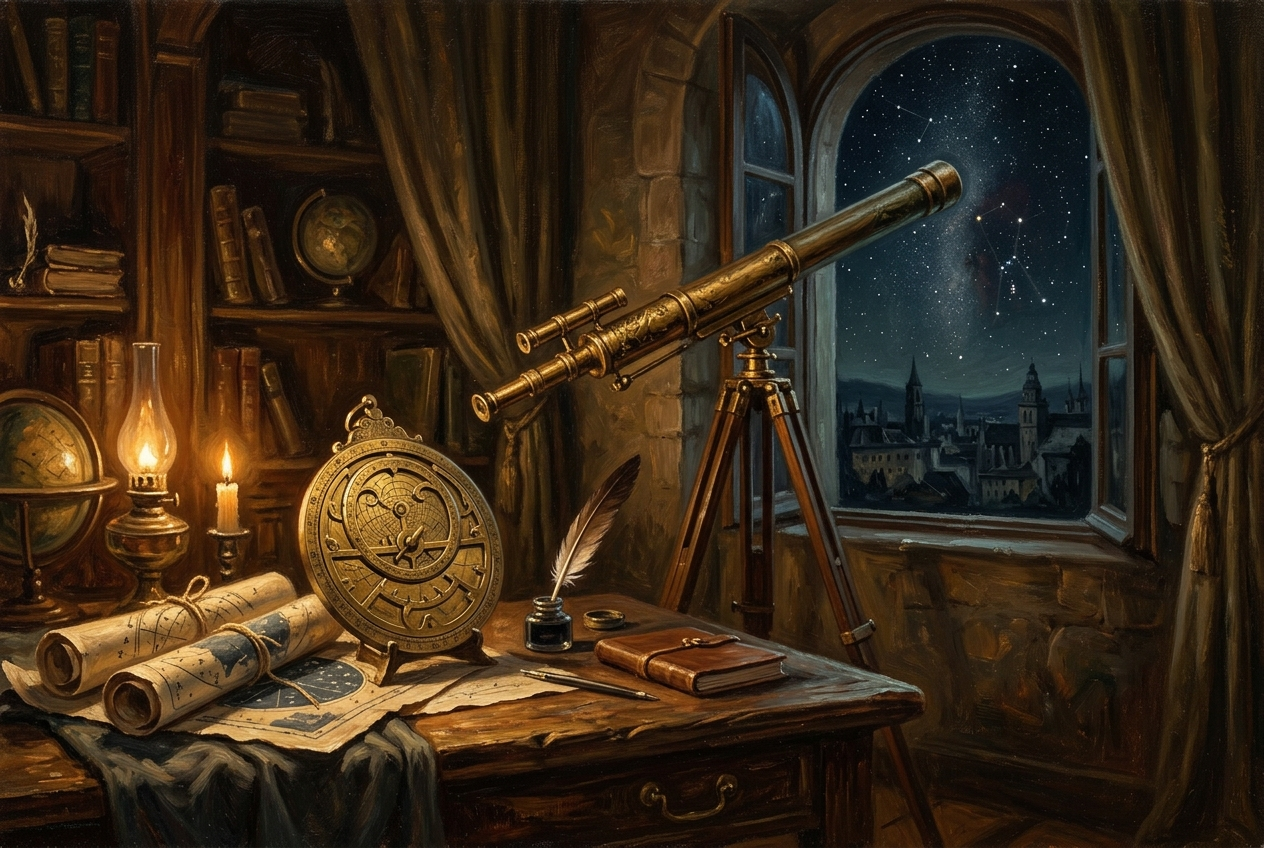
Rhodes in the second century BC was rich, cosmopolitan and blessed with clear Mediterranean nights. Working there between roughly 190 and 120 BC, Hipparchus of Nicaea did something no Greek or Babylonian astronomer had done: he recorded the fixed stars as one dataset, with measured positions and estimated brightnesses, so that a stranger centuries later could tell whether the sky had changed.
Almost none of his writing survives. We reconstruct him from citations, mostly Ptolemy's. What the citations describe is a working method: sighting instruments read by eye, relative measurements chained together to avoid the problem of timekeeping, chord tables standing in for trigonometry, and sexagesimal arithmetic inherited from centuries of Mesopotamian record keeping.
Two results outlasted everything. The six-grade brightness scale, first grade brightest to sixth grade faintest, is the ancestor of modern magnitudes, backwards numbers included. And by comparing his measurement of Spica against an observation made about a century and a half earlier, he found that the equinox points slide along the ecliptic: the precession of the equinoxes, a wobble whose physical cause waited eighteen centuries for Newton.
The catalog itself was lost, absorbed into Ptolemy's Almagest and argued over by scholars ever since. Then in 2022 researchers reported reading star coordinates beneath a Christian text in the Codex Climaci Rescriptus palimpsest, dated by precession to his era. The collection ends where the work continues: Tycho, Bessel and parallax, then the Hipparcos satellite and Gaia, mapping nearly two billion stars using exactly the logic he started with.
各章
全8章のスナップ。 1章2分。
Pliny says a star appeared where none had been, and that it pushed Hipparchus into an unglamorous decision: record the whole sky for observers not yet born.
この物語が食卓で話したくなる理由
“The magnitude scale runs backwards because the brightest stars were called first grade.”
Smaller numbers mean brighter objects, so Sirius sits at about minus one and a half, and the convention traces back to the six-grade ranking used in antiquity.
“Polaris is a temporary pole star.”
Precession swings Earth's axis around a cone roughly every twenty-six thousand years. Thuban held the position when the pyramids were built, and Vega will hold it later.
続けて読む
展示室にあるその他の物語
決断してみて、いかがでしたか?
MindSnapは毎日、こうした2分のターニングポイントに加え、レッスン、クイズ、日替わり豆知識をお届けします。
日替わり豆知識は無料 ・ 価格は事前表示 ・ ワンタップで解約可能