How Ottoman Ships Crossed Land to Take Constantinople

Arts & History Editor
Last updated: August 2026
7 min read

TL;DR
In April 1453 the Byzantine defenders of Constantinople had closed the Golden Horn with a great floating chain, keeping the Ottoman fleet out of the city's harbour. Mehmed II answered by building a timber track over the hill behind Galata and hauling dozens of light warships overland on greased rollers into the Horn. The ships did not breach the walls themselves, but they forced the outnumbered defenders to guard a long harbour wall they had thought was safe, stretching a thin garrison even thinner in the weeks before the final assault.
Some moments in military history are remembered because of a clever weapon. This one is remembered because of a clever road. On a spring morning in 1453, the defenders of Constantinople looked out across the Golden Horn, the deep inlet that formed the city's northern harbour, and saw Ottoman warships floating where no Ottoman warship should have been. The ships had not sailed in. They had been carried over a hill.
To understand why that sight was so alarming, you have to understand the geography the defenders were relying on, and the single piece of iron that held it all together.
A city defended on three sides
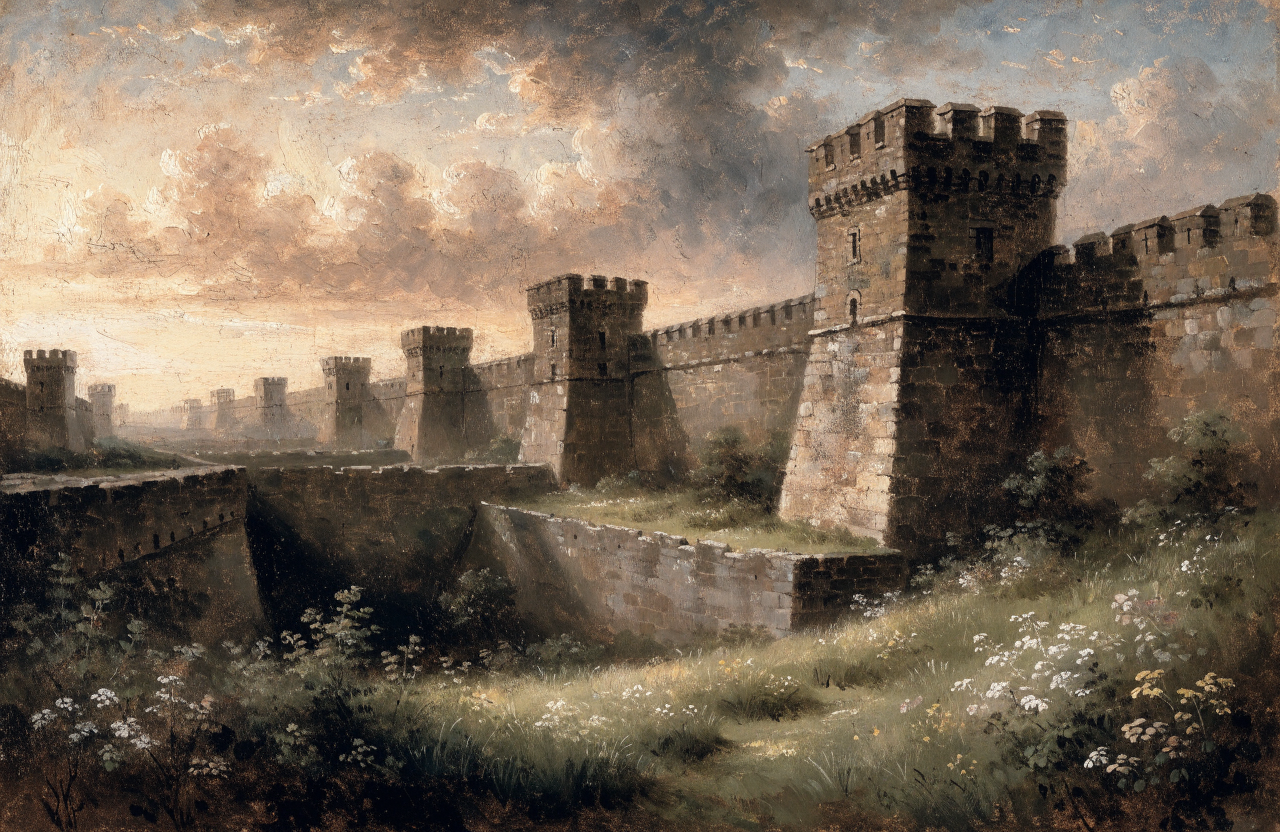
Constantinople sat on a triangular peninsula. Its western, landward side was protected by the Theodosian Walls, a layered system of moat, outer wall and inner wall that had turned back besiegers for roughly a thousand years. The story of those fortifications is told in our explainer on the Theodosian Walls. The southern side faced the Sea of Marmara, where strong currents and sea walls made a landing difficult. The northern side faced the Golden Horn.
The Golden Horn was the city's safe harbour and its soft spot at the same time. The sea walls along it were lower and weaker than the land walls, because for most of the city's history the Horn itself had been the defence. If an enemy fleet got inside, those walls could be attacked from the water. So the Byzantines kept the enemy fleet out.
Why the chain mattered
Across the mouth of the Golden Horn the defenders stretched a massive boom: a chain of heavy iron links supported on wooden floats, running from the city to the walls of Galata on the far shore. Galata was a Genoese trading colony that stayed officially neutral during the siege, which mattered later. With the chain in place and Byzantine and Italian ships guarding it, the Ottoman fleet anchored in the Bosphorus could not enter the harbour.
The chain had a history of its own. A similar barrier had been used in earlier sieges, and the Ottomans tested this one early. Attempts to force it failed, and in a sea fight in April a small group of Christian supply ships fought their way past the Ottoman fleet into the harbour, a humiliating moment for the besiegers in full view of both armies. The chain is the subject of a chapter in our collection, The Day the Middle Ages Ended, because so much of the siege turned on it.
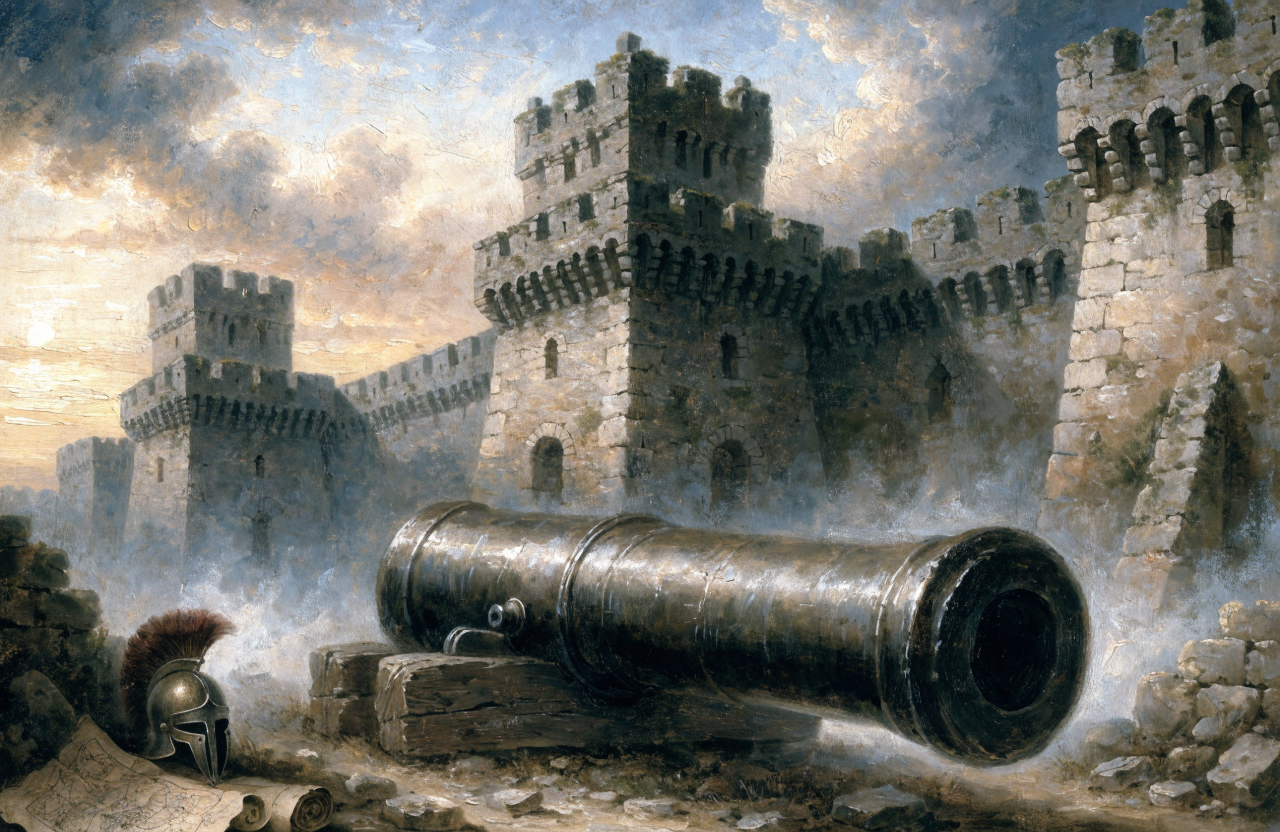
For Mehmed II, the young sultan whose life is covered in our profile of Mehmed the Conqueror, this was a real problem. His great cannon were pounding the land walls, but the defenders were repairing damage at night and holding. As long as the harbour stayed closed, the defenders could concentrate their limited men on the landward side.
The portage: moving a fleet over a hill
If the ships could not go through the chain, they would go around it. North of Galata, the land rose into a ridge before dropping again toward the upper part of the Golden Horn, well inside the boom. Mehmed's engineers prepared a route from the Bosphorus shore, up that slope and down the other side.
The method, as described by contemporary and near-contemporary accounts, was simple in principle and enormous in effort. Workers laid a track of timber along the route and greased the logs with animal fat. Ships were lifted out of the water onto wooden cradles and rolled along the greased track, pulled by teams of oxen and large numbers of men. Accounts describe some vessels being moved with their sails raised and crews aboard, oars working the air, as if sailing across the land. Whether that detail is literal or a storyteller's flourish, it captures how strange the scene looked.
The ships involved were mostly lighter galleys and smaller vessels rather than the largest ships of the fleet, which is part of why the plan was feasible at all. Sources disagree on the exact number, with figures often cited around seventy, so it is safest to say that dozens of ships made the crossing. The bulk of the work appears to have been done in a concentrated push over a night and the following day, around 22 April, and the defenders were taken by surprise.
Galata's position helped. The route ran behind the Genoese colony, out of easy view from the city, and the neutral Genoese did not stop it. Historians have long debated how much they knew and when.
Was this a new idea?
Not entirely. Dragging ships overland was an old technique in the Mediterranean world. In antiquity a paved trackway carried ships across the narrow isthmus of Corinth, and medieval fleets had been moved short distances overland elsewhere. What made the 1453 portage memorable was the combination of scale, speed and timing: a large group of warships moved over steep ground in the middle of a siege, landing exactly where the enemy had no plan to defend.
It also fits a pattern in Mehmed's campaign. The same siege saw Orban's great cannon dragged from Edirne, and a fortress, Rumeli Hisari, built on the Bosphorus the year before to control shipping. Mehmed's strength was logistics: moving heavy things to places where they changed the problem.
What it changed about the siege
The ships in the upper Golden Horn did not storm the city. Their impact was quieter and more corrosive. The harbour wall, which the defenders had counted on as a secure flank, was suddenly a front line. Men had to be pulled from the land walls to watch it, at a time when the defenders were already badly outnumbered, with estimates for the defending force usually given in the thousands against an Ottoman army many times larger.
The Ottomans then built a pontoon bridge across the upper Horn, linking their forces on both sides and letting them move troops and guns more freely around the city. A Venetian plan to burn the Ottoman ships at night with fire ships was betrayed or detected and ended in failure, with captured sailors executed in view of the walls. The episode deepened mistrust between the Venetians and Genoese inside and near the city.
In short, the portage changed the arithmetic. A siege is often a contest of endurance: can the defenders keep enough men at every threatened point? By opening a second front on the water, Mehmed made the answer harder every day. When the final assault came on 29 May, the defenders were exhausted and spread thin along walls they could no longer fully man.
How to remember the episode
- The problem: a floating chain closed the Golden Horn, so the weaker harbour walls were safe.
- The answer: a greased timber track over the hill behind Galata, with ships pulled by oxen and men.
- The effect: defenders had to split their thin garrison between the land walls and the harbour.
- The lesson: in sieges, logistics and surprise can matter as much as firepower.
The bigger story
The fall of Constantinople in 1453 ended the last remnant of the Roman Empire and is often used as a marker for the end of the Middle Ages. The full sequence, from the walls and cannon to the final night, is laid out in our guide to the fall of Constantinople. The portage is one of its most vivid chapters because it is so easy to picture and so hard to believe.
If you want to walk through the siege as a story, MindSnap's collection The Day the Middle Ages Ended tells it in short daily chapters. MindSnap is our app, so weigh that recommendation accordingly. It also has a feature called Turning Points, where you face a historical decision like Mehmed's harbour problem and choose what you would do before seeing what actually happened. It is a good way to notice that the obvious move, attacking the chain again, was not the one that worked.
The chain was never broken. It was simply made irrelevant.
Frequently asked questions

One snap tomorrow morning.
Two minutes in art, history, psychology, philosophy or economics, then the app tells you you're done.
Get MindSnap on iOSFree daily fact, forever. Pro is $9.99/month or $44.99/year.