What Really Happened in 1453? The Fall of Constantinople, Explained

Arts & History Editor
Last updated: August 2026
8 min read
TL;DR
On 29 May 1453, after a siege of roughly seven weeks, the army of Sultan Mehmed II took Constantinople and ended the Roman Empire in its eastern form after almost eleven centuries. The city fell because the defenders were catastrophically outnumbered, the walls that had held for a thousand years now faced gunpowder artillery, and Ottoman ingenuity neutralised the harbour defences. The consequences were real: a new imperial capital, a reordered eastern Mediterranean, fresh urgency behind Atlantic exploration, and Greek scholars and manuscripts moving west. What it did not do was single-handedly cause the Renaissance, which was already well underway.
By the spring of 1453 Constantinople was a shadow of the city that had once ruled the Mediterranean world. The Byzantine Empire had been reduced to the capital, a slice of Thrace and a few scattered holdings, and the population had collapsed to perhaps fifty thousand people rattling around inside walls built for half a million. Whole districts inside the fortifications were farmland.
What remained was the geography and the masonry. Constantinople sat on a peninsula with water on two sides and one of the most formidable land defences ever constructed on the third. That combination had defeated attackers for a thousand years. In 1453 it failed, and the reason it failed is a genuinely interesting story about technology meeting stone.
The walls that had never been broken
The Theodosian Walls, raised in the fifth century, ran roughly six kilometres across the landward side. They were not one wall but a layered system: a moat, then a low outer wall with towers, a terrace, then the great inner wall about twelve metres high and five thick, studded with ninety-six towers.
An attacker had to cross the ditch under fire, take the outer wall, and then assault the inner wall from a confined killing ground with defenders above on both flanks. Arab, Bulgar, Rus and Avar armies had all tried and gone home. The one successful capture before 1453, by the Fourth Crusade in 1204, came through the sea walls and Venetian ships, not through the land defences.
Mehmed's guns
Mehmed II was twenty-one and had inherited a state with enormous resources and a long-standing ambition. His answer to the walls was gunpowder at a scale nobody had attempted.
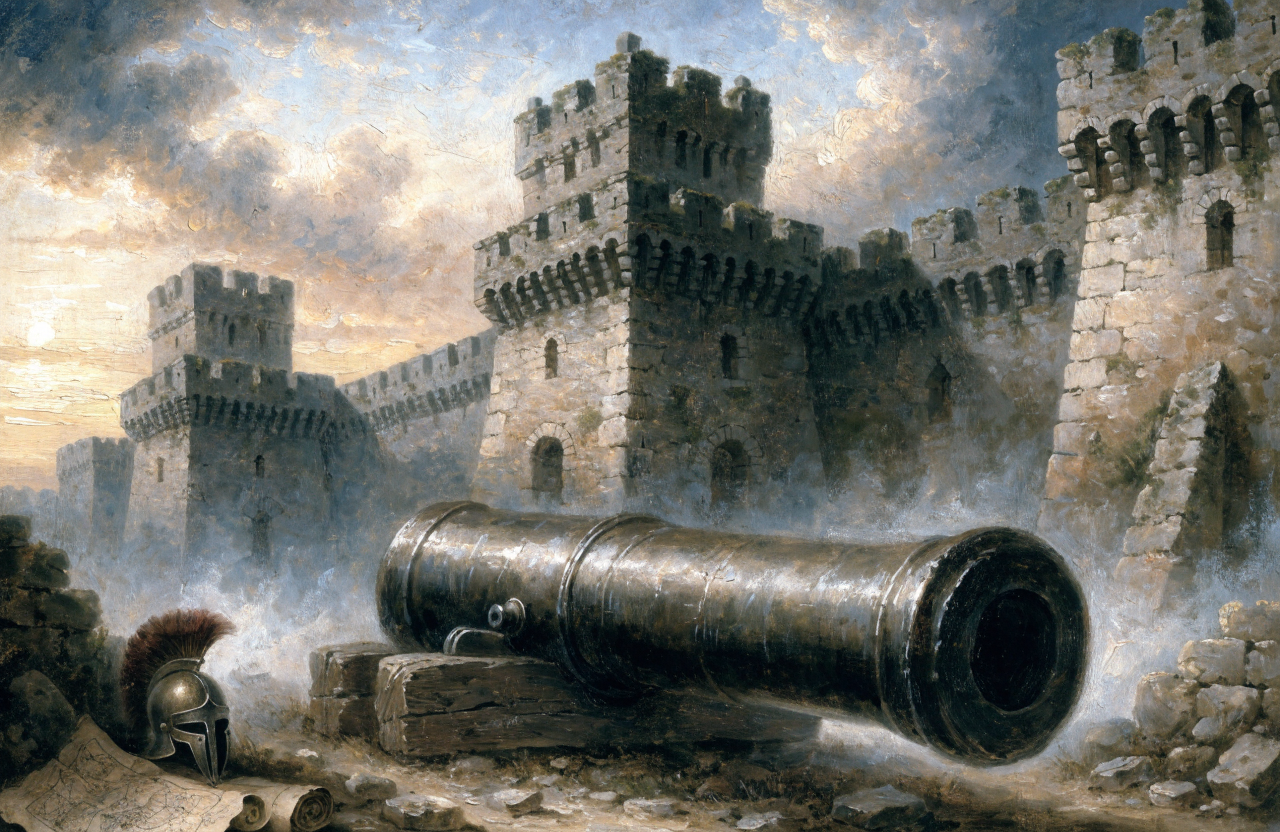
A Hungarian founder named Orban had reportedly offered his services to the Byzantines first, who could not pay him. He went to the Sultan, who could. The result was a siege train including bombards of extraordinary size, the largest of them a bronze monster that fired stone balls weighing several hundred kilograms. It was slow, needing hours to cool and reload, and it consumed itself with use. But it did something no siege engine had ever done to Theodosius's masonry: it knocked pieces of it down.
Estimates of the two forces vary widely across sources, and anyone offering you a precise figure is guessing. The honest version is that Mehmed brought something in the range of fifty to eighty thousand fighting men, and the defenders, under Emperor Constantine XI, had roughly seven thousand, including a Genoese contingent under Giovanni Giustiniani. Even at the most generous reading, the defence was outnumbered by something like eight or ten to one, and had to hold every metre of a six-kilometre perimeter.
The chain and the ships over the hill
The Golden Horn, the deep harbour on the city's northern flank, was the soft point in the sea defences, and the Byzantines closed it the way they always had: a great iron chain slung across the entrance on floats, anchored at both ends. It worked. Ottoman ships could not force it.
So Mehmed went around it. His men laid a greased slipway of timber across the ridge of Pera and hauled a portion of the fleet overland from the Bosphorus into the Golden Horn, appearing inside the harbour the chain was supposed to protect. The engineering was the point. It stretched the defenders along another stretch of wall they had hoped to leave lightly held, and there were no spare men to stretch.
A handful of relief ships did break through the blockade in April, to enormous cheering. No real Western relief army ever came. Papal appeals for a crusade produced sympathy, promises and very little else, in part because of the bitter theological split between the Latin and Greek churches that a recent attempted union had failed to heal.
29 May
The bombardment ground on for weeks, opening breaches that the defenders repaired at night with rubble, earth and barrels, which absorbed shot better than solid stone. Assaults were repelled. Mining attempts were countered by defenders who located and collapsed the tunnels. For a while it looked as though the city might hold long enough for the season to turn.
In the early hours of 29 May, Mehmed launched a general assault in waves: irregulars first, then Anatolian regiments, then the janissaries. It concentrated on the Mesoteichion, the weakest stretch, where the wall dips toward the Lycus valley. Giustiniani was gravely wounded and carried away, and his Genoese troops began to leave with him. In the confusion Ottoman soldiers got over the outer defences and into the space between the walls, and a gate was forced.
Constantine XI was last seen fighting near the breach. His body was never conclusively identified, which is why he passes almost immediately out of history and into legend, including the folk story of an emperor turned to marble, waiting. He was the last Roman emperor, and the line he stood at the end of ran back to Augustus.
The city was sacked over the following days, as the customs of the age permitted for a place taken by storm. Mehmed then halted the plunder, entered the Hagia Sophia and ordered its conversion to a mosque. He took the title Kayser-i Rum, Caesar of Rome, and set about repopulating the city as his capital.
Why it mattered
Four consequences are worth separating from the noise.
- The Roman Empire ended. Not as metaphor: an institutional line of emperors running from the first century closed in 1453, and Byzantine Greek administration, law and court culture ended with it.
- A new great power took a permanent seat astride the straits. Constantinople became Istanbul and the capital of an empire that would shape the eastern Mediterranean, the Balkans and the Black Sea for four and a half centuries.
- Trade incentives shifted. The Ottomans now controlled the terminus of the eastern land routes and taxed what passed. That did not close trade, but it strengthened the commercial case for finding a sea road to Asia, which Portuguese and later Spanish crowns pursued in earnest within decades.
- Greek learning moved west. Scholars, teachers and manuscripts had been travelling toward Italy for generations, and the fall accelerated the flow, enriching Greek studies in Florence, Venice and beyond.
The choke-point logic in that third bullet is not a medieval curiosity. Whoever holds a narrow water passage holds a lever on everyone who needs it, which is the argument we make with modern examples in maritime chokepoints explained.
The myth worth busting
You will often read that the fall of Constantinople caused the Renaissance. It is a tidy line and it does not survive contact with dates.
The Italian Renaissance was decades old by 1453. Brunelleschi's dome was finished in 1436. Petrarch had been hunting classical manuscripts in the previous century. Greek teachers such as Manuel Chrysoloras were lecturing in Florence around 1400, and the Council of Ferrara and Florence brought Byzantine intellectuals west in the late 1430s. The refugees of 1453 joined a movement already running, and strengthened its Greek component. They did not start it.
The same instinct to compress a slow process into one dramatic date is exactly what goes wrong when people talk about Rome collapsing in a single year, which we take apart in the myths about the fall of Rome. Sudden endings make better stories than they make history.
It is fair, though, to ask what a different 1453 would have looked like: a relief fleet arriving, or Orban never getting paid. Counterfactuals are a useful discipline as long as you hold them loosely, which is the spirit of history's greatest what-ifs.
Standing in the breach
Disclosure: MindSnap is our app. This siege is the spine of one of our story-driven collections, The Day the Middle Ages Ended, which follows the seven weeks from the first gun to the forced gate. It is also the opening scenario in Turning Points, where you make the decisions the defenders faced, including whether to hold the Mesoteichion or pull men back, and see how your choice compares with what actually happened.
The detail I keep returning to is the rubble. Every night, ordinary citizens filled the day's breaches with earth and barrels, and it worked, over and over, until the night it did not. Eleven centuries of empire came down to whether a few thousand exhausted people could patch a wall faster than a cannon could open it.
Frequently asked questions
One snap tomorrow morning.
Two minutes in art, history, psychology, philosophy or economics, then the app tells you you're done.
Get MindSnap on iOSFree daily fact, forever. Pro is $9.99/month or $44.99/year.