History's Greatest What-Ifs: 6 Moments That Nearly Went the Other Way

Arts & History Editor
Last updated: August 2026
10 min read
TL;DR
Counterfactual history is useful only when it is disciplined: change one variable, keep it close to the moment, respect what people actually knew, and stop before the causal chain gets long. Six documented near-misses, from a besieged Constantinople to a New Haven laboratory, show what a careful what-if can teach and where it has to admit ignorance. Holding a decision in your hand, as in MindSnap's Turning Points, teaches contingency better than reading a verdict about it.
Most amateur counterfactuals fail in the same way. Someone changes one small fact centuries ago and then marches confidently forward to a present-day conclusion, as if history were a line of dominoes with no wind in the room. It rarely is. Doing this well means being far more modest about what a single altered moment can tell you.
Four rules for a responsible counterfactual
- Change one variable. If you alter a wound, a vote, a weather pattern and a personality all at once, you have written fiction, not history.
- Keep the change close to the moment. A counterfactual about the next hour or day is testable against what people actually knew and feared. A counterfactual about the next century is a guess dressed as an argument.
- Respect what the actors knew at the time, not what we know now. Nobody in 1453 knew the Byzantine Empire was in its final years; they knew a wall had held for weeks and might hold for longer.
- Avoid long causal chains. Each additional link, first this happens, then that, then this other thing, multiplies your uncertainty. Two links is usually the honest limit.
Used this way, a what-if is not a prophecy. It is a tool for feeling contingency, the sense that an outcome we treat as inevitable was, at the time, a near thing decided by fatigue, weather, a closed gate or a single stubborn juror. That is the spirit behind MindSnap's Turning Points feature, which is our app's way of putting you inside a real decision rather than telling you how it ended. The six cases below follow the same discipline.
1. Constantinople, 1453: the gate left ajar
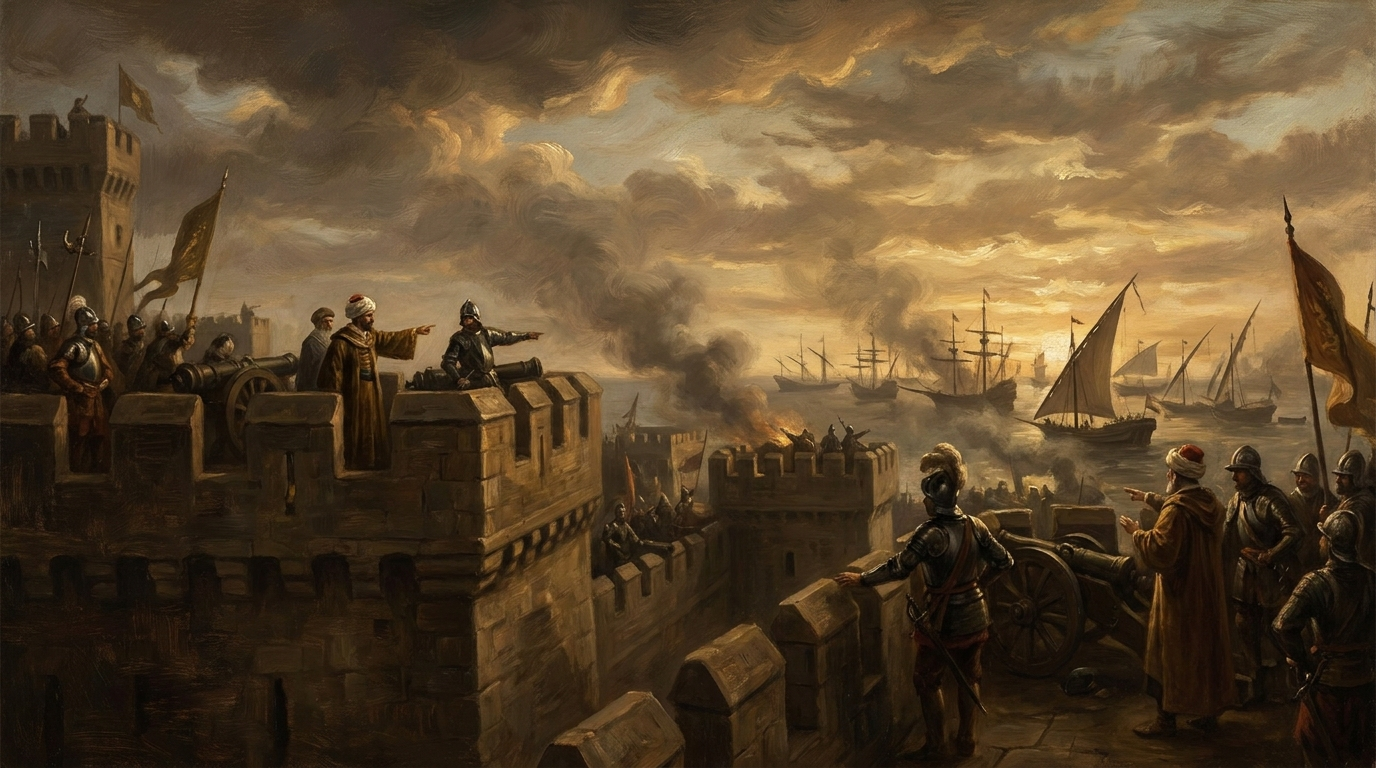
By late May 1453, Constantinople's Theodosian Walls had withstood Ottoman siege for weeks. What actually happened is well documented: during the final assault on 29 May, the Genoese commander Giovanni Giustiniani, defending a key section of the wall, was gravely wounded and carried from the breach. His withdrawal is widely credited with breaking the defenders' morale, and the Ottomans forced their way in shortly after. The city fell that day, ending the Byzantine Empire after roughly eleven centuries.
What was genuinely in the balance was narrow: whether that one commander stayed at his post for another hour, and whether a postern gate reportedly left unlocked, the Kerkoporta, was secured in time. A disciplined counterfactual can say the siege might have continued into exhaustion or negotiated terms on either side. It cannot responsibly claim the empire would have survived another century, or that the Renaissance would have unfolded differently: too many other pressures on Byzantium, and too many other channels for Greek scholarship into Italy, were already in motion. The Turning Points scenario for this moment puts you at the wall in the final hours, without telling you it is the final day.
2. Athens, 399 BC: the boat from Delos
Socrates was convicted by an Athenian jury and, according to Plato's account, had a real opportunity to escape before his execution; his friend Crito reportedly offered to arrange it. Socrates declined and drank the hemlock in 399 BC. That refusal, not the trial itself, is the moment historians of philosophy return to.
What was in the balance was a single choice by one man about whether to honour a legal verdict he considered unjust in substance but binding in form. A careful counterfactual can note that Athenian custom sometimes tolerated a condemned man's quiet flight into exile, so the door was not merely rhetorical. It cannot claim that a fled Socrates would have written the dialogues we have; those texts are Plato's construction of a life, made more urgent by the death. The Turning Points rendering of this scene is deliberately about the argument in the cell, not the verdict already delivered.
3. Amsterdam, 1637: the auction that did not clear
The Dutch tulip bulb market, having risen to extraordinary prices for a small number of rare varieties, collapsed in the first week of February 1637 when a routine auction in Haarlem failed to attract buyers at the expected price. Panic spread through the trading network within days. Courts and florists' guilds later allowed many buyers to settle for a fraction of the contracted price rather than enforcing full payment, which is one reason the popular image of nationwide ruin overstates the damage.
The narrow counterfactual is about that single failed auction: had buyers shown up that week, the unwind might have been slower and less visible, though few economic historians think the underlying prices were sustainable regardless. It is fair to say the specific crash date was contingent; it is not fair to say tulip mania would have avoided a correction altogether.
4. New Haven, 1961: the fortieth volt
Stanley Milgram's obedience experiments at Yale, running through 1961 and after, are remembered for one number: the high proportion of participants who continued administering what they believed were dangerous electric shocks when instructed to by an authority figure. Each participant's session included repeated decision points where they could have stopped.
The honest counterfactual here is per-person, not aggregate. Any individual participant could plausibly have refused at an earlier prompt, and some did. What cannot be inferred is a single dramatic hinge that would have changed the whole result: the finding was robust across many participants and later replications in a way that a single altered moment does not explain away. That is precisely why the scenario is worth sitting inside rather than summarising, which is the premise of the Turning Points version of this evening in the laboratory.
5. Paris, 1874: the exhibition nobody had to attend
A group of painters rejected or discouraged by the official Salon organised an independent exhibition in April 1874, later known as the founding show of Impressionism. It was mocked by contemporary critics and sold poorly. The painters could have stayed within the Salon system, competing for its shrinking tolerance of unconventional work, rather than staging their own show.
The narrow claim: had the group not organised independently, individual careers would likely have taken longer and been shaped more by Salon juries. The broad claim, that modern art would not exist without this exact exhibition, overreaches; similar pressures against academic painting were building across Europe. This is the kind of temptation counterfactual history has to resist most often, letting one vivid scene stand in for a whole current.
6. Two further cases worth the same treatment
The discipline above travels well beyond these five. The 1962 Cuban Missile Crisis turned on a small number of individual decisions, including a Soviet submarine officer's refusal to authorise a nuclear torpedo launch during a tense standoff; historians still debate exactly how close that came to catastrophe, and the honest answer is that we do not have full visibility into every chain of command that week. Closer to certainty is the 1815 Battle of Waterloo, where weather delaying the start of fighting, and the late arrival of Prussian reinforcement, are both documented factors in a battle that was tactically close for much of the day, even though Napoleon's broader position in Europe was already deteriorating.
What a good counterfactual is for
The value of a what-if is not the alternate ending. It is the reminder that the actual ending was not owed to anyone.
Reading a verdict, this side won, this empire fell, this market crashed, trains the mind to treat outcomes as settled facts that could only have gone one way. Holding the decision itself, with only the information the people in the room had, restores the sense that history is made of choices under uncertainty. That is a different kind of understanding from memorising a date, and it does not replace the documented record, which always deserves the last word. If you want to try this directly rather than read about it, MindSnap's Turning Points feature is built for exactly that: a real decision, a time limit, and the actual outcome revealed only afterwards. It sits alongside MindSnap's five flagship story collections, covering Art, History, Psychology, Philosophy and Economics, plus unlimited further topics; MindSnap is our app.
Frequently asked questions

One snap tomorrow morning.
Two minutes in art, history, psychology, philosophy or economics, then the app tells you you're done.
Get MindSnap on iOSFree daily fact, forever. Pro is $9.99/month or $44.99/year.