How to Read a Painting: A 5-Step Method From Museum Educators

Arts & History Editor
Last updated: August 2026
8 min read
TL;DR
Reading a painting takes five steps: look before you read the label, find the light, follow the composition, read the hands and faces, and only then ask what the picture wants. Ninety seconds of that order beats twenty minutes of wandering, because you build your own reading before the wall text supplies one.
Most people go round a gallery in a fixed sequence: glance at the picture, read the label, glance back, move on. It feels efficient and it is close to useless, because the label hands you a conclusion before you have had a single observation of your own. Museum educators are trained to reverse that order, and the reversal is most of the skill.
Here is the method we use, worked through with Rembrandt because he rewards it more than almost anyone.
Step 1: Look for thirty seconds before you read anything
Thirty seconds is much longer than it sounds in a gallery. Stand still, cover the label with your hand if you must, and answer three questions silently: what is happening, where am I standing in relation to it, and what did I notice first?
That last question is the important one, because painters direct attention deliberately. If your eye went to a face, a hand or a patch of white cloth, that was not an accident. You have just detected the composition doing its job before you knew the title.
Step 2: Find the light and ask where it comes from
Light is the fastest route into a picture's meaning. Trace it: where is the source, what does it strike, and crucially what has been left dark on purpose?
Rembrandt is the great teacher here. In The Anatomy Lesson of Dr Nicolaes Tulp the brightest thing in a room full of important men is the corpse. Light is not illumination, it is argument: the body is the subject, and the dignitaries are the audience. Once you start asking what the light chose, you notice that in his later self-portraits the light gets narrower and later, until it lands only on the face and one hand and everything else is allowed to go.
Our collection Rembrandt's Shadow follows exactly this thread, from early confidence to the extraordinary honesty of the last paintings.
Step 3: Follow the composition, then find the odd one out
Composition is the route the painter has laid out for your eye. Look for the largest shapes first, then the lines that connect them: a raised arm, a table edge, the diagonal of a stair.
- Triangles are stable, so they signal calm, order or authority.
- Strong diagonals signal movement or crisis, which is why baroque drama runs on them.
- Circles or ovals of figures suggest community, ritual or conspiracy depending on where the light falls.
- Empty space is content. A figure pushed to one edge with emptiness beside them is a statement about isolation, not a mistake.
Then find the element that breaks the pattern. In The Night Watch, everyone is in motion in a way group portraits of the period never were, and a small girl in gold light appears where no client paid to be. The anomaly is almost always where the meaning is.
Step 4: Read the hands and the faces
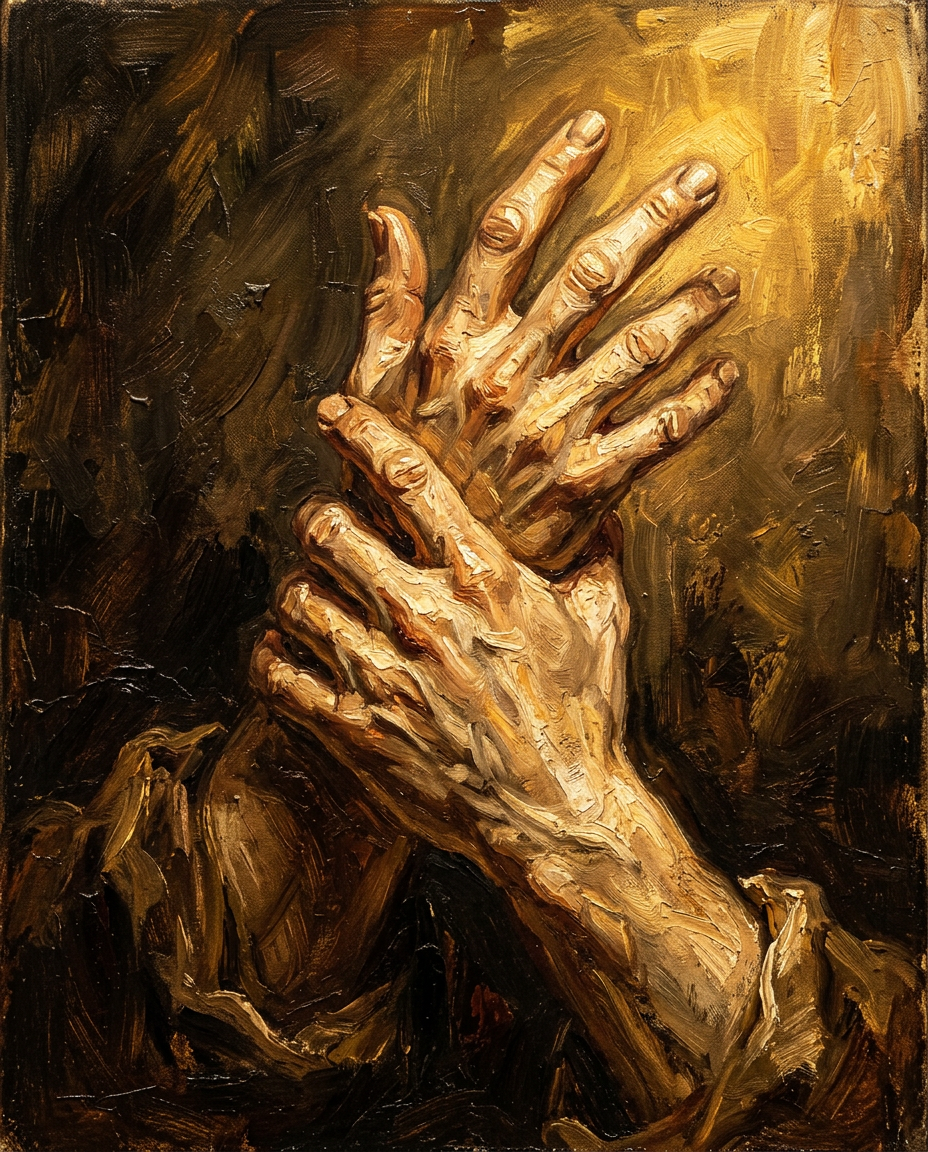
Faces get all the attention, but hands are where painters put the emotion they do not want to say out loud. Hands show status, tension and relationship, and they were the hardest thing to paint, so a confident hand is a signature of skill.
- 1Whose hands are visible, and whose are hidden? Hidden hands often mean withheld power or discomfort.
- 2What are the hands touching, and with how much pressure?
- 3Do the hands agree with the face? A composed face over a clenched hand is a painter telling you the sitter is performing.
- 4Where are the eyes going? Look for who looks at whom, and who looks at you. Being looked at by a figure changes you from observer to participant.
In Rembrandt's late portraits the hands frequently soften into loose paint while the eyes stay exact. He is deciding what deserves precision, and he decides in favour of the gaze.
Step 5: Ask what the picture wants from you
Every painting was made for a purpose, and it usually wants something: your devotion, your admiration for a patron, your unease, your money, your recognition of a family's standing. Asking directly is not cynical, it is context.
Now read the label. Date, place, who commissioned it, what it was for. You will find your own observations either confirmed or usefully contradicted, and both outcomes teach you something the label alone could not.
The ninety-second version
| Step | Question | Time |
|---|---|---|
| 1. Look | What did I notice first? | 30 seconds |
| 2. Light | Where does it come from, and what is left dark? | 15 seconds |
| 3. Composition | What shape is it, and what breaks the shape? | 15 seconds |
| 4. Hands and faces | Who is performing, and who is looking at me? | 20 seconds |
| 5. Purpose | What did this want from its first viewer? | 10 seconds |
Two habits make it stick. Look at fewer pictures for longer, because six paintings properly seen beat sixty walked past. And say one sentence out loud about each one before you move, because a spoken sentence is retrieval and it is the difference between a visit you remember and a visit you photographed.
Why this works when art history does not
Learning names and movements gives you labels for things you cannot yet see. This method gives you the seeing first, and the labels then attach to something real. It is the same principle as any good sequence: one observable thing at a time, in an order your attention can hold.
Disclosure: MindSnap is our app. Its art collection is built as one two-minute chapter a day using this order of looking, alongside unlimited topics, and the Turning Points scenarios put you inside decisions like the ones these painters faced. Neither is a substitute for standing in front of the real thing for thirty seconds.
The label tells you what a painting is. Thirty seconds of silence tells you what it does.
Frequently asked questions
One snap tomorrow morning.
Two minutes in art, history, psychology, philosophy or economics, then the app tells you you're done.
Get MindSnap on iOSFree daily fact, forever. Pro is $9.99/month or $44.99/year.