The Most Expensive Colors in History (And Why Blue Broke Banks)

Curiosity Columnist
Last updated: August 2026
8 min read
TL;DR
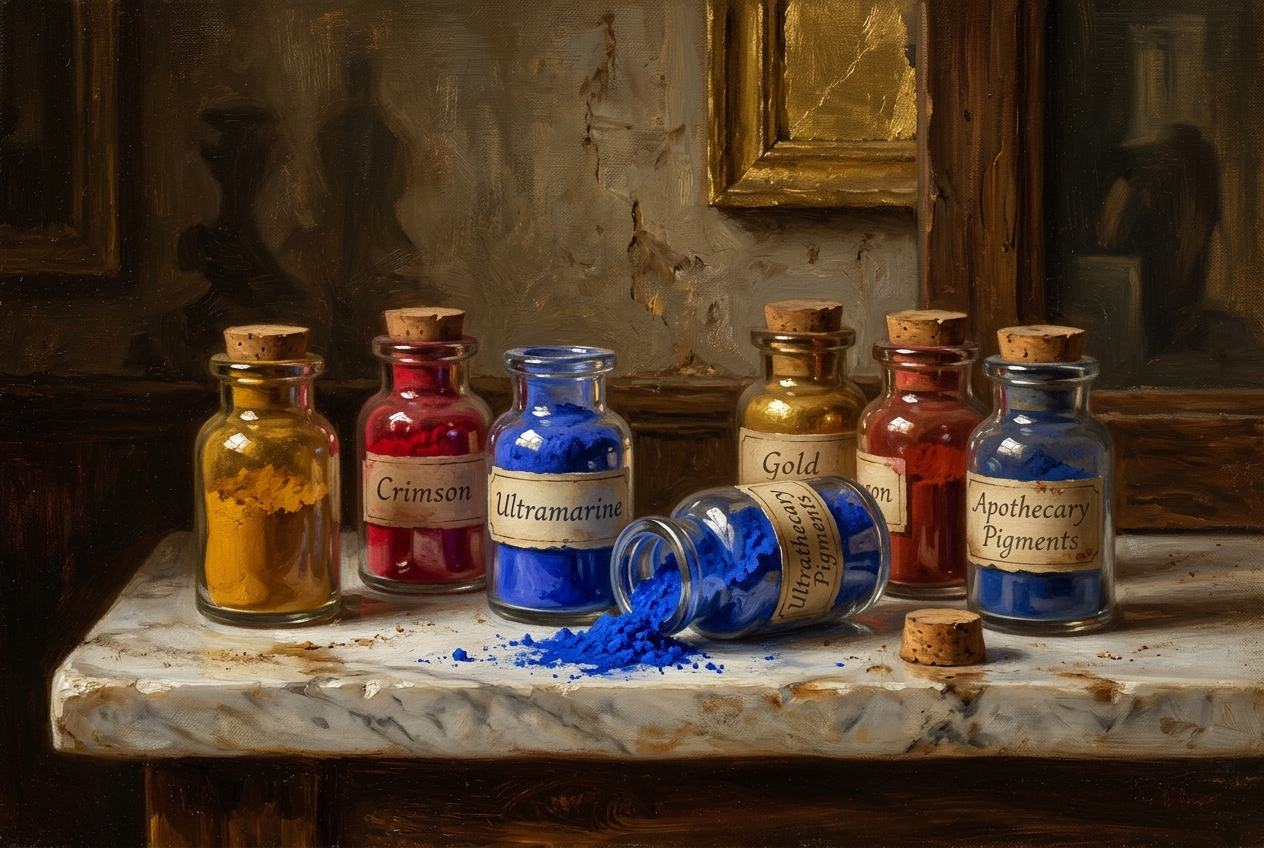
The most expensive colours in history were expensive for boring supply reasons. Ultramarine came from one remote mountain range and cost more than gold by weight. Tyrian purple needed thousands of sea snails per garment. Mummy brown was ground-up mummies, and it stayed on sale into the twentieth century. Cheap colour is barely two centuries old.
We have a favourite colour in this office and we put it in the footer, so this article is not neutral. Ultramarine is also, historically, the correct answer to which colour cost the most, so at least the bias is well founded.
Here is the short history of colours that ruined people financially, in rough order of expense.
1. Ultramarine: the blue that cost more than gold
Natural ultramarine is made by grinding lapis lazuli, and for most of recorded history lapis came from essentially one place: the Sar-e-Sang mines in Badakhshan, in what is now northeastern Afghanistan. Every scrap of it in a Venetian workshop had crossed thousands of miles of the routes we wrote about in the Silk Road never really closed.
The distance was only half the problem. Grinding lapis produces a dull grey blue, because the rock is mostly not the useful mineral. Extracting proper ultramarine required a laborious process of kneading the powder in wax and lye over days to separate the pigment out, and the yield was small. The name says it plainly: ultramarinus, from beyond the sea.
- It routinely cost more per weight than gold, and Renaissance contracts specified the grade of ultramarine and who was paying for it.
- This is why the Virgin Mary wears blue. It was the most expensive cloth a patron could commission in paint, so it went to the most important figure.
- Some painters used it so sparingly that you can date financial trouble by the blue disappearing from their pictures.
- In 1826 a French chemist, Jean-Baptiste Guimet, won a prize for a synthetic version. Ultramarine went from ruinous to affordable in a single step, and painting changed with it.
Our own footer note about ultramarine is a nod to that history: a colour that had to be carried across a continent before anyone could look at it. If pigment economics interests you, how to read a painting covers what painters did with the colours they could afford.
2. Tyrian purple: thousands of snails per robe
Tyrian purple came from the mucous secretion of predatory sea snails, chiefly Murex species, harvested and processed by Phoenician dyers at Tyre. The output per animal was minuscule, so estimates of the snails needed for a single garment run into the thousands, and by some accounts far higher for a full robe.
The production also stank appallingly, so dye works sat downwind of cities. The result was a colour that darkened rather than faded with age, which was unheard of, and Roman law eventually restricted the deepest purple to imperial use. Purple as a royal colour is not symbolism that came first, it is a price tag that hardened into a rule.
3. Mummy brown: exactly what it sounds like
From roughly the sixteenth century, European colourmen sold a rich brown pigment made from ground Egyptian mummies, human and animal, mixed with pitch and myrrh. It was valued for glazes and shadow tones, and painters used it without much comment because provenance was not a question anyone asked of a tube.
The story people repeat, and it appears to be genuine, is that the painter Edward Burne-Jones was horrified on learning what it was and held a small burial for his tube in the garden. At least one British supplier reported running out of stock only in the twentieth century, having reached the end of a particular mummy.
4. Vermilion, and the mercury problem
Vermilion is mercury sulphide, made either by grinding the mineral cinnabar or, later, synthetically. It gave the most brilliant red available for centuries and was correspondingly expensive, and it also poisoned the people who made it. Cinnabar mining, notably in Roman Spain, was work assigned to those who could not refuse it.
It had a second flaw: some vermilion darkens toward grey or black over time, which is why certain medieval reds now look like dried blood.
5. Indian yellow, cow urine, and a story to treat carefully
Indian yellow was a fluorescent, deeply saturated yellow imported into Europe from the seventeenth century. The widely repeated account is that it was made from the urine of cattle fed exclusively on mango leaves, and that it was banned in the early twentieth century on animal welfare grounds. The mango-urine origin is documented in a nineteenth-century investigation, but details of the ban are thinner than the confident retellings suggest, so it belongs in the interesting-but-verify pile.
6. Cochineal red, and an empire built on insects
Cochineal is made from dried scale insects farmed on prickly pear cactus in Mexico. After the Spanish conquest it became one of the most valuable exports from the Americas, behind silver, because it produced a red that European dyers could not match. It took tens of thousands of insects to make a kilogram of dye, and Spain protected the secret of its origin for a long time.
It never fully went away. Carmine from cochineal is still used as a food and cosmetic colouring, which is why some strawberry yoghurts are, technically, insect coloured.
The pattern behind all of them
| Colour | Source | Why it cost so much |
|---|---|---|
| Ultramarine | Lapis lazuli from Afghanistan | One source, vast distance, tiny yield |
| Tyrian purple | Murex sea snails | Thousands of animals per garment |
| Mummy brown | Ground Egyptian mummies | Finite and unrepeatable supply |
| Vermilion | Cinnabar, mercury sulphide | Scarce ore and lethal processing |
| Cochineal | Scale insects on cactus | Labour-intensive farming, monopoly control |
Every one of them is the same story: a single hard-to-reach source, a process with a poor yield, and someone in the middle charging for access. Which is also the story of most trade in general, as chokepoints argues about water rather than pigment.
The dinner-party takeaway
Cheap colour is astonishingly recent. For most of human history a colour was a logistics achievement, and the palette of a painting told you the budget of a patron before it told you anything about taste. When synthetic pigments arrived in the nineteenth century they did not just lower costs, they broke the link between wealth and what an artist was allowed to see.
For most of history, blue was not a colour. It was a shipping problem.
Disclosure: MindSnap is our app, and this is the sort of thread it runs on: one two-minute chapter a day, plus unlimited topics. If you like pigment history, our art collection Rembrandt's Shadow starts with what light and expensive paint could actually buy.
Frequently asked questions

One snap tomorrow morning.
Two minutes in art, history, psychology, philosophy or economics, then the app tells you you're done.
Get MindSnap on iOSFree daily fact, forever. Pro is $9.99/month or $44.99/year.