How to Learn on Your Commute Without Reading a Single Page

Curiosity Columnist
Last updated: August 2026
8 min read
TL;DR
You do not need a free hand or a seat to learn on a commute. Audio works when you are driving or walking, quizzes and short lessons work when you have a thumb free, and observation games work when you have nothing at all. Match the method to the actual conditions of your journey rather than to an imagined quiet train.
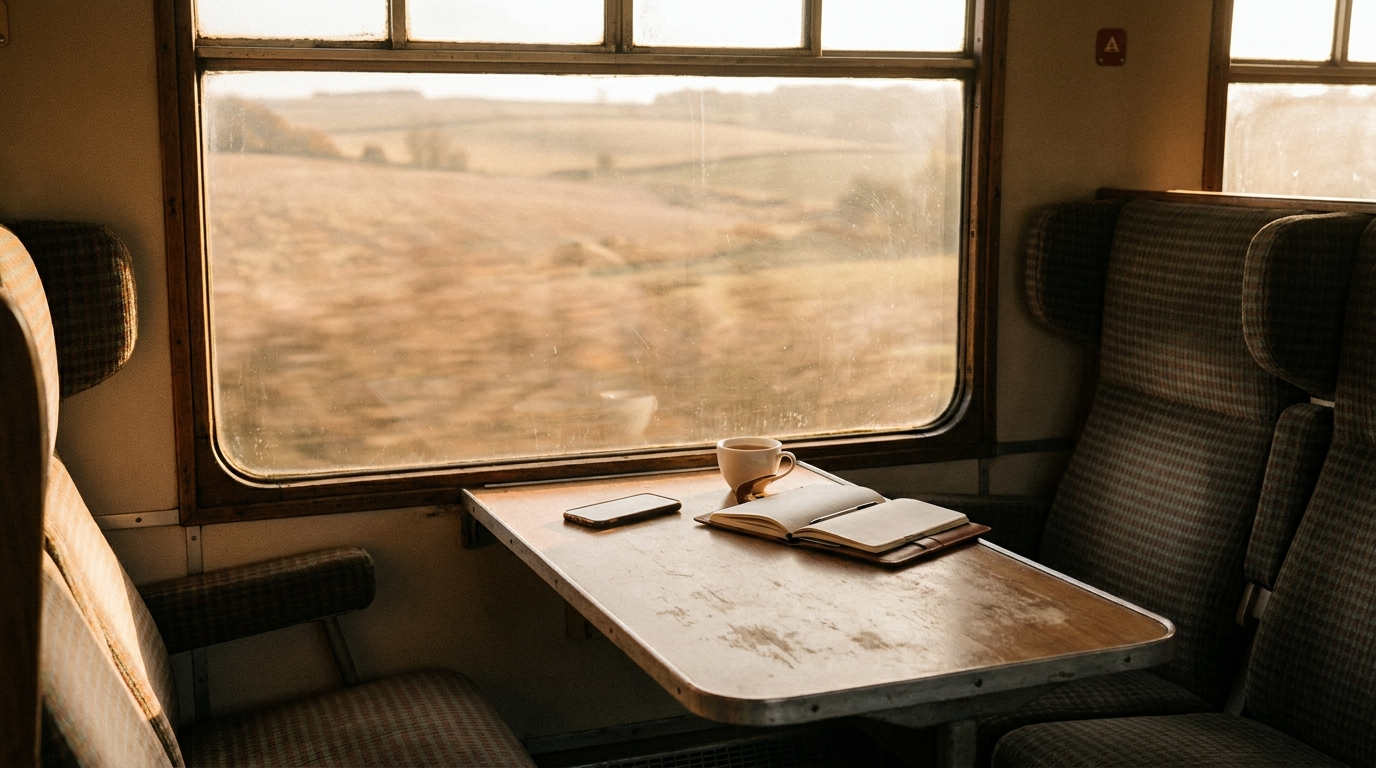
Most commute learning advice assumes a seat, a table and a coffee. The real thing involves a hand on a rail, one earbud that keeps disconnecting, and eleven minutes on a bus that may or may not stop early. So let us plan for that instead.
The organising rule: pick the method that fits the constraint of your specific journey. There are only four constraints that matter.
Match the method to your hands, eyes and ears
| Your journey | What is free | What works |
|---|---|---|
| Driving | Ears only | Audio, and saying things back out loud |
| Packed train, standing | Ears, sometimes one thumb | Audio, or a one-thumb quiz |
| Seated train or bus | Eyes and thumbs | A short lesson, then a retrieval question |
| Walking or cycling | Ears, and your eyes are busy usefully | Audio, plus observation games |
| Very short hop, under 10 minutes | Barely anything | One fact, one question, done |
If you have ears: audio, used properly
Audio is the workhorse of commute learning, and most people use it badly, as background noise that leaves nothing behind. Three adjustments fix that.
- 1Pick one thing per journey. One episode, one chapter, one topic. Queue jumping is why nothing sticks.
- 2Say one sentence out loud when you arrive. In the car, at the bike rack, in the lift. That single sentence turns listening into retrieval, which is the step that builds memory. Why it matters is in the illusion of knowing.
- 3Do not raise the speed past the point where you can predict the next sentence. Faster playback feels efficient and reliably reduces what you retain.
Good audio material for a commute: history and science narrative podcasts, single-topic explainer series, audiobook chapters where each chapter stands alone, and language listening at a level slightly below comfortable.
If you have one thumb: quizzes and short lessons
One thumb is more capability than people credit. Anything designed for a single hand and a short window works: flashcards, quiz questions, a two-minute lesson.
- Quizzing beats reading here, because retrieval survives interruption. If your stop arrives mid-question, you lose nothing.
- Use the same start cue every day. Sitting or gripping the rail is a stronger trigger than a time, which is the whole point of habit stacking.
- Download in advance. Underground stretches and tunnels destroy any habit that needs a connection.
- Choose material with a defined end. A session that finishes leaves you with the small satisfaction that gets you back tomorrow; an infinite feed just becomes scrolling with better wallpaper.
If you have nothing: observation games
No signal, no space, no headphones. This is where most commutes actually live, and it is oddly the most interesting mode, because you learn to read the environment instead of a screen.
- 1Read the buildings. Note one architectural detail you cannot name, then look it up later. Cornices, brickwork bonds, blocked-up windows. Blocked windows in Britain are often a legacy of the window tax, and once you see one you see fifty.
- 2Read the street names. Names ending in gate, wick, thorpe or ford carry Old Norse and Old English geography, so the map is a language lesson.
- 3Count and estimate. How many people boarded, what fraction wore headphones, how long the dwell time was. Estimation is a real skill and this is free practice.
- 4Play spot the infrastructure. Which of these cables is power and which is fibre, where does the water go, why is that bridge that height. Every answer is a small piece of engineering literacy.
- 5Reconstruct yesterday's lesson from memory. No device needed, and it is the single highest-value thing on this list.
Three realistic scenarios
The 40-minute drive
One podcast episode, no queue skipping, and a sentence out loud in the car park. If you want to be organised, keep a note on your phone titled 'said out loud' and add the sentence at a red light or after parking, never while moving.
The 22-minute packed train
Downloaded audio for the crowded first half, then a quiz once space opens up. If you never get space, stay on audio and use the walk from the station as your retrieval window.
The 9-minute bus
One short lesson or one fact, then stop. Nine minutes is not a study session and treating it like one guarantees you abandon it by Thursday. Nine minutes is exactly enough for one idea you can retell at lunch, which is the standard we use in 23 two-minute facts.
What does not work on a commute
- Anything requiring notes. If it needs a pen, it is not commute material.
- Long-form arguments needing continuous attention. Announcements will win. Keep books for stationary time.
- Two subjects at once. Split attention across a language and a history series and you will make progress in neither.
- Podcasts you love as entertainment. Keep those, but do not count them as learning, because the honest accounting matters more than the total.
The short version
Decide what is free on your journey, choose the one method that fits it, and end with a sentence out loud. That last step is what separates a commute you learned something on from a commute you filled.
The commute is not dead time. It is the most reliably repeated twenty minutes of your week, which makes it the best place to put a habit.
Disclosure: MindSnap is our app, and it was built for exactly this window: one two-minute chapter a day, offline-friendly, with a defined ending, across curated narrative collections such as The Hemlock Hour plus unlimited topics. If your commute has a seat, the Turning Points scenarios take about the same two minutes and end with a decision.
Frequently asked questions



One snap tomorrow morning.
Two minutes in art, history, psychology, philosophy or economics, then the app tells you you're done.
Get MindSnap on iOSFree daily fact, forever. Pro is $9.99/month or $44.99/year.