Why Do Countries Want Warm Water Ports?

Learning Science Writer
Last updated: August 2026
7 min read

TL;DR
A warm water port is a harbour that stays free of ice all year and gives reliable access to the open ocean. States have sought them because seasonal ice interrupts trade and immobilises navies, and because a port is only as useful as the sea routes beyond it. The classic case is Russia, whose long history of expansion toward the Baltic, the Black Sea and the Pacific is often read through this lens. Landlocked states face a harder version of the same problem and usually solve it through treaties, leases and transit agreements.
The phrase sounds almost cosy, like a holiday harbour. In geopolitics it means something stricter and more important. A warm water port is one that does not freeze in winter and that connects to open ocean without depending on a passage someone else can easily close. Having one is so ordinary for most coastal countries that they rarely think about it. Lacking one has shaped the history of some of the largest states on Earth.
What counts as a warm water port
The term has two parts, and both matter. The first is ice. A harbour that freezes for several months a year forces ships to wait, reroute or rely on icebreakers. Cargo piles up, fishing stops and warships sit idle exactly when they might be needed. Water temperature is not really the point: a port in a cold country can stay ice-free if ocean currents keep it open, as warm Atlantic water does along the coast of northern Norway and around Murmansk.
The second part is access. A port that never freezes is still limited if every route out of it passes through a narrow strait controlled by another power. A harbour on an enclosed sea can be ice-free and still feel like a cul-de-sac. So when historians talk about a country seeking warm water access, they usually mean a harbour that is open all year and opens onto the world ocean, not just onto a neighbour's waters.
Why ports are worth so much
Shipping has long been the cheapest way to move heavy goods over long distances. A country that can load grain, timber, ore or manufactured goods onto ships all year can trade continuously. One that loses its harbours to ice for half the year has to store, delay or send goods overland at higher cost.
Navies care for related reasons. A fleet frozen in port cannot protect trade, project power or respond to a crisis. Before modern icebreakers, a northern navy effectively lost part of the year. That is why the location of naval bases has always been a strategic decision rather than a convenience.
It helps to separate this from a different question: why port cities so often become rich and powerful. That is about trade networks, finance and the mixing of people and ideas, and it is explored in why port cities rule the world. The warm water question is narrower. It is about whether a state has dependable access to the sea at all.
The classic case: Russia
No country is more associated with the search for warm water ports than Russia, and the historical reason is geography. For centuries the Russian state's core lay deep inland, with its natural coasts on the Arctic, where ice closes the sea for much of the year. Its early outlet, the White Sea port of Arkhangelsk, was frozen for months each winter.
Peter the Great and the Baltic
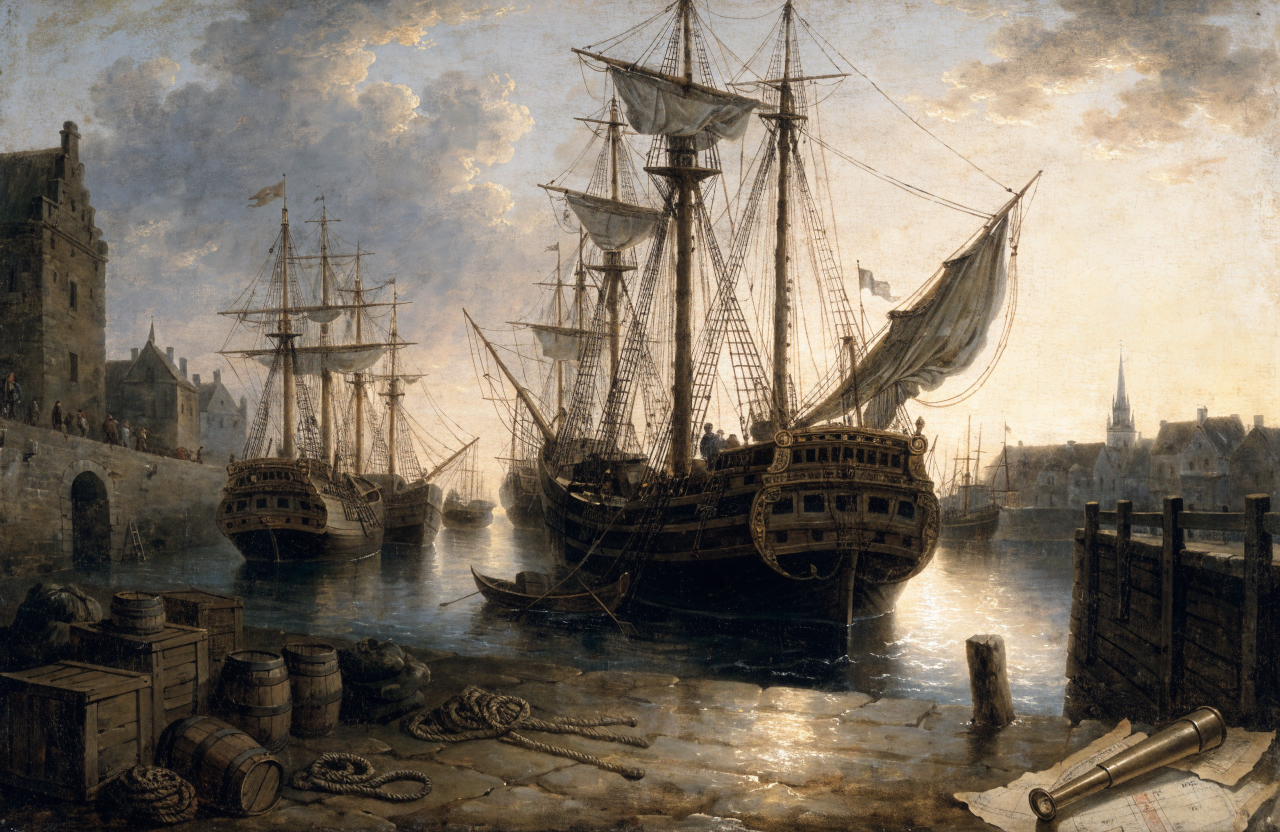
Peter the Great, who ruled from the late seventeenth into the early eighteenth century, made sea access a central aim. After long war with Sweden he secured a coastline on the Baltic and founded St Petersburg in 1703, deliberately building a capital facing west across the water. The Baltic gave Russia a far better connection to European trade, but it was not a perfect solution: parts of it freeze in hard winters, and ships leaving it must pass the Danish straits, which other powers could watch.
The Black Sea and the Straits
In the late eighteenth century, under Catherine the Great, Russia gained territory on the northern Black Sea coast and Crimea, and founded Sevastopol as a naval base. The Black Sea is ice-free in its main ports, but every ship heading for the Mediterranean must pass the Bosphorus and the Dardanelles. Control of those straits became one of the most persistent questions in European diplomacy for the next two centuries. The history of that waterway is traced in our history of the Bosphorus Strait, and the general logic of narrow sea passages is covered in our explainer on maritime chokepoints.
The Pacific
In the Far East, Vladivostok was founded in 1860, but its harbour can ice over in winter and needed icebreaking to stay open. In the 1890s Russia leased Port Arthur on China's Liaodong Peninsula, a harbour that stayed open more reliably. Rivalry over that region was one of the causes of the Russo-Japanese War of 1904 to 1905, after which the lease passed to Japan.
Historians caution against treating the search for warm water as a single master plan running through all of Russian history. Rulers had many motives, including security, prestige, religion and trade. But the pattern of reaching for open, ice-free sea access recurs often enough that it remains one of the standard lenses for reading the map.
Other examples of the same logic
- Imperial powers in the age of sail sought coaling stations and naval bases on distant warm coasts so their fleets could operate year round.
- Countries with long but awkward coastlines have dredged rivers and built artificial harbours to create reliable deep water access.
- States with ports on enclosed seas have often negotiated treaties governing passage through the straits that lead out of them.
The harder version: no coast at all
For landlocked countries, the question is not whether their port is warm but whether they have one at all. Their solution is usually legal rather than territorial: transit agreements, free zones in a neighbour's port, and long leases on terminals or warehouses. Several landlocked states in Africa, Central Asia and South America move much of their trade through dedicated arrangements in neighbouring ports, and international law, including the UN Convention on the Law of the Sea, recognises a right of access to and from the sea for landlocked states, though the details depend on agreements with transit countries.
Those arrangements work, but they create dependence. Costs, delays and politics in the transit country become part of the landlocked country's economy. That trade-off is explored in our explainer on how landlocked countries trade.
Does it still matter today?
Technology has softened the problem without erasing it. Icebreakers keep many northern harbours open longer, and pipelines, rail and air carry goods that once needed ships. Yet most of the world's traded goods by weight still travel by sea, and navies still need bases that are open when they are needed. Geography changes slowly, which is why a question Peter the Great would recognise still appears in modern textbooks.
A coastline is only as useful as the water in front of it, and the passages beyond that.
Frequently asked questions
One snap tomorrow morning.
Two minutes in art, history, psychology, philosophy or economics, then the app tells you you're done.
Get MindSnap on iOSFree daily fact, forever. Pro is $9.99/month or $44.99/year.