Who Was Mehmed the Conqueror?
Arts & History Editor
Last updated: August 2026
8 min read

TL;DR
Mehmed II (1432 to 1481) was the Ottoman sultan who captured Constantinople in 1453 at the age of 21, ending the Byzantine Empire. He prepared methodically: building the fortress of Rumeli Hisari on the Bosphorus, commissioning enormous cannon and hauling ships overland into the Golden Horn. He was also a patron of Italian artists, including Gentile Bellini, a codifier of Ottoman law and the rebuilder of Constantinople as a cosmopolitan imperial capital. His conquest is often treated as a hinge between the medieval and early modern worlds.
On 29 May 1453, a young man rode into Constantinople, a city that had been the capital of the Roman Empire in the east for more than a thousand years. He was 21. His name was Mehmed, the seventh sultan of the Ottoman dynasty, and from that day he would be known as Fatih: the Conqueror.
Most people know Mehmed for that one morning. But the conquest was the product of years of planning, and the man behind it was more complicated than the warrior of legend: a strategist, a reader, a lawgiver and an unexpected patron of Renaissance art.
A difficult apprenticeship
Mehmed was born in 1432 in Edirne, then the Ottoman capital, a son of Sultan Murad II. He was not originally expected to rule, but the deaths of older brothers made him heir. He received a broad education, and later sources describe him as knowing several languages and taking a strong interest in history, geography and the stories of earlier conquerors.
His first taste of power went badly. Murad stepped back from the throne in 1444 and left the boy sultan in charge, but a crusading army and unrest at court led to Murad's return. Mehmed spent the following years in the provinces, watching and waiting. When Murad died in 1451, Mehmed took the throne again, now determined to prove himself. Many in Europe initially dismissed him as inexperienced. They would not do so for long.
Preparing for Constantinople
By the mid fifteenth century, the Byzantine Empire was a shadow of its former self, reduced to little more than Constantinople and a few scattered territories. But the city itself remained formidable, protected by water on two sides and by the great Theodosian land walls on the third. Earlier sieges had failed. Mehmed set out to remove every advantage the defenders had.
Rumeli Hisari: the throat cutter
In 1452 he built a fortress on the European shore of the Bosphorus, at the narrowest point of the strait, facing an older Ottoman fort on the Asian side. It went up in a matter of months. Known today as Rumeli Hisari, it allowed the Ottomans to control shipping through the strait and cut Constantinople off from help arriving from the Black Sea. Contemporaries nicknamed it the throat cutter.
The great cannon
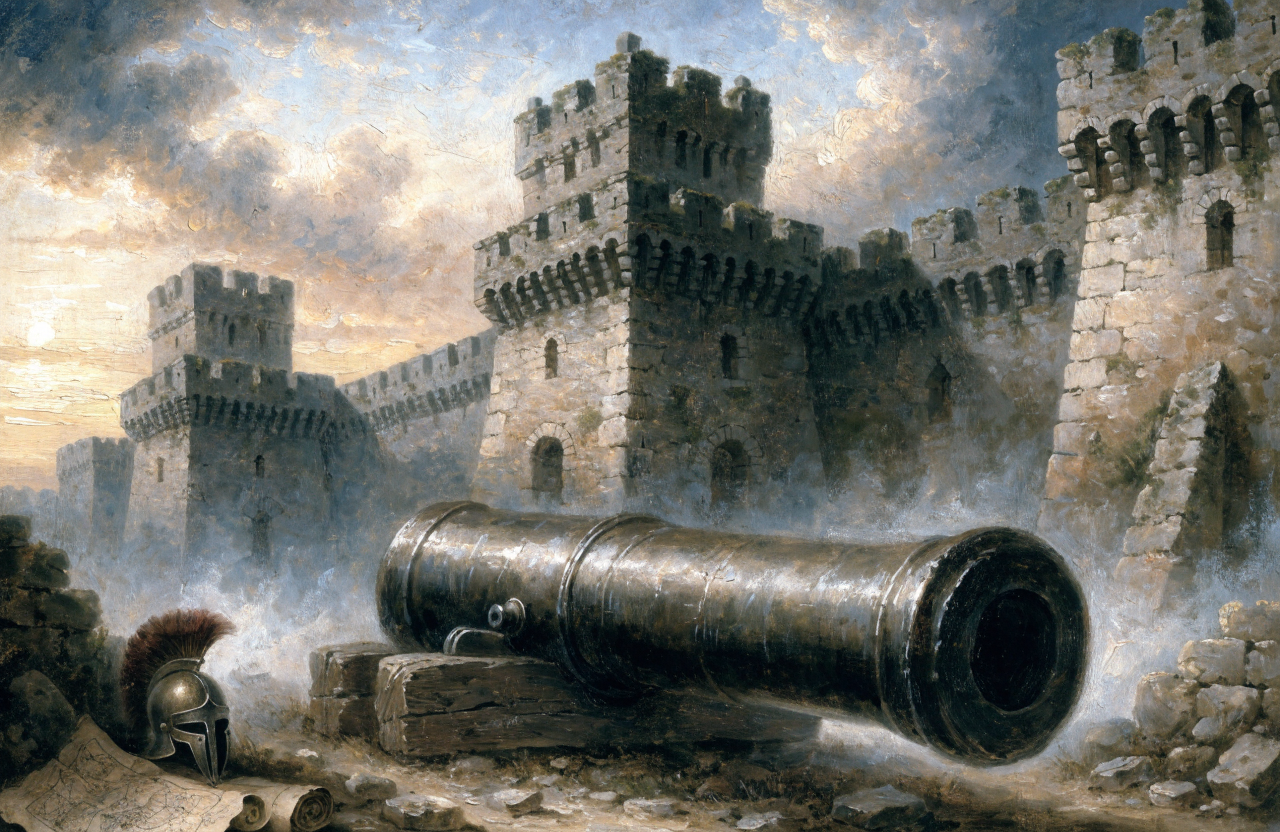
Mehmed also invested in the newest military technology. A Hungarian founder named Orban, who had reportedly offered his services to the Byzantines first, cast enormous bronze cannon for the sultan. The largest was so heavy that it had to be dragged toward the city by teams of oxen and could fire only a limited number of times a day. Its story is told in our article on Orban's cannon.
Ships over the hills
The defenders had stretched a great chain across the mouth of the Golden Horn, the inlet on the city's northern side, keeping the Ottoman fleet out. Mehmed's answer became one of the most famous moves of the siege. His men built a track of greased logs over the hills behind the neighbouring settlement of Galata and hauled dozens of ships overland, launching them into the Golden Horn behind the chain. The defenders now had to stretch their limited forces along another wall.
The fall of the city
The siege lasted about 53 days, from early April to late May 1453. The cannon battered the land walls, the defenders repaired them by night, and both sides suffered heavily. On 29 May, a final assault broke through. The last Byzantine emperor, Constantine XI, died in the fighting. You can follow the full siege in our account of the fall of Constantinople in 1453, and chapter by chapter in the collection The Day the Middle Ages Ended.
Mehmed entered the city and went to Hagia Sophia, the great church of Justinian, which was converted into a mosque. The conquest gave him enormous prestige across the Islamic world, and he styled himself in ways that drew on the Roman legacy of the city he now held.
Rebuilding a capital
The city Mehmed took was badly depopulated, and he set about filling it again. He resettled people from across his territories, including Muslims, Orthodox Christians, Armenians and Jews, sometimes by force. He allowed the Greek Orthodox community to choose a new patriarch, Gennadios Scholarios, and gave religious communities a degree of self-administration, an approach that would shape Ottoman governance for centuries.
He also built. The Fatih mosque complex, with its schools, hospital, kitchens and baths, became a new civic centre. He began construction of a new palace on the old acropolis of the city, the site that would become Topkapi Palace. Constantinople, increasingly known as Istanbul, became the capital of an empire that stretched across two continents, a story told more broadly in our explainer on the Ottoman Empire.
The lesser-known Mehmed
Patron of Italian artists
One of the most surprising chapters of Mehmed's life involves Renaissance Italy. Despite years of war with Venice, he asked the Venetians to send him a skilled painter after peace was made in 1479. They sent Gentile Bellini, one of the leading artists of the city. Bellini spent time at the Ottoman court, and a portrait of Mehmed attributed to him, showing the sultan in profile beneath a decorative arch, now hangs in the National Gallery in London. Mehmed also commissioned portrait medals from Italian artists.
Collector of knowledge
Mehmed gathered a library containing works in several languages, including Greek texts, and he showed interest in geography and maps. He hosted scholars at his court and is remembered in Ottoman tradition as a ruler who valued learning, alongside his reputation as a soldier.
Lawgiver
He also issued law codes, known as kanunnames, that set out rules for state administration, court ceremony and criminal and financial matters alongside Islamic law. These codes helped give the expanding empire a more centralised structure. Among their most controversial provisions was one that permitted a new sultan to execute his brothers to prevent civil war, a practice that shows the hard edges of his statecraft.
Later campaigns and death
Mehmed did not stop at Constantinople. Over the following decades he campaigned in the Balkans, around the Black Sea and in Anatolia, absorbing Serbia, much of Greece and the empire of Trebizond. Some ventures failed: the siege of Belgrade in 1456 and the siege of Rhodes in 1480 did not succeed. In 1480 Ottoman forces landed at Otranto in southern Italy, alarming the pope. Mehmed died in 1481, on campaign, and the Italian venture was soon abandoned.
Why 1453 is a hinge of history
Historians often use 1453 as one of the markers for the end of the Middle Ages. The fall of Constantinople ended the last direct continuation of the Roman Empire, confirmed the Ottomans as a major power in Europe and the Mediterranean, and encouraged Greek scholars and manuscripts to move west, where they fed the Renaissance. It also sharpened European interest in trade routes that avoided the eastern Mediterranean.
No single date really divides one age from another, but some decisions change what comes next. If you want to step inside those decisions yourself, Turning Points puts you in the moment and asks what you would have done.
Mehmed is usually remembered as a conqueror. He was also a builder, a reader and a ruler who sat for a Venetian painter, and that fuller picture is what makes him worth knowing.
Frequently asked questions

One snap tomorrow morning.
Two minutes in art, history, psychology, philosophy or economics, then the app tells you you're done.
Get MindSnap on iOSFree daily fact, forever. Pro is $9.99/month or $44.99/year.