What Was the Ottoman Empire?

Arts & History Editor
Last updated: August 2026
9 min read
TL;DR
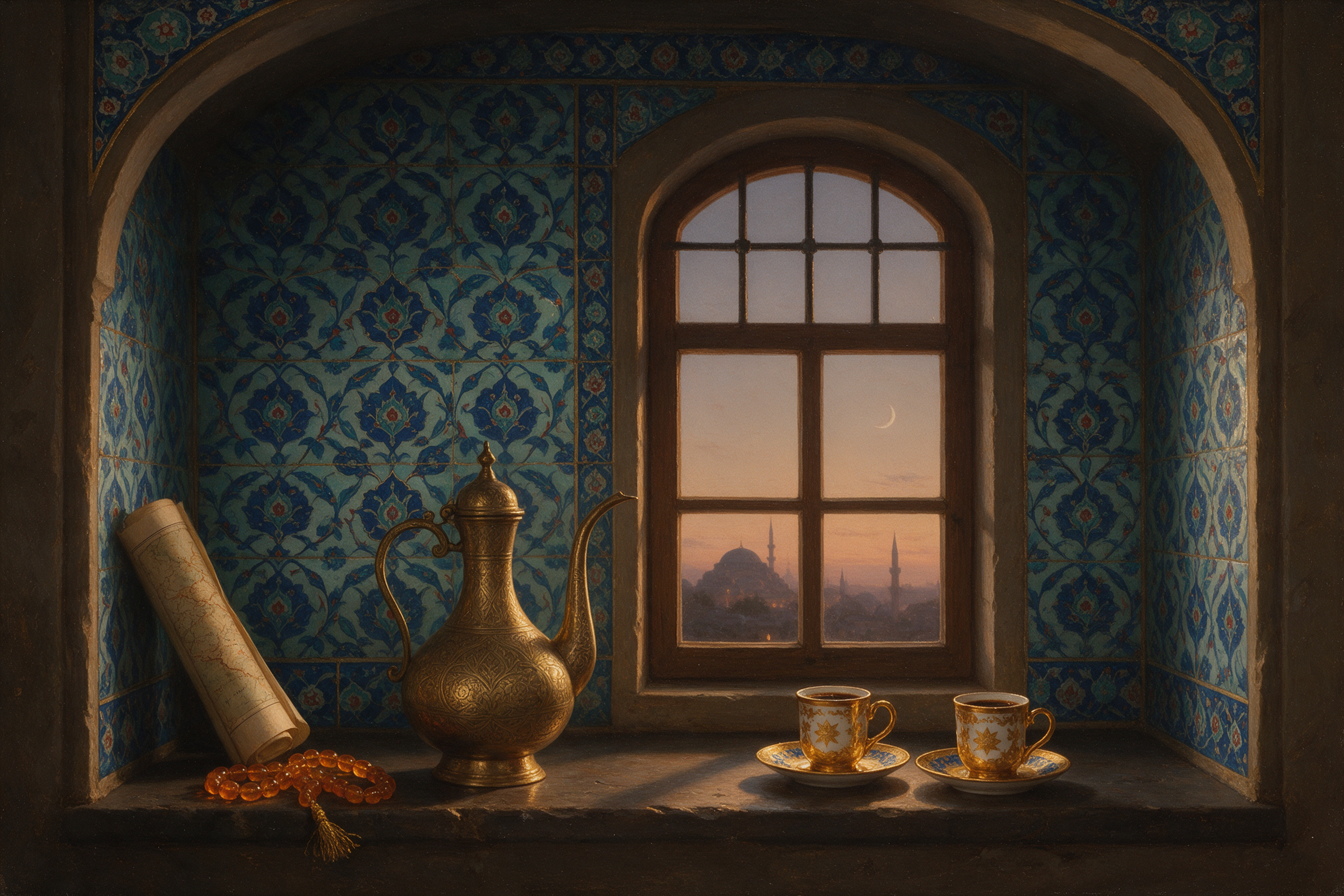
The Ottoman Empire grew from a small Anatolian frontier principality around 1300 into a state that ruled parts of three continents for roughly six centuries. Its rise turned on the capture of Constantinople in 1453, its strength on control of the land and sea routes between Europe and Asia, and its administration on distinctive institutions: the devshirme and the janissary corps, and the millet arrangement for governing religious communities. Its long contraction reshaped borders from the Balkans to the Middle East, and the modern map still shows the outline.
Empires are usually explained through their peak, which is the least instructive moment to look at. The Ottoman state is better understood as a frontier operation that kept solving the problem in front of it, and kept being changed by the solutions.
This is a structural account rather than a verdict: where the state came from, what it controlled, how it held together, why it shrank, and what it left behind on the map.
A frontier principality
Around 1300 western Anatolia was a patchwork. Byzantine authority had receded, the Seljuk order had fragmented after the Mongol arrival, and a set of small Turkish principalities competed along an unsettled border. One of them, led by a chief named Osman, occupied a useful position between Byzantine territory and its Turkish rivals.
Frontier position brought recruits, plunder and legitimacy, and the Ottomans were unusually effective at converting all three into permanent administration. They crossed into Europe in the 1350s, took Adrianople and made it a capital, and by the end of the century controlled much of the Balkans and western Anatolia. The pattern that mattered was absorption: rival elites were incorporated rather than erased wherever that was cheaper, which is how a small principality outgrew neighbours who started level with it.
The empire nearly ended in 1402, when Timur shattered the Ottoman army at Ankara and the state fragmented into competing claimants. That it reassembled within two decades says something about how deep the administrative structure already ran.
1453: the hinge
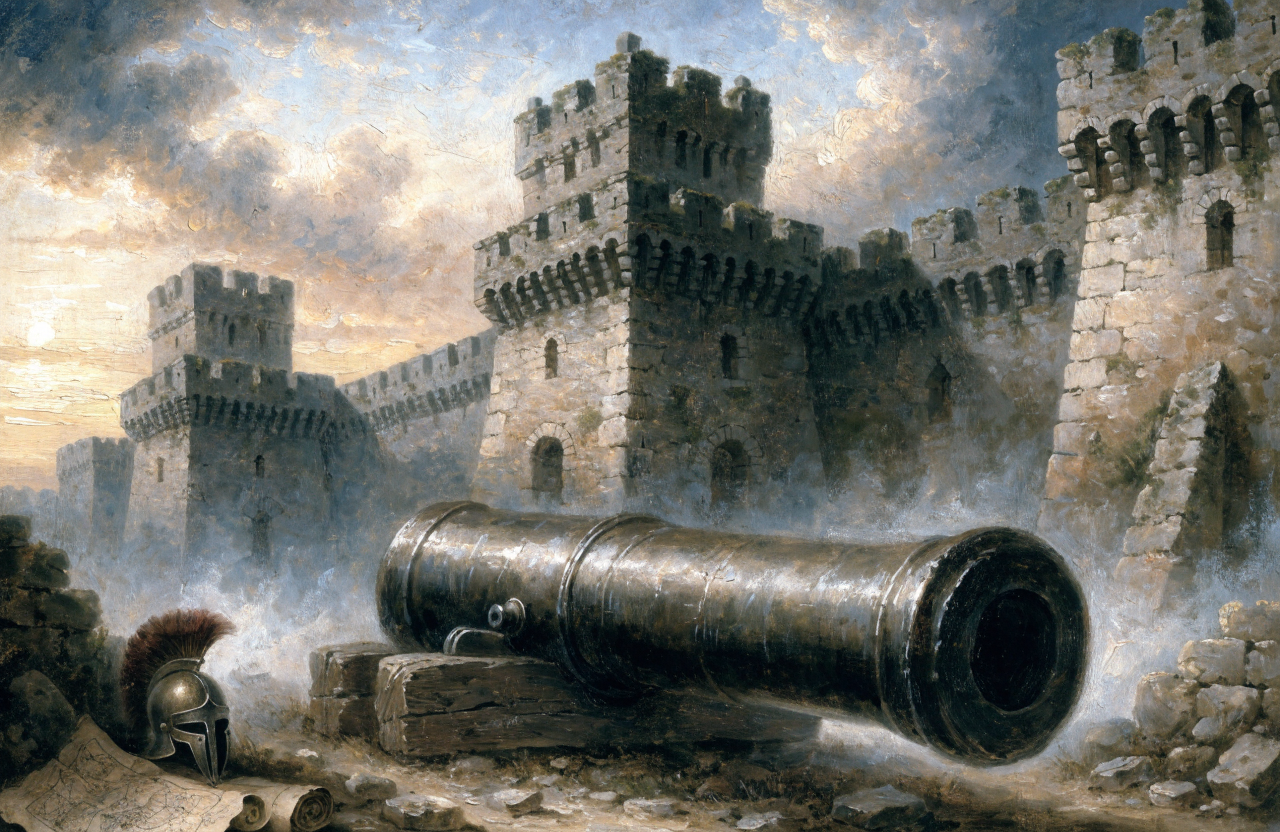
Constantinople had survived sieges for a thousand years behind the Theodosian walls. In 1453 the young sultan Mehmed II took it after a siege of roughly seven weeks, using a siege train that included very large cannon alongside a blockade of the sea approaches.
The consequences were structural, not just symbolic. The city sat exactly where a state needs to sit to govern both sides of the straits, and it gave the Ottomans a capital, a port and an imperial claim in one acquisition. Mehmed rebuilt and repopulated it deliberately, and it became the administrative centre of everything that followed. The siege itself is worth its own telling, which we gave it in the fall of Constantinople, and the wider consequences run through our story collection The Day the Middle Ages Ended. Disclosure: MindSnap is our app, so treat that as a recommendation with an interest attached.
It is also the moment that ended the Byzantine state, whose institutions and territory the Ottomans partly inherited. We covered that side of the story in what was the Byzantine Empire.
Sitting on the routes
For roughly three centuries the Ottoman state held the ground where Europe, Asia and Africa meet. That meant the straits between the Black Sea and the Mediterranean, the overland corridors through Anatolia and Syria, the Red Sea approaches, and after the conquest of Egypt in 1517 the routes through Cairo and Alexandria.
Control of routes is a different kind of power from control of land. It generates customs revenue, gives leverage over distant economies, and makes the state a participant in other people's commerce whether or not it produces the goods. European interest in sea routes to Asia in the fifteenth and sixteenth centuries was shaped by the cost and politics of the existing overland and Red Sea passages, and the eventual Atlantic and Indian Ocean traffic gradually reduced the strategic value of the corridors the Ottomans held. That is a recurring pattern: whoever controls a chokepoint prospers until technology routes around it.
How it governed
The devshirme and the janissaries
The Ottomans built a standing infantry corps, the janissaries, recruited largely through the devshirme, a levy of boys from Christian populations in the Balkans and elsewhere who were converted, educated and placed in imperial service. From the same system came administrators, including grand viziers.
The logic was that servants with no independent landholding or lineage owed everything to the sultan, which produced a professional army and bureaucracy at a time when European rulers were still assembling forces from nobles with their own interests. Over time the corps acquired exactly the independent interests it was designed to prevent, becoming a political force that made and unmade sultans, and resisting military reform until it was violently abolished in 1826. We looked at that arc in who were the janissaries.
The millet arrangement
The empire ruled a religiously plural population and did not attempt uniformity. Non-Muslim communities, principally Orthodox Christians, Armenians and Jews, were organised under their own religious leadership, which handled much of their internal law in matters such as marriage and inheritance, in exchange for taxes and loyalty.
This was not equality in a modern sense, and legal status differed by community. As an administrative solution it was durable and comparatively cheap, which is why a state governing that many languages and faiths held together as long as it did. Historians debate how formal and how consistent the system was before the nineteenth century, when it was codified more explicitly.
Land, law and the sultan
Revenue rested heavily on agricultural land, much of it assigned as timars to cavalry in return for service, which tied military capacity to rural administration. Law combined religious jurisprudence with sultanic regulation, the kanun, giving the state room to legislate on taxation and administration. Suleiman, ruling from 1520 to 1566, is remembered as lawgiver for that codifying work as much as for the conquests.
The long contraction
There was no single collapse. The failed siege of Vienna in 1683 marked the end of expansion in central Europe, and the treaty of Karlowitz in 1699 was the first in which the empire ceded substantial territory by negotiation. Through the eighteenth and nineteenth centuries it lost ground to Habsburg and Russian pressure, and to nationalist movements in the Balkans that produced new states.
Meanwhile the economic centre of gravity moved. Atlantic trade, then industrial production and the capital that came with it, favoured other powers, and Ottoman finances grew dependent on European lending. Nineteenth-century reform, the Tanzimat, rebuilt the army, the law and the administration along more centralised lines with real effect, but from a weaker relative position. The empire entered the First World War alongside Germany and Austria-Hungary, was partitioned after defeat, and the sultanate was abolished in 1922, with the Republic of Turkey declared in 1923.
What it left on the map
- Borders: many boundaries across the Balkans, the eastern Mediterranean and the Middle East trace Ottoman provincial lines or the settlements that carved them up after 1918.
- Chokepoints: the Bosphorus and Dardanelles remain a governed passage with their own treaty regime, a direct descendant of centuries of straits politics.
- Plural populations: the distribution of religious and linguistic communities across southeastern Europe and the Levant reflects centuries of Ottoman movement, settlement and administration.
- Institutions and habits: land registration, legal codes and administrative vocabulary in successor states still carry Ottoman inheritance.
If you want to feel how these decisions looked from inside, our interactive Turning Points scenarios put you in a few of them and ask you to choose before revealing what actually happened, and you can browse the wider subject range in topics.
The takeaway
The Ottoman Empire lasted six centuries because it was good at the unglamorous parts: absorbing rivals, professionalising service, taxing routes, and governing difference without insisting on uniformity. It contracted when the routes it sat on mattered less, when its neighbours industrialised, and when the loyalty of communities shifted toward nations. Both halves of that story are structural, and both are still visible on the map.
An empire built on the crossroads of three continents prospers exactly as long as the crossroads matters.
Frequently asked questions
One snap tomorrow morning.
Two minutes in art, history, psychology, philosophy or economics, then the app tells you you're done.
Get MindSnap on iOSFree daily fact, forever. Pro is $9.99/month or $44.99/year.