What Was the Byzantine Empire? Rome's Forgotten Second Act

Arts & History Editor
Last updated: August 2026
8 min read
TL;DR
The Byzantine Empire was the Roman Empire. Its citizens called themselves Romans, spoke Greek, kept Roman law and ruled from Constantinople, a city whose position on the Bosphorus made it the richest and best defended capital in the medieval world. It survived the western collapse by a thousand years, produced Justinian's law code and Hagia Sophia, defended itself with Greek fire and a provincial military system called the themes, and ended in 1453 when Ottoman cannon breached the walls. The idea that it was permanently decadent and doomed comes from later writers who disliked it, not from the record.
Ask when the Roman Empire fell and most people answer 476, the year a Germanic commander deposed the last emperor in the west. It is a defensible date for half an empire. For the other half it is off by nine hundred and seventy-seven years.
The eastern Roman Empire, which historians label Byzantine, carried on from its capital at Constantinople until 1453. It kept Roman law, Roman administration, Roman coinage and the Roman name. Nobody living inside it used the word Byzantine. That is a label invented by scholars long afterwards, and it has quietly cost the empire a millennium of recognition.
They called themselves Romans
This is the single fact that reframes everything. The inhabitants called themselves Rhomaioi, Romans, and considered their state the continuous Roman Empire, because it was. There was no break, no refounding, no moment when an eastern successor took over from something that had ended. The imperial office, the senate, the law and the tax system ran on without interruption while the western provinces fragmented.
What did change was language. Latin faded from government use over the sixth and seventh centuries and Greek took over, which was simply practical: Greek was what the eastern Mediterranean spoke and had spoken since Alexander. A Greek-speaking Roman sounds like a contradiction only if you assume Rome was defined by its language rather than by its institutions.
Their neighbours agreed, which is the better evidence. Muslim writers called them Rum. The Ottomans who eventually took Constantinople described their new possession in the same terms. When western Europeans crowned their own emperor in 800, the diplomatic awkwardness that followed existed precisely because everyone understood there was already a Roman emperor, and he was in Constantinople.
A capital built on a chokepoint
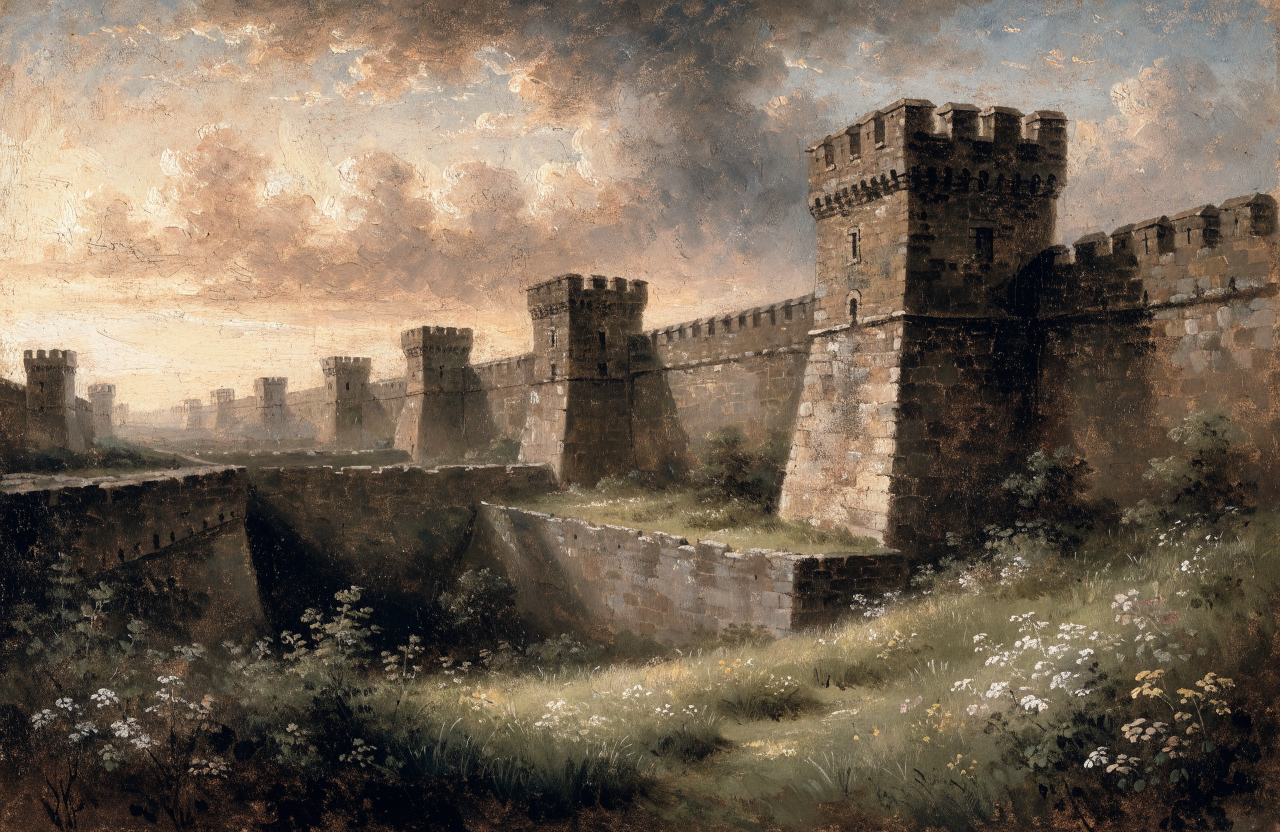
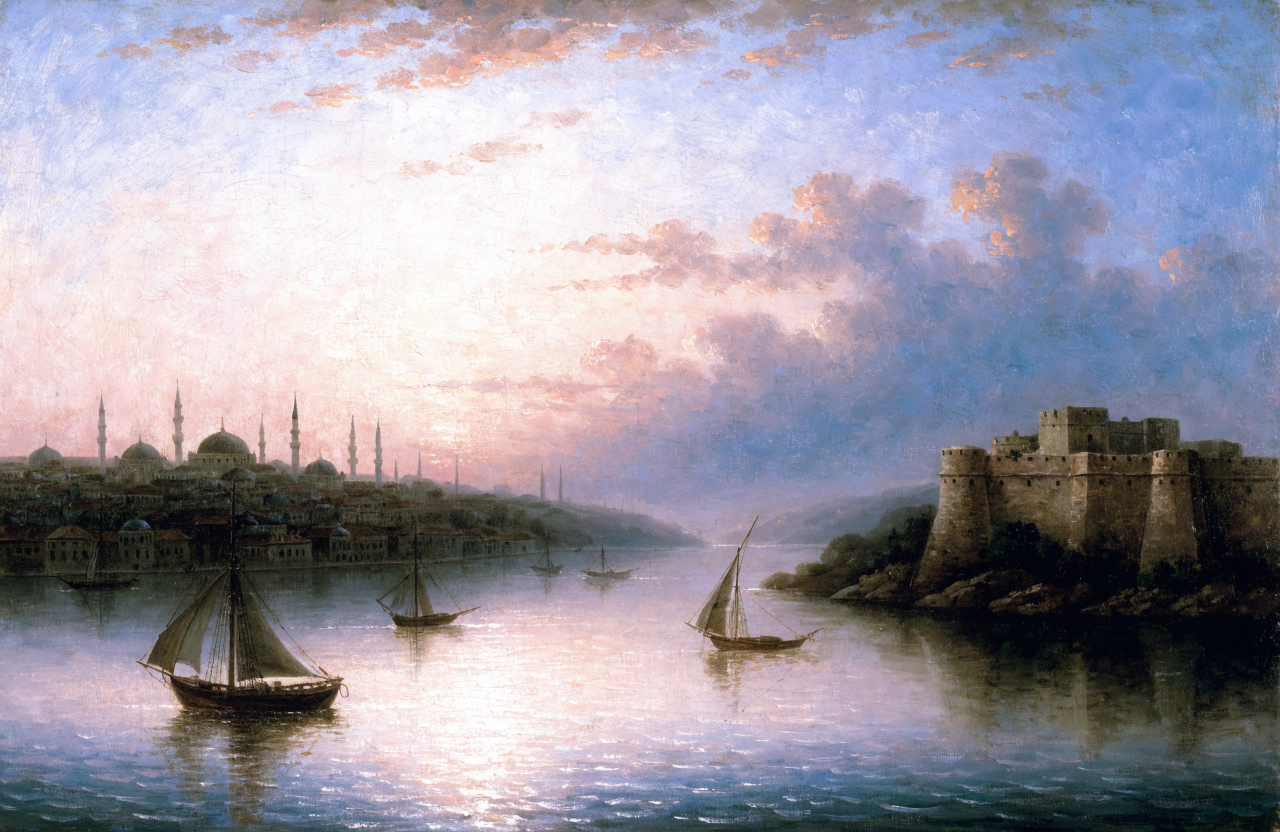
Constantine chose the site in 330 and the choice did more for the empire's longevity than any emperor did. The city sits on a promontory at the meeting of the Bosphorus, the Sea of Marmara and a deep sheltered inlet called the Golden Horn. Water guards three sides. A chain could close the harbour. Only the landward western approach needed heavy fortification, and that is where the Theodosian Walls went up in the fifth century, a triple line of ditch, outer wall and towering inner wall that repelled attackers for a thousand years. We look at that engineering in the Theodosian Walls explained.
The position was also an economic instrument. Every ship moving between the Mediterranean and the Black Sea passed through the strait, and the grain, timber, furs and slaves of that trade could be taxed at a single point. Overland routes between Europe and Asia converged on the same crossing. The city was a tollbooth on two of the world's busiest arteries, which is why it stayed wealthy long after its territory shrank. The longer history of that waterway is in the Bosphorus strait.
Justinian, the law and the great church
The sixth-century reign of Justinian is the empire's most consequential. Two achievements outlasted everything else he attempted.
The first was legal. Justinian ordered the sprawling, contradictory mass of Roman law compiled, pruned and organised into what became known as the Corpus Juris Civilis. When western Europe rediscovered that compilation in the eleventh and twelfth centuries it became the foundation of legal education and, eventually, of the civil law systems used across much of the world today. Roman law reached modernity through Constantinople, not through Rome.
The second was Hagia Sophia, completed in 537 and for nearly a thousand years the largest enclosed space on earth. Its innovation was a vast dome pierced by a ring of windows, so the roof appears to float on light rather than rest on masonry. Contemporaries struggled to describe it and the building still does that to visitors. It has since served as a church, a mosque, a museum and a mosque again, and it remains standing in Istanbul.
Justinian also reconquered Italy, North Africa and part of Spain. Those gains were expensive, thinly held and largely lost within a century, and the plague that struck during his reign drained the manpower and revenue that might have secured them. It is a useful corrective to the idea that expansion equals strength.
How a shrinking empire kept surviving
By the seventh century the empire had lost Syria, Egypt and North Africa and was fighting for its life. What it did next is the part worth knowing, because it is a case study in institutional adaptation.
- The themes. Provinces were reorganised as military districts where soldiers held land locally and were called up when needed. Defence became cheaper and faster, and troops now had a personal stake in holding the ground they stood on.
- Greek fire. A liquid incendiary, projected from siphons on ships, that burned on water and could not be extinguished conventionally. It broke naval sieges repeatedly. The recipe was a state secret so well kept that it is still not confidently reconstructed.
- Diplomacy as a weapon. Subsidies, marriages, granted titles and carefully staged ceremony were used to turn potential enemies against each other. This was policy, not weakness, and it was cheaper than campaigning.
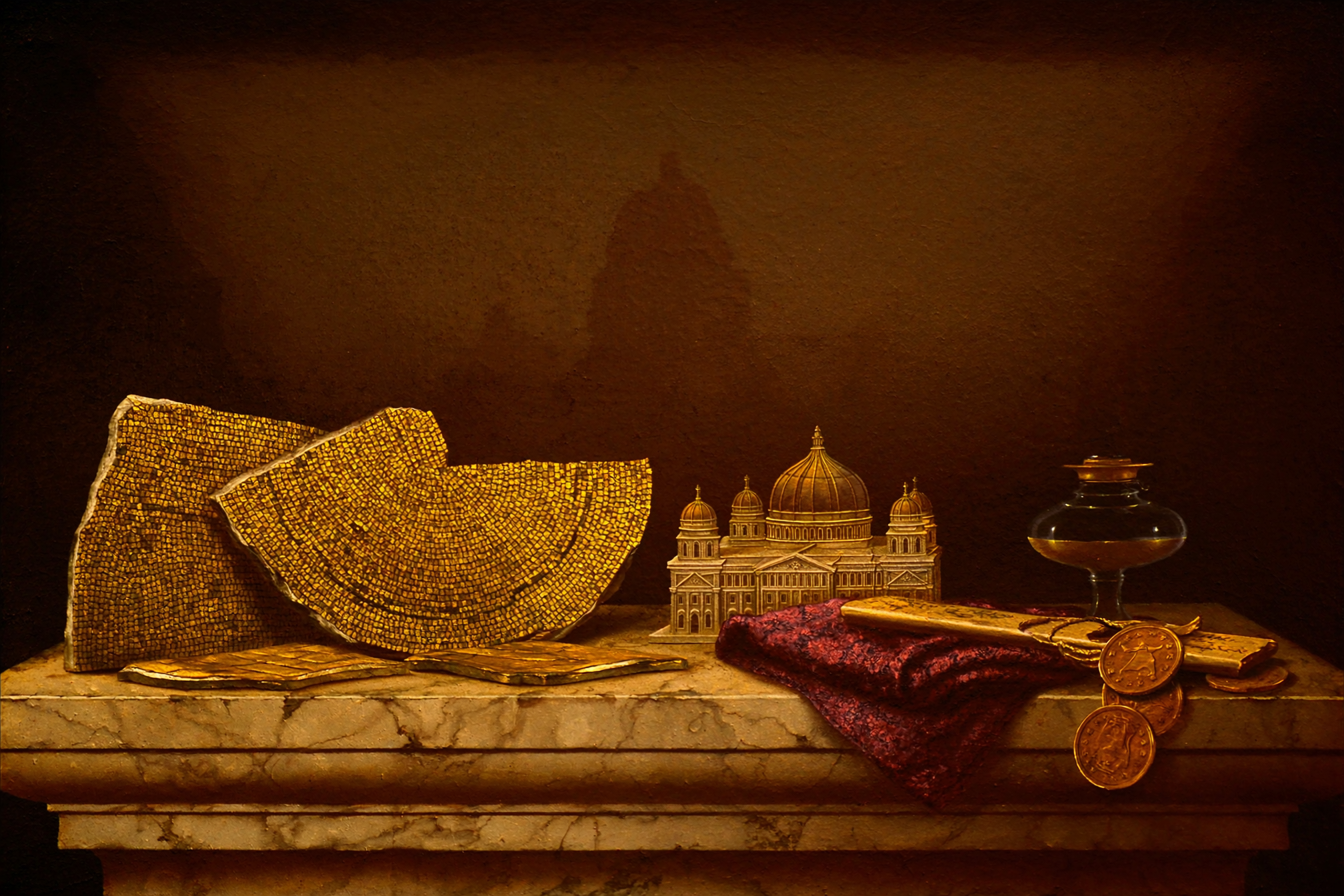
- Money. A gold coin, the solidus, held its weight and purity so consistently for centuries that it became the reserve currency of the medieval Mediterranean.
The result was an empire that lost territory repeatedly and recovered repeatedly, including a strong revival under the Macedonian dynasty in the tenth and eleventh centuries. The catastrophic blow came in 1204, when a crusading army sacked Constantinople itself and carved the empire into pieces. It was restored in 1261, but never recovered its wealth or its reach.
1453, and why the date matters
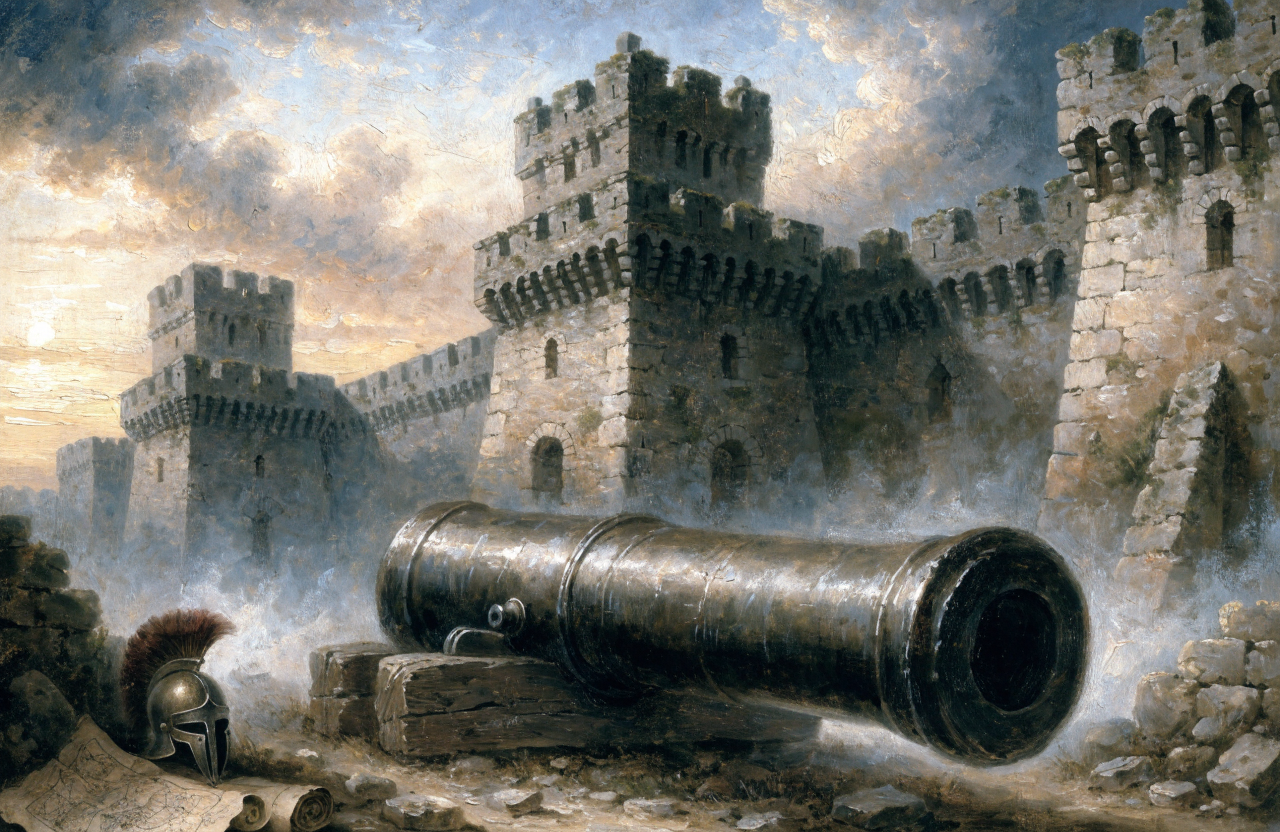
By the fifteenth century the empire was little more than its capital and a few fragments. In 1453 Mehmed II brought an enormous army and, decisively, siege artillery capable of doing what nothing before had managed to the Theodosian Walls. After roughly seven weeks of bombardment the defences were breached, the last emperor died fighting near a small gate in the walls, and the city became Ottoman.
Historians use 1453 as a convenient hinge between the medieval and early modern worlds, and the reasoning is sound. Greek scholars carrying manuscripts west fed the Renaissance. Changed conditions on the eastern trade routes sharpened European interest in finding a sea passage to Asia, which is where the age of Atlantic voyages begins. Our collection The Day the Middle Ages Ended follows the siege and its consequences chapter by chapter, and the fall of Constantinople is the short version.
The myth of a decadent empire
The word byzantine now means needlessly complicated and quietly corrupt, and that is a slander with an identifiable origin. Enlightenment writers, hostile to the empire's religiosity and its court ceremony, described a thousand years as a single long decline. Later western historians repeated it.
A state does not survive eleven centuries, on the most contested frontier in the world, by being uniquely decadent. Complex bureaucracy was how it taxed and defended itself efficiently. Elaborate ceremony was diplomacy performed for audiences who read it fluently. Its bureaucratic sophistication was the reason for its resilience, not evidence of its rot. More medieval misconceptions of this kind are collected in middle ages myths.
Empires end at moments where the outcome was not obvious to the people living through it. That is the premise behind Turning Points, the interactive feature in MindSnap, which is our app: you face the decision as it stood, then find out what actually happened. The last days of Constantinople are exactly that kind of moment, and they are much stranger and closer run than the tidy version suggests.
Frequently asked questions
One snap tomorrow morning.
Two minutes in art, history, psychology, philosophy or economics, then the app tells you you're done.
Get MindSnap on iOSFree daily fact, forever. Pro is $9.99/month or $44.99/year.