The Theodosian Walls: How Constantinople Held Out for a Thousand Years

Arts & History Editor
Last updated: August 2026
9 min read
TL;DR
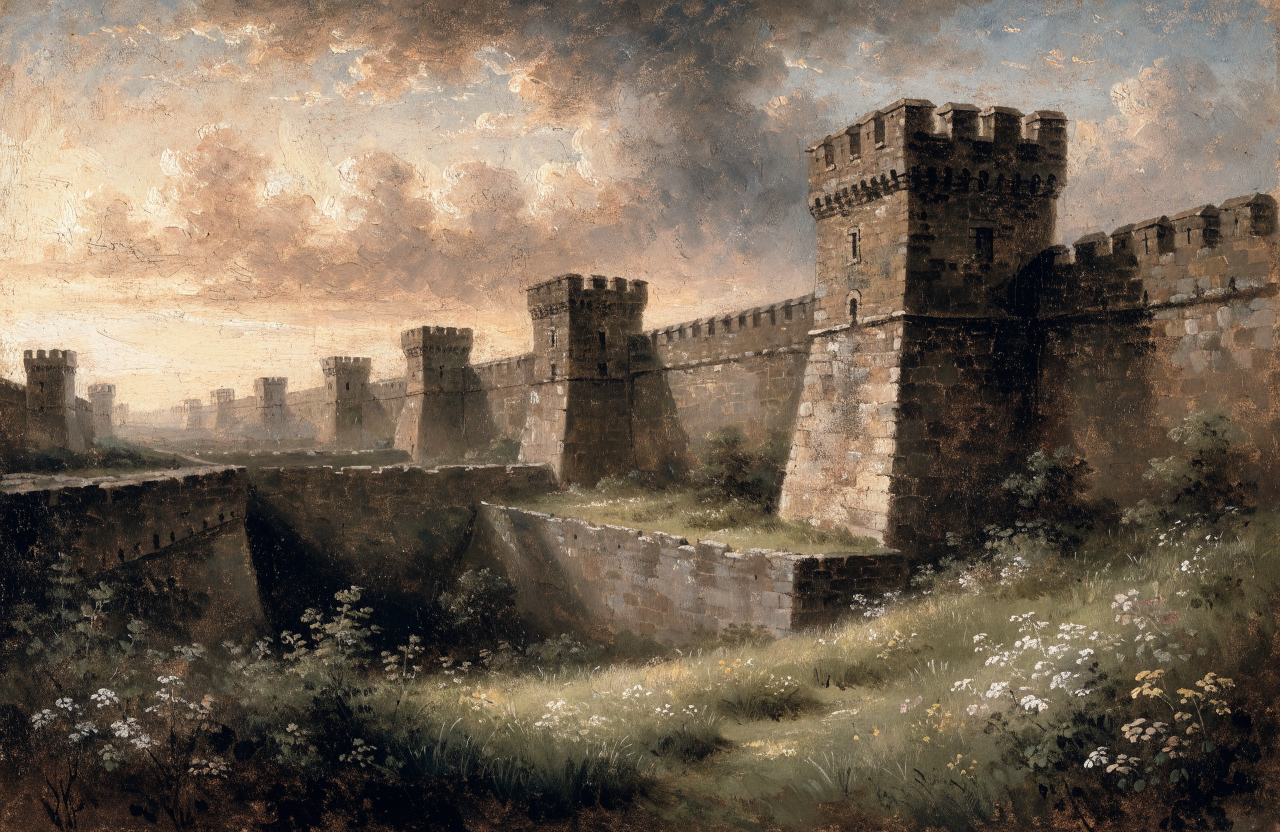
The Theodosian Walls, built across the landward side of Constantinople in the early fifth century, layered a broad moat, a low outer wall, a tall inner wall and around ninety-six towers into a single defensive system roughly six kilometres long. For a thousand years they turned assault after assault into failure, which let the eastern Roman state survive long after the west collapsed. They were breached decisively only twice: by a diverted crusade in 1204 and by Ottoman gunpowder artillery in 1453.
Most fortifications are remembered for the moment they failed. The land walls of Constantinople are remembered for how long they did not. Built in the reign of Theodosius II in the early fifth century, they stood across the only landward approach to the city and defeated attacker after attacker for roughly a thousand years. In an era when a determined army could usually take a walled city eventually, that record is not a detail of military engineering. It is one of the reasons the map of Europe and the Middle East looks the way it does.
A city with only one weakness
Constantinople occupied a peninsula. Water guarded most of it: the Sea of Marmara to the south, the deep natural harbour of the Golden Horn to the north, and the Bosphorus strait at the tip, a waterway whose strategic weight has shaped the region for millennia and which we traced in the history of the Bosphorus. Only the western side faced open land, a corridor of a few kilometres between the sea and the harbour.
That geography set the entire problem. Defend that corridor well enough and the city becomes a place that must be starved rather than stormed, and starving it meant controlling the seas, which for centuries nobody besieging it reliably could. The walls did not have to be impregnable everywhere. They had to be impregnable in one place.
What the system actually looked like
The land walls are usually described as triple, which undersells how carefully layered they were. An attacker crossing the ground in front of them met a sequence of obstacles, each designed so that overcoming it left you worse off for the next.
- A broad moat, roughly twenty metres wide and floodable, with a low breastwork on its inner edge. Siege towers and rams could not cross it until it was filled, and filling it under fire was slow, exposed work.
- An outer wall, lower and thinner, studded with its own towers and fronted by a terrace. Taking it put attackers in a narrow strip overlooked from above.
- An inner terrace between the two walls, a killing ground where crowded troops could be shot at from both flanks and from the front.
- The inner wall, some five metres thick and rising around twelve metres, the real barrier, with a wall walk allowing defenders to move reserves quickly to any threatened point.
- Around ninety-six towers on the inner wall, offset from those on the outer wall so that fire covered the gaps rather than duplicating it.
The genius is in the sequencing rather than in any single element. Every layer bought time, and time was the resource besiegers lacked, because armies camped outside a well-supplied city ran short of food, discipline and patience long before the defenders did. The whole circuit ran roughly six kilometres from the Marmara shore to the Golden Horn, and later work extended sea walls around the rest of the perimeter.
Built once, maintained forever
An earthquake in 447 brought down long stretches at the worst imaginable moment, with Attila's Huns in the Balkans. The city's factions, ordinarily bitter rivals, rebuilt them in weeks. That episode says as much about the walls as the design does: they worked because a state existed that could repair them urgently, garrison them properly and keep the moat clear for centuries. Fortifications are institutions, not just masonry.
A thousand years of failed sieges
The list of armies that tried and left is long. Avars and Persians combined against the city in 626 and could not coordinate an assault across the water. Arab forces besieged it in the late seventh century and again in 717 and 718, the second attempt ending in disaster amid winter, hunger and Byzantine incendiary weapons. Bulgars, Rus raiders and rival claimants tried in later centuries. Each failure had its own local causes, but the constant was that the land walls made a quick storming impossible and turned every attempt into an endurance contest fought on the besieger's supply lines.
The strategic consequence is easy to state and hard to overstate. Because Constantinople held, the eastern Roman state survived the collapse of the western empire by a thousand years, preserving Roman law, Greek learning and an unbroken administrative tradition. It also functioned, for centuries, as a barrier absorbing pressure that would otherwise have moved further west. A great deal of what people assume about this era is wrong in interesting ways, which is the subject of common myths about the Middle Ages.
The exception in 1204
The walls' first serious failure was not really a failure of the walls. In 1204, the Fourth Crusade, diverted into Byzantine politics, attacked from the Golden Horn side using ships against the sea walls, which were lower and less elaborate than the land defences. The city was sacked, and the empire that emerged decades later was a diminished thing with a garrison far too small for six kilometres of fortification. The masonry was still formidable. The state behind it no longer was.
Why gunpowder ended it
The walls were built against an entire physics of siegecraft: ladders, rams, towers, mines, catapults and torsion artillery, all of which delivered force in ways tall thin stone handles well. Vertical height defeated ladders. Depth defeated mining. Layering defeated everything else by making every gain temporary.
Large-calibre gunpowder cannon changed the arithmetic. A heavy iron ball delivers concentrated impact repeatedly at the same point, and a tall vertical wall is close to the worst possible shape to receive it. In 1453, Mehmed II brought an artillery train built for exactly this task and fired on selected sections for weeks. Defenders repaired breaches nightly with earth, timber and rubble, and improvised earthworks absorbed shot better than the original masonry did, which is a quiet clue about where military architecture went next: low, thick, angled bastions rather than high walls.
Even then it was close, and the fall involved exhaustion, a garrison of a few thousand defending a circuit built for far more, and a final assault at a weakened point. The full sequence, including the parts usually mangled in retellings, is in the fall of Constantinople in 1453. Within a century, the tall-wall era was over across Europe, replaced by the squat geometry of gunpowder-age fortresses.
| Layer | Approximate scale | What it defeated |
|---|---|---|
| Moat | About 20 m wide, floodable | Rams, siege towers, rapid approach |
| Outer wall | Lower, with towers | First wave assaults, escalade |
| Inner terrace | Narrow strip between walls | Massed troops, crossfire trap |
| Inner wall | About 5 m thick, 12 m high | Ladders, mining, torsion artillery |
| Towers | Around 96, offset in two lines | Gaps in covering fire |
What is left, and why it still matters
Long stretches of the walls still run through Istanbul, some restored, some collapsing into gardens and workshops. Standing at the moat line, the thing that registers is not the height of any one wall but the depth of the whole arrangement: you can see how far an attacker had to come and how little of that distance was ever out of view.
The wider lesson is that defences shape history by buying time rather than by being invincible. A thousand years of bought time gave the eastern empire the room to transmit classical learning westward, and the year the walls finally fell became a hinge that historians still argue about. If you want that story as a narrative rather than a summary, our story-led collection The Day the Middle Ages Ended walks through the 1453 siege chapter by chapter, and our interactive Turning Points scenarios put you in the position of deciding what the defenders should do before you learn what they chose. MindSnap is our app, so read that as a pointer rather than a neutral recommendation.
The walls did not make the city safe. They made it expensive, and for a thousand years that was enough.
Frequently asked questions

One snap tomorrow morning.
Two minutes in art, history, psychology, philosophy or economics, then the app tells you you're done.
Get MindSnap on iOSFree daily fact, forever. Pro is $9.99/month or $44.99/year.