Timber Geopolitics Explained: How Forests Built and Broke Empires

Arts & History Editor
Last updated: August 2026
7 min read

TL;DR
Wooden navies depended on forests that took generations to mature. Hulls required huge quantities of suitable oak; masts demanded exceptionally tall, straight trees; ropes and rigging needed other naval stores. Baltic trade, Venetian forest management and British claims over North American mast trees reveal how resource dependence shaped policy long before oil. Possessing trees was only the beginning: access, transport and replacement mattered just as much.
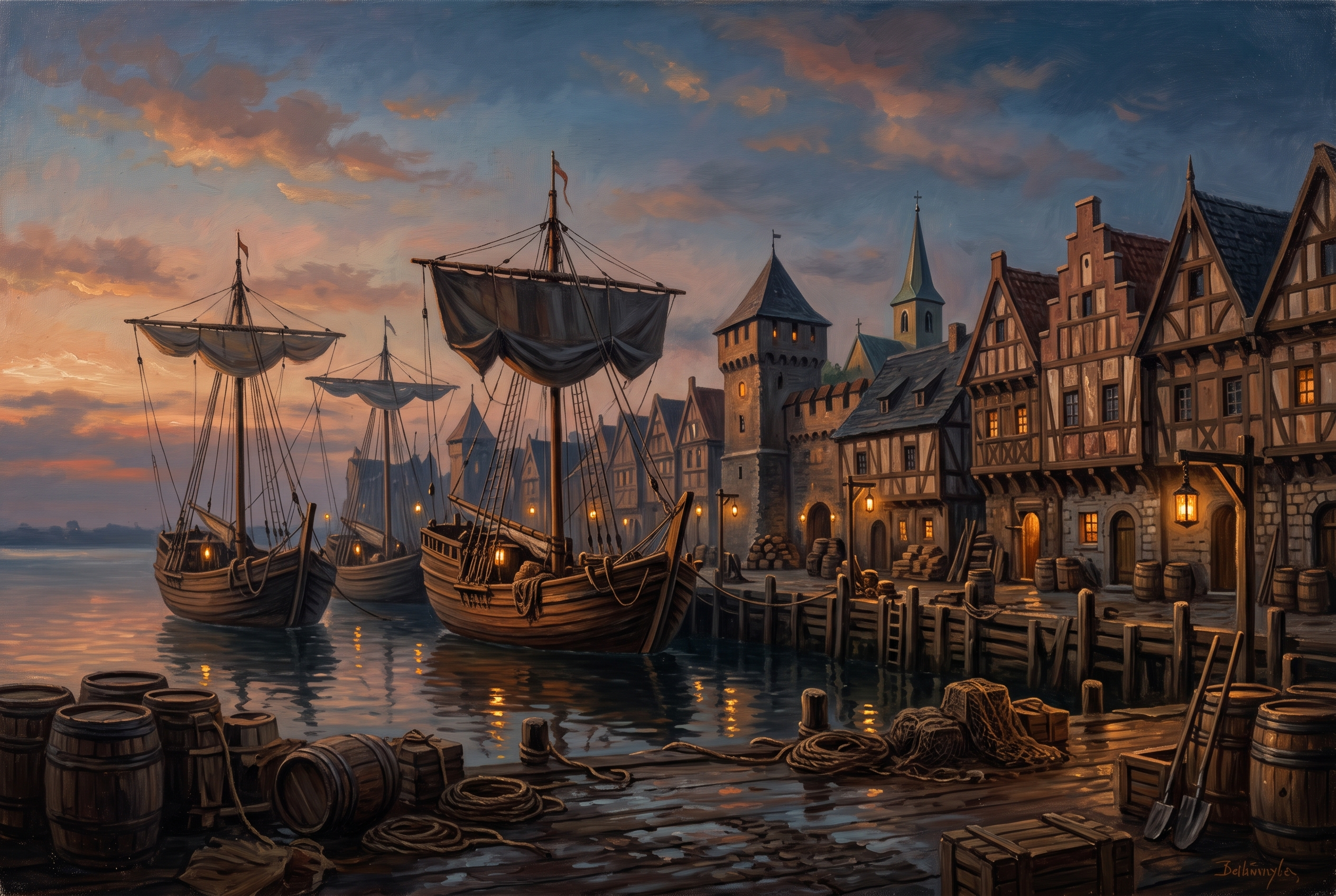
Before a navy could command the sea, someone had to find its trees. A large wooden warship was a floating assembly of timber, rope, pitch and labour, with a supply chain reaching far beyond the dockyard. The fleet visible in a harbour represented forests cut years earlier and growth that had begun generations before its admirals were born.
This is timber geopolitics: the way access to suitable wood and related supplies shaped a state's strategic options. Forests did not mechanically cause wars or determine every alliance. But they imposed costs, dependencies and time limits. A government might approve more ships immediately. It could not order a mature oak to appear next spring.
A warship was not made from interchangeable wood
A large ship of the line could consume thousands of mature oaks, with the exact requirement depending on size, design and how timber needs were counted. Shipbuilders needed more than volume. They sought strong planking, durable structural pieces and naturally curved branches or trunks that could form knees and frames. A forest full of small, straight trees was not equivalent to one containing the required shapes.
Masts presented a different problem. They needed timber that was exceptionally tall, straight and suitable for supporting sails under stress. Long conifers were especially valuable. Builders developed ways to assemble larger masts from multiple pieces, but access to good mast timber remained a strategic concern. A damaged mast could turn a fighting ship into a vessel struggling simply to move.
The fleet also needed replacements. Ships suffered wear, rot, storms and battle damage, while dockyards and repair stations consumed supplies continuously. Counting the trees required for a new vessel captures only part of the dependence. Naval power was not a purchase completed at launch. It was an ongoing relationship with land, labour and transport.
The Baltic was a maritime supply system
Northern and eastern Europe supplied timber and naval stores to seafaring states farther west. Through Baltic ports came wood, hemp for rope, flax for sailcloth, tar and pitch for protecting ships and rigging. These goods belonged together in a navy's supply calculations, even though they came from different plants and required different processing.
The trade depended on rivers, merchants, warehouses and shipping routes. A tree growing inland became useful to a distant dockyard only if it could be felled, moved to water, assembled into a shipment and delivered. Our account of the Hanseatic League describes the commercial networks that helped organise northern trade, though naval supply relationships changed across the centuries.
For importing powers, this created a vulnerability as well as an opportunity. Buying abroad could be cheaper or offer better timber than local sources. But it exposed shipbuilding to interrupted trade, diplomatic disputes and rival control of routes. Strategic independence was difficult when a country's strongest fleet depended on cargoes arriving through waters it did not fully control.
Venice treated forests as part of the arsenal
Venice's maritime strength rested on an unusually developed relationship between shipbuilding and administration. The Arsenal needed reliable supplies, and the republic regulated forests in its territories, including oak resources on the mainland. Officials could reserve suitable trees, inspect woodland and restrict uses that competed with shipbuilding. Forest management belonged to the same strategic world as galleys and fortified ports.
That did not mean a perfectly sustainable system in the modern sense. Rules could conflict with local needs, enforcement was uneven and timber demands changed. Woodland supplied fuel, buildings, agriculture and livelihoods as well as ships. A state's long-term naval interest did not automatically match the immediate priorities of communities living beside the trees.
The underlying insight was nevertheless important: a forest could be managed as a future inventory. Protecting a growing tree meant accepting a cost now for a ship that might not be built for decades. Timber forced maritime governments to think across time horizons longer than a campaign, a budget or the career of an individual official.
Britain's masts reached across the Atlantic
British naval builders used domestic timber but also relied on imports for important supplies, including mast wood. North America's tall white pines offered an alternative source to European markets. Access to those trees could reduce one dependence while creating another: ships still had to bring them across the ocean, and colonial administrations had to secure them on the ground.
The Crown reserved certain large white pines for naval use under rules that varied over time. Surveyors marked claimed trees with the broad arrow, a sign of royal property. The reservation could extend into areas colonists regarded as available for their own cutting or land use. A tree therefore became a visible argument about who had authority over a resource.
Enforcement of these claims was one colonial grievance among many. The Pine Tree Riot in New Hampshire in 1772 is a well-known confrontation over penalties for cutting reserved pines. It would be misleading to explain the American Revolution through mast timber alone. The narrower point is that naval supply policy reached into local life and could turn distant strategic needs into immediate resentment.
Depletion changed the map of supply
Deforestation and pressure on accessible mature woodland encouraged states and merchants to look farther afield. But the story was not a simple sequence in which every navy cut down its home forests and immediately collapsed. Agriculture, fuel demand, construction and industrial uses all competed for wood. Imports, regulation, changing designs and improved transport could postpone or alter the consequences.
Accessibility mattered as much as total forest cover. A large woodland without a practical route to a port could be less useful than a smaller one beside a navigable river. That is the recurring mechanism explored in geography and power: resources become strategic advantages through the costs of moving and using them, not merely through their presence on a map.
Quality and timing mattered too. Planting trees was not a quick remedy for the loss of mature shipbuilding timber. Nor could every species substitute for another. Naval planners had to balance reserves, imports and technical adaptations while accepting that the biological timetable was beyond their command. Timber made the difference between a renewable resource and a rapidly replaceable one impossible to ignore.
The route could matter as much as the forest
A timber shipment was valuable only if it reached the yard. Narrow passages, controlled ports and hostile fleets could turn an abundant supply into an uncertain one. Our maritime chokepoints explainer examines the broader logic of concentrated routes. The goods have changed, but the problem of access through limited corridors has a long history.
The same is true of ports. A harbour's location, depth and seasonal usability affect how supplies arrive and ships operate, as discussed in warm-water ports. Timber policy cannot be separated neatly from geography. A state could possess excellent forests yet lack convenient maritime access, or command a valuable port while depending heavily on someone else's hinterland.
The pattern that survives the wooden fleet
Steam power and metal hulls changed the navy's material needs, not the basic existence of supply chains. Modern parallels include dependence on specialised materials, processing capacity and transport infrastructure. These comparisons are useful at the level of mechanism; they do not make today's resources identical to oak or imply that one historical outcome must repeat.
Like salt in trade and empire, timber shows that resource politics began long before oil. Strategic power required more than owning the resource. It required suitable quality, reliable access, skilled preparation and the ability to replace losses. The forest behind the fleet was part of the fleet, even when nobody standing on the quay could see it.
Frequently asked questions


One snap tomorrow morning.
Two minutes in art, history, psychology, philosophy or economics, then the app tells you you're done.
Get MindSnap on iOSFree daily fact, forever. Pro is $9.99/month or $44.99/year.