How the Hanseatic League Ruled Medieval Trade Without an Empire

Arts & History Editor
Last updated: August 2026
8 min read
TL;DR
The Hanseatic League was an association of merchant towns around the Baltic and North Sea, led in practice by Luebeck, that dominated northern European trade from roughly the thirteenth to the sixteenth century. It had no capital, no standing army and no monarch. Its power came from standardised commercial practice, protected convoys, shared trading posts from Bergen to Novgorod, and negotiated privileges in foreign ports. It declined as centralised territorial states grew strong enough to write their own rules and as Atlantic trade shifted the centre of gravity west.
Ask who controlled northern European trade in 1400 and there is no satisfying answer in the form of a country. The answer is a list of towns. Luebeck, Hamburg, Bremen, Danzig, Riga, Cologne and dozens more, bound by shared interest rather than shared sovereignty, collectively called the Hansa.
This is one of history's more useful oddities, because it shows commercial power operating without any of the machinery we now assume it needs. No capital city. No emperor. No navy in the modern sense. For roughly three hundred years it worked anyway.
What the League actually was
The word Hanse originally meant something like a company or convoy of merchants. It began in the twelfth and thirteenth centuries as informal cooperation between German traders operating abroad, who found that travelling together and bargaining together produced better terms than going alone.
Over time these merchant groups fused with the towns they came from, and the association of merchants became an association of cities. Luebeck, founded on the Baltic in the mid-twelfth century, became its natural centre, partly through geography and partly because its legal code was widely copied by other towns.
Crucially, the League never became a state. Membership was fluid, with no fixed roster and towns drifting in and out. Decisions were taken at irregular assemblies known as the Hansetag, where delegates negotiated positions and then went home to towns that might or might not comply. Enforcement was economic: the ultimate sanction was exclusion from Hansa trade, which for a merchant town was severe.
The three sources of its power
Standardised commercial practice
The Hansa's least glamorous achievement was its most important. Across a region of competing lords and coinages, member towns converged on comparable commercial law, contract forms, weights and quality standards, and shared conventions for handling debt and disputes. A merchant from Luebeck arriving in Riga knew roughly which rules applied. That predictability lowered the cost of doing business, and lower transaction costs are the quiet engine of every trading network.
Protected shipping
The Baltic was dangerous, with pirates and wrecking coasts. Sailing in convoy, sharing intelligence about hazards and mounting joint action against piracy made cargoes more likely to arrive. The League did not need a permanent navy because member towns could pool armed ships when required, and did so effectively enough to fight and win against the Kingdom of Denmark in the 1360s, concluding with the Treaty of Stralsund in 1370, which confirmed extensive Hansa privileges in Danish waters.
Privileges abroad
The League's signature institution was the kontor, a semi-autonomous trading station in a foreign city where Hansa merchants lived, stored goods and governed themselves under their own rules. Four are usually singled out:
- Bergen in Norway, the hub for dried cod, where the Bryggen waterfront still stands as a World Heritage site.
- Novgorod in Russia, the Peterhof, gateway to furs, wax and forest goods from the interior.
- London, the Steelyard on the Thames, a walled compound with its own quay.
- Bruges in Flanders, the essential link to cloth production and to southern European trade.
These were won by negotiation and leverage rather than conquest. A ruler granted privileges because Hansa merchants brought goods, credit and customs revenue, and could take them elsewhere.
The cog, and what it carried
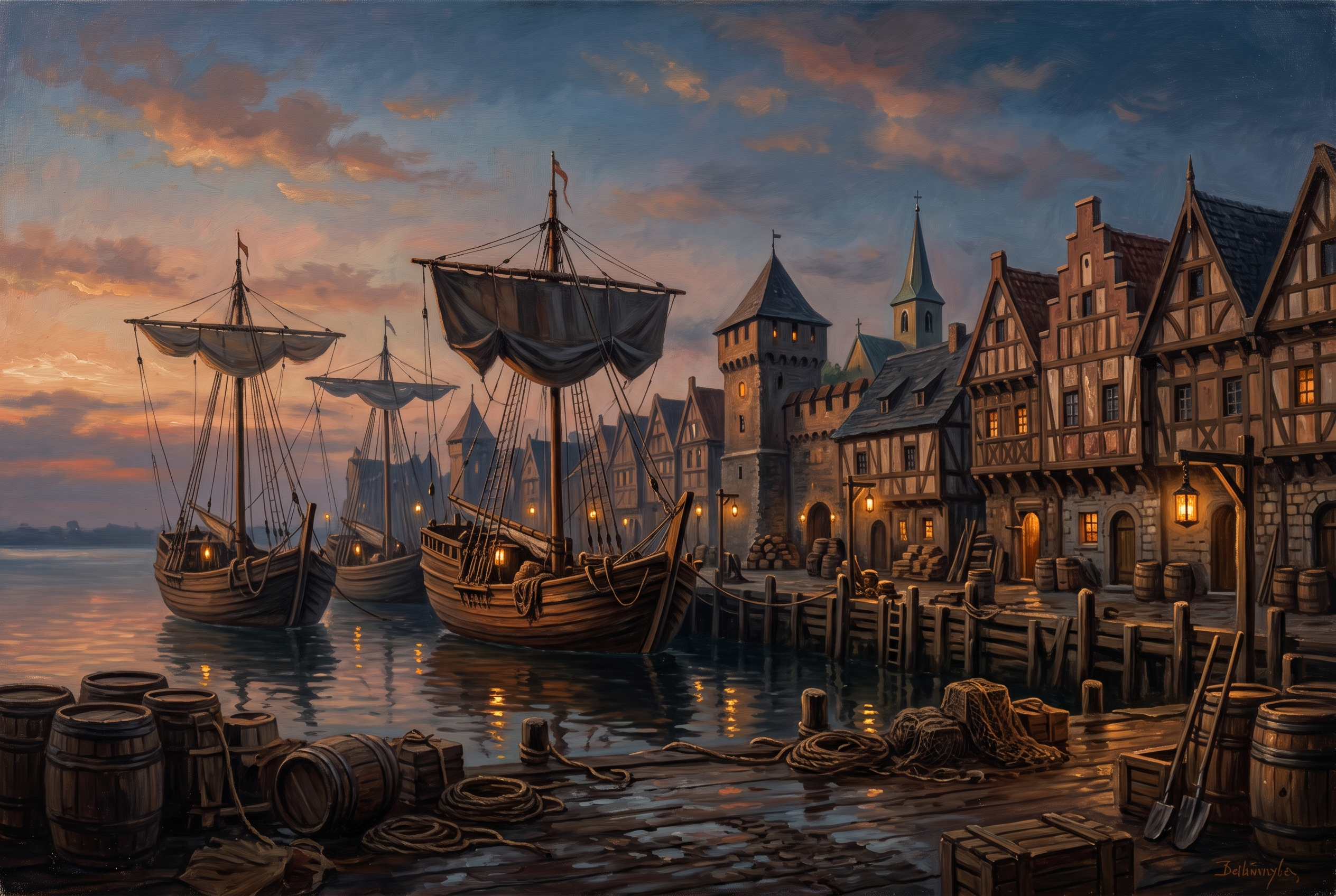
None of this works without a ship. The Hansa's workhorse was the cog: a single-masted, broad-beamed, flat-bottomed vessel with high sides and a stern rudder, built for capacity rather than speed. It could sit upright on a tidal flat to unload, sail with a small crew, and swallow a great deal of bulk cargo. Later the larger hulk and then the multi-masted carrack succeeded it.
The cargo was unromantic and enormously valuable in aggregate:
| Good | Source | Why it mattered |
|---|---|---|
| Salted herring | Baltic fisheries, notably around Skania | Cheap preserved protein for a Christian calendar full of fast days |
| Dried cod (stockfish) | Norway, via Bergen | Kept for years, fed ships, armies and inland towns |
| Salt | Lueneburg and later the Bay of Biscay | Without it the fish trade does not exist |
| Grain | Prussia, Poland, Livonia | Fed the crowded, food-importing cities of the west |
| Timber, pitch, tar, hemp, flax | Baltic forests | Shipbuilding supplies for all of Europe |
| Furs and wax | Russian interior via Novgorod | High-value luxuries and church candles |
| Cloth | Flanders and England | The manufactured good flowing back east |
Read that table and the map explains itself. The Hansa moved bulk goods from a resource-rich, thinly populated east and north to a manufacturing, densely populated west, and carried finished cloth back. It is the same logic that still shapes shipping lanes today, a point I have made about port cities and about the way containerisation later rewrote the same routes in how the shipping container shrank the world.
Why it declined
The Hansa did not collapse in a dramatic year. It faded across the fifteenth and sixteenth centuries, for reasons that are mostly structural.
- 1Territorial states grew stronger. Denmark, Sweden, Poland, Muscovy, England and the Dutch provinces consolidated, and consolidated states prefer to grant privileges to their own merchants. Ivan III closed the Novgorod kontor in 1494, and English policy turned steadily against the Steelyard, which was finally shut in the late sixteenth century.
- 2Dutch competition. Dutch shippers built cheaper, more efficient vessels and undercut Hansa freight rates in the Baltic itself, which is the most damaging kind of rival: one who does your business better.
- 3The Atlantic turn. Once trade routes reached around Africa and across to the Americas, the economic centre of Europe shifted toward the western seaboard, and the Baltic became one region among several rather than the northern core.
- 4Structural weakness. A league with no central treasury, no permanent army and voluntary compliance cannot enforce a common policy against determined states. Its greatest strength in good times was its fragility in bad ones.
- 5Shifting fish. The herring shoals moved from the Baltic toward the North Sea in the later medieval period, redistributing one of the network's foundational trades.
The last formal assembly met in 1669, long after the League had ceased to matter. Hamburg, Bremen and Luebeck kept the title of Hanseatic city, and still carry it on their car plates.
Networks versus empires
The Hansa is the clearest medieval example of a pattern that recurs: a network can out-compete an empire for a long time by being cheaper, more flexible and better informed, and it tends to lose once states become capable enough to internalise the same functions themselves.
It is tempting to read modern trade blocs and shipping alliances straight into this story, and worth resisting the strong version of the comparison. The Hansa had no treaty, no parliament and no shared currency. What genuinely rhymes is narrower and more interesting: standardised rules reduce friction, protected routes attract cargo, and negotiated access can substitute for territorial control. Venice was the Mediterranean counterpart, running a comparable trick with a very different structure, which I have described in how Venice ruled the Mediterranean.
The period also sits right beside one of our favourite hinge moments: the closing of the eastern Mediterranean route in 1453, which pushed Europe toward the Atlantic and helped end the Hansa's world. That story is told chapter by chapter in The Day the Middle Ages Ended, and you can test how you would have played one of those decisions yourself in Turning Points.
It had no capital, no crown and no army. For three hundred years it set the price of fish across half of Europe.
Frequently asked questions
One snap tomorrow morning.
Two minutes in art, history, psychology, philosophy or economics, then the app tells you you're done.
Get MindSnap on iOSFree daily fact, forever. Pro is $9.99/month or $44.99/year.