How the Shipping Container Shrank the World

Learning Science Writer
Last updated: August 2026
7 min read
TL;DR
Before the container, almost everything crossed the ocean as break-bulk cargo: sacks, barrels, crates and bales, loaded piece by piece by gangs of dockers. Ships spent as long in port as at sea, and the cost of moving goods was dominated by handling rather than distance. In 1956 the American trucking entrepreneur Malcom McLean loaded standardized steel boxes onto a converted tanker and proved the alternative. The hard part was not the box, it was the standardization: agreeing dimensions, corner fittings and lifting gear so that any crane, truck chassis and railcar in the world could handle any container. Once that settled, the geography of trade changed. Ports left crowded city centres for deep-water sites with room for cranes and stacks, freight costs became a small fraction of a product's price, and manufacturing could be split across continents. The container did not just make shipping cheaper. It made the modern supply chain thinkable.
The most consequential object of the twentieth century is arguably a corrugated steel box with nothing inside it. It has no moving parts, no inventor's flourish, no elegance at all. Its entire genius is that it is exactly the same as every other one.
To see why that matters, you have to start with what shipping looked like before it, because the modern arrangement is so total that the older world is genuinely hard to picture.
Before: the world of break-bulk
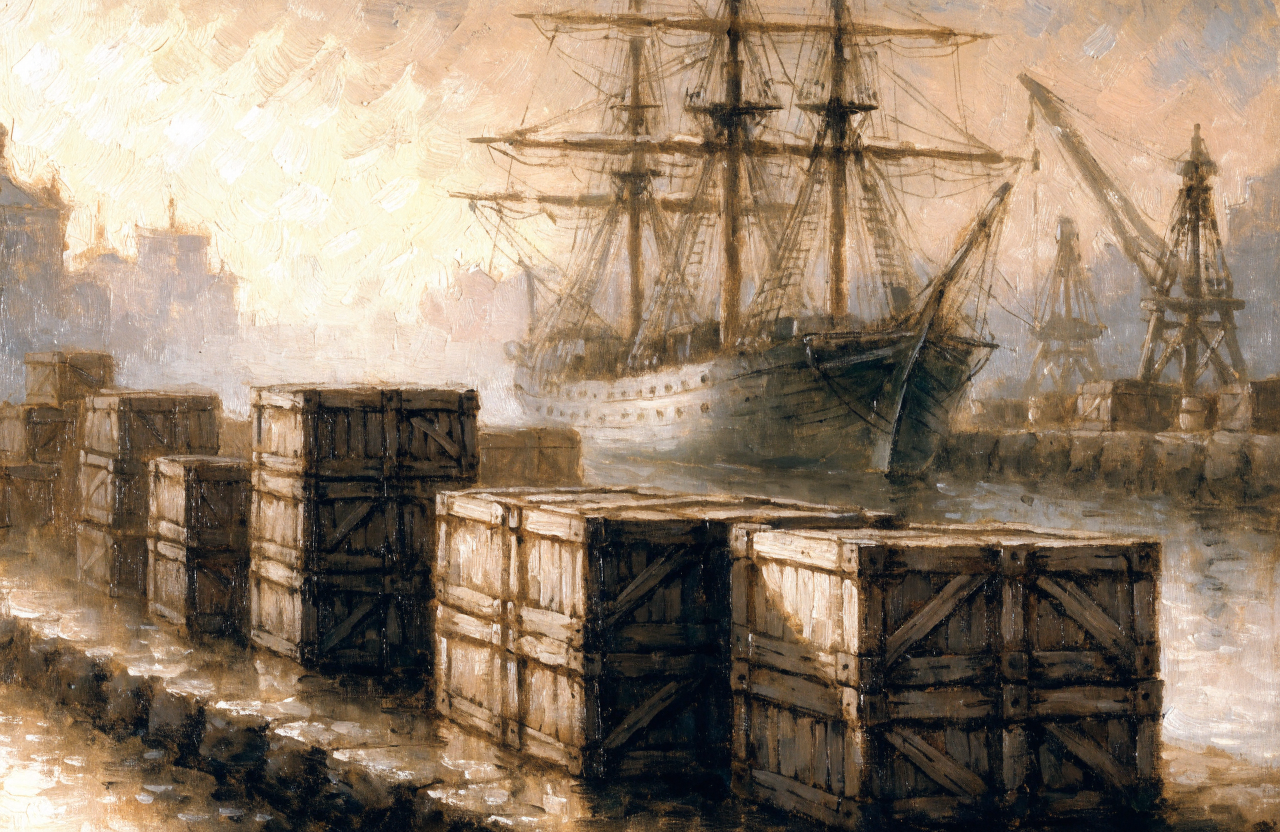
Cargo used to travel as itself. Coffee in sacks, oil in drums, machinery in crates, cotton in bales, all of it stowed by hand into the hold of a ship by teams of dockworkers who fitted awkward shapes together like a moving jigsaw. Loading a single vessel could take days, sometimes weeks. A ship might spend as much of its life tied up at a quay as at sea, and a ship in port is a very expensive object doing nothing.
The consequences ran deeper than delay. Because handling was so labour-intensive, the cost of moving goods was dominated not by the ocean crossing but by the two ends of it. Every transfer between truck, warehouse, quay and hold meant more hands, more time and more opportunity for breakage and theft, and pilferage on the docks was a routine cost of business rather than a scandal. Insurance priced it in.
The economic result was a world where distance was genuinely expensive. It made sense to manufacture close to your customers, to source materials nearby where possible, and to treat any long-distance trade as reserved for goods valuable enough to justify the friction. That logic is old, and it shaped commerce for millennia. We follow its earlier version along the Silk Road and modern trade, where the same rule applied: only high-value goods could pay the cost of the journey.
1956: a trucker looks at a dock
The person who broke that pattern was not a shipping man. Malcom McLean ran a trucking company in North Carolina, and his complaint was the one every trucker had: he spent hours parked at a quay watching his cargo be unpacked from his trailer and repacked into a hold. His question was the obvious one nobody in shipping had pursued to its conclusion. Why unpack it at all? Why not lift the whole box?
In 1956 he put that to the test, loading a converted tanker with standardized steel boxes and sending it from Newark to Houston. The demonstration was not glamorous and the industry did not immediately capitulate. What it proved was that a crane could do in minutes what a gang of dockers did in hours, and that the box could move from ship to chassis to warehouse without its contents ever being touched.
The Vietnam War became an unlikely accelerant, because moving military supplies at scale is exactly the problem the container solves, and once one large customer commits, the equipment follows.
The real battle was standardization
Here is the part of the story that gets skipped, and it is the part that actually matters. A container is only useful if it is interchangeable. If one line uses boxes of one length and another uses a different length, and their corner fittings do not match, then every port needs different cranes and every trucking firm needs different chassis. You have not created a network, you have created several incompatible private systems.
So the decisive work was committee work: agreeing lengths, heights, corner castings and lifting points as international standards, over years of negotiation between shipping lines, railways, national bodies and standards organisations, each with equipment they had already bought and an interest in their own dimensions winning. It is unglamorous history, and it is the reason a box loaded in Vietnam can be lifted by a crane in Rotterdam and set onto a chassis in Ohio without anyone making a phone call.
The lesson generalises. Networks deliver their value only once the interface is boring and universal, which is also the story of shipping's modern nervous system, the cables we describe in undersea cables explained.
After: ports move, and cities change
Container handling wants things the old ports could not offer. It wants deep water for ever-larger ships, flat acres for stacking boxes, gantry cranes, and rail and motorway links running straight off the quay. Historic ports were the opposite: shallow river frontage in the middle of dense cities, warehouses built for hand-carried goods, streets designed for carts.
So the trade moved out. Activity shifted downstream and offshore to purpose-built deep-water terminals, and the old waterfronts, cleared of the labour that had defined them for centuries, eventually became apartments, museums and offices. Dockwork itself changed character completely, from vast gangs of casual labour to smaller crews of crane and equipment operators, and the social upheaval of that shift was real and painful in every port city it touched.
The ranking of ports changed too. Prominence stopped depending on proximity to a manufacturing city and started depending on depth, land and connections. Some medieval trading giants became secondary. Some places that had been almost nothing became global hubs. Why certain coastlines keep winning across every era of this is the subject of why port cities rule the world.
The geography that did not change
For all this upheaval, the container did not repeal geography. Ships still have to go where the water goes, and the routes still funnel through the same narrow places they always have: the straits and canals where a few miles of water carry a startling share of world trade. Standardization made the flow larger and cheaper, which paradoxically made those pinch points more consequential, not less. A blockage now backs up a system that is optimised on the assumption that nothing blocks.
That is the modern version of a very old rule, and it is why the same handful of waterways keeps appearing in the news. We map them in maritime chokepoints explained.
What it made possible
- Freight became a small enough share of a product's price that where you make something stopped being determined by where you sell it.
- Manufacturing could be split into stages across countries, with components crossing oceans several times before final assembly.
- Just-in-time inventory became viable, because arrival times were predictable rather than approximate.
- Consumers gained enormous variety at lower prices, and simultaneously lost visibility of where anything came from.
- Supply chains became long, efficient and brittle, which is why a single stuck ship or closed port now makes global headlines.
It is worth holding both halves of that ledger. The container is one of the great efficiency gains in economic history and it dissolved industries and neighbourhoods that had existed for generations. Both things are true, and the honest version of the story includes both.
Disclosure, since I am about to point at our own product: MindSnap is our app. Stories like this one, where a mundane object quietly reorganises the world, are exactly the shape we build lessons around. You can see the range in topics, and if you would rather stand inside a decision than read about it, Turning Points lets you make the call yourself.
The next time you pass a stack of containers on a rail siding, it is worth a second look. They are all the same, on purpose, and that is the whole trick.
Frequently asked questions

One snap tomorrow morning.
Two minutes in art, history, psychology, philosophy or economics, then the app tells you you're done.
Get MindSnap on iOSFree daily fact, forever. Pro is $9.99/month or $44.99/year.