How Venice Ruled the Mediterranean Without a Large Army

Arts & History Editor
Last updated: August 2026
8 min read
TL;DR
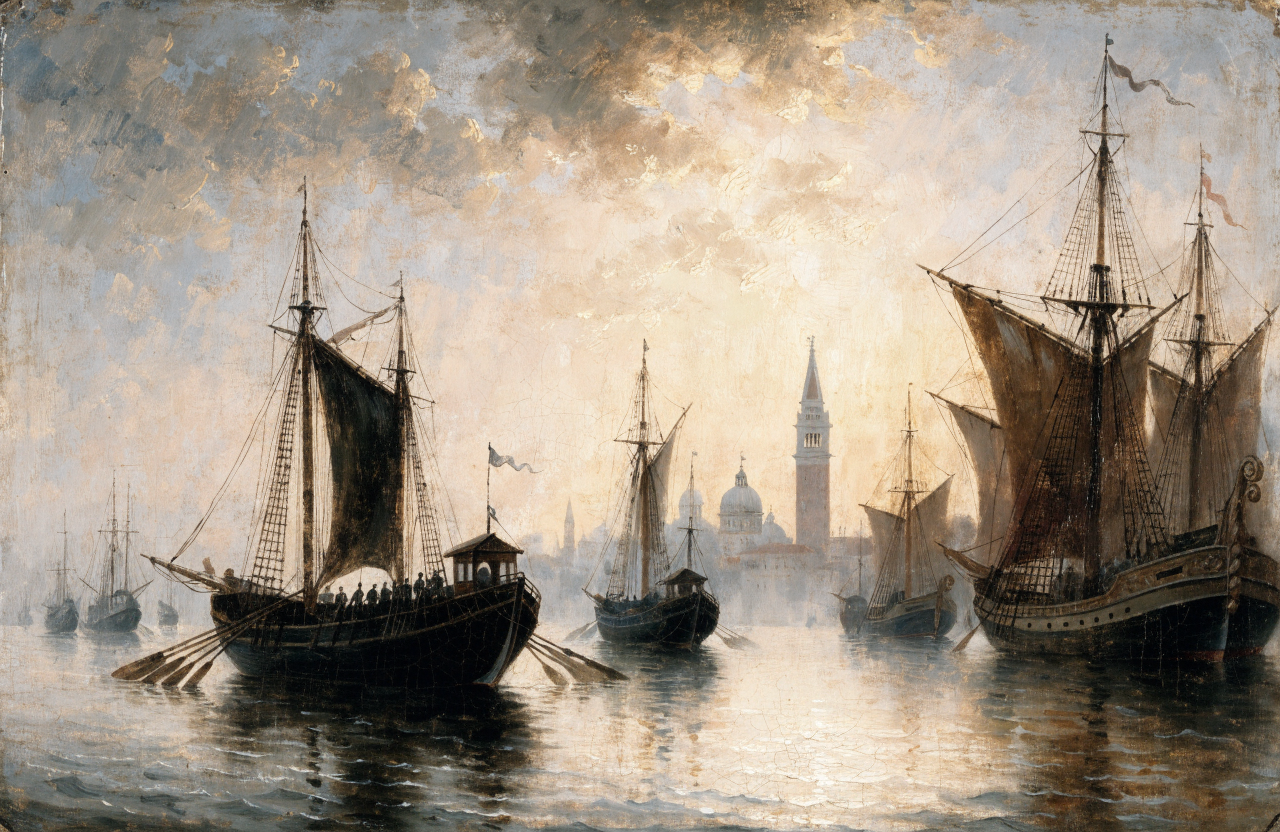
Venice had no farmland, no natural resources and never fielded an army that could threaten a major land power. For roughly five centuries it nonetheless controlled the most valuable trade in the eastern Mediterranean. The reasons are unglamorous and repeatable: a lagoon that made invasion by land almost pointless, a state-run shipyard that turned warship construction into standardised production, regulated convoys that made merchant voyages predictable enough to finance, and a chain of ports and islands that let cargo move in stages under Venetian protection. Its decline came less from defeat in battle than from the map changing around it, as Ottoman power consolidated the eastern routes and Atlantic voyages moved the centre of long-distance trade west. The pattern is timeless: geography plus institutions beats raw size, until the geography stops mattering.
Stand in Venice today and the strangeness is easy to miss under the crowds. There is no hinterland, no defensible hill, no mineral wealth, not even reliable fresh water in the early centuries. A settlement on salt marsh should have stayed a fishing village. Instead it became the clearing house for the most valuable goods moving between Asia and Europe, and it held that position for longer than most empires last.
The explanation is not a great general or a lucky war. It is a set of advantages that compounded, and they are worth understanding because the same shape recurs wherever a small place punches above its weight.
Advantage one: a lagoon is a strange kind of fortress
Venice sits behind shallow water threaded with narrow channels. To an attacker with an army, this is maddening. Cavalry is useless. Siege trains cannot be dragged across mud. Deep-draught ships run aground unless they know the channels, and the channels were marked by pilings that could be pulled up. An enemy could ravage the mainland and still find the city untouched a few kilometres away.
The result was an unusual security arrangement: the city could underinvest in land defence and put its money into ships, trade and administration. Most rivals had to pay for walls, garrisons and field armies simply to survive. Venice paid for a navy that also generated revenue.
The lagoon shaped politics too. With no land nobility holding castles and estates, power concentrated in merchant families whose wealth came from voyages. A state run by traders naturally wrote policy that served trade. This is a recurring theme in maritime cities, and we traced the wider version in why port cities rule the world.
Advantage two: the Arsenal, an industrial system before industry
The Arsenale was a state-owned shipyard complex covering a large walled district of the city, and it is one of the most remarkable institutions of the pre-modern world. Rather than building each ship as a bespoke project, Venice standardised designs, stockpiled interchangeable components, and moved hulls through sequential stages of fitting out.
Visitors described galleys being completed at a speed that seemed impossible, and while the celebrated accounts of ships finished in hours during ceremonial demonstrations should be read as showmanship, the underlying capability was real: Venice could surge naval production, maintain a reserve of hulls, and refit quickly after losses. In naval terms, replacement rate matters more than any single battle.
Two consequences followed. First, Venice could lose ships and stay a power, which very few of its rivals could. Second, the Arsenal concentrated skilled labour under state supervision, giving the Republic control over its own war-making capacity rather than dependence on private contractors.
Advantage three: convoys, regulation and predictable risk
Venice's most underrated innovation was administrative. Long-distance trade in this period was catastrophically risky: storms, pirates, hostile ports, spoiled cargo. The Republic responded by turning voyages into scheduled public infrastructure.
State galley convoys sailed on fixed routes at fixed seasons, with cargo space auctioned to merchants and armed escorts provided as a matter of policy. Ships travelled together. Routes, stopping points and departure windows were set by the state. Contracts, partnerships and profit-sharing arrangements were standardised enough that investors could price a voyage instead of gambling on one.
That predictability was the real product. It meant a modest merchant could put capital into a share of a cargo, and it meant credit could flow toward trade rather than sitting idle. The same logic explains why the great overland exchange worked in stages rather than end to end, which we covered in the spice routes.
Advantage four: a chain of ports, not a block of territory
Venice never tried to hold a large contiguous empire in the modern sense. It held nodes: Adriatic harbours, Aegean islands, Crete, Cyprus for a period, trading quarters in eastern cities. Each node offered shelter, water, repair, a warehouse and a garrison.
A chain of ports is far cheaper than a landmass. You defend anchorages, not frontiers. And a chain converts geography into a service: goods coming west from Asian markets could move from one Venetian-protected stage to the next until they reached the city, where they were taxed, warehoused, insured and sold on into Europe. The value captured was the value of being the reliable middle.
The vulnerability is obvious in hindsight. A chain breaks at its weakest link, and every node had to be defended against whoever wanted the same water. That is the permanent condition of narrow-sea power, which is the subject of maritime chokepoints explained.
The uncomfortable part of the record
A fair account cannot leave out how ruthless this system was. Venetian involvement in the Fourth Crusade ended with the sack of Constantinople in 1204, a Christian city looted by a Christian army, and Venice took territory, relics and trading privileges from the wreckage. Rival cities, above all Genoa, were fought over commercial access for generations. Colonial administration on Crete and elsewhere produced repeated revolts.
None of this makes Venice unusual for its era. It does mean the Republic's success was built on coercion as well as clever institutions, and any story that presents it purely as a triumph of commerce is flattering it.
Why it faded
Venice was not conquered out of its position. The map moved.
The consolidation of Ottoman power reorganised the eastern Mediterranean, and the fall of Constantinople in 1453 marked the point at which the terms of eastern trade were set by a single large state rather than negotiated among fragments. Venice adapted, traded, fought and traded again, but it now dealt with a counterparty far stronger than itself. That turning point is the subject of the fall of Constantinople, and it is also the story we tell as a chapter series in the collection The Day the Middle Ages Ended.
The deeper blow was Atlantic. Once ships could reach Asian markets around Africa and cargo could cross the ocean westward, the eastern Mediterranean stopped being the only door. A city whose entire advantage was being the indispensable middle of one route cannot easily survive the route becoming optional. Venice remained wealthy, artistically extraordinary and diplomatically busy for centuries after its commercial peak, which is what decline usually looks like from inside: not collapse, just relative shrinkage.
The pattern worth keeping
Strip away the gondolas and Venice is a case study in something durable. Small powers succeed by holding a position that larger powers must pass through, and by building institutions that make passing through them cheap, safe and predictable. Geography supplies the position. Institutions supply the reliability. Neither works alone: a good harbour with bad law is a smuggling port, and excellent law in the wrong place is an archive.
It also carries a warning. An advantage that depends on being the only route is hostage to the discovery of another route. Singapore, Panama, Rotterdam and the Gulf ports all live with a version of that risk today.
If you would rather feel a decision than read about one, our Turning Points scenarios put you inside moments like 1453 and ask what you would have done, then show what actually happened. Disclosure: MindSnap is our app, and Turning Points is one of its features, so treat that as an invitation rather than an impartial recommendation.
Frequently asked questions
One snap tomorrow morning.
Two minutes in art, history, psychology, philosophy or economics, then the app tells you you're done.
Get MindSnap on iOSFree daily fact, forever. Pro is $9.99/month or $44.99/year.