The Spice Routes Explained: How Pepper and Nutmeg Redrew the World Map

Arts & History Editor
Last updated: August 2026
8 min read
TL;DR
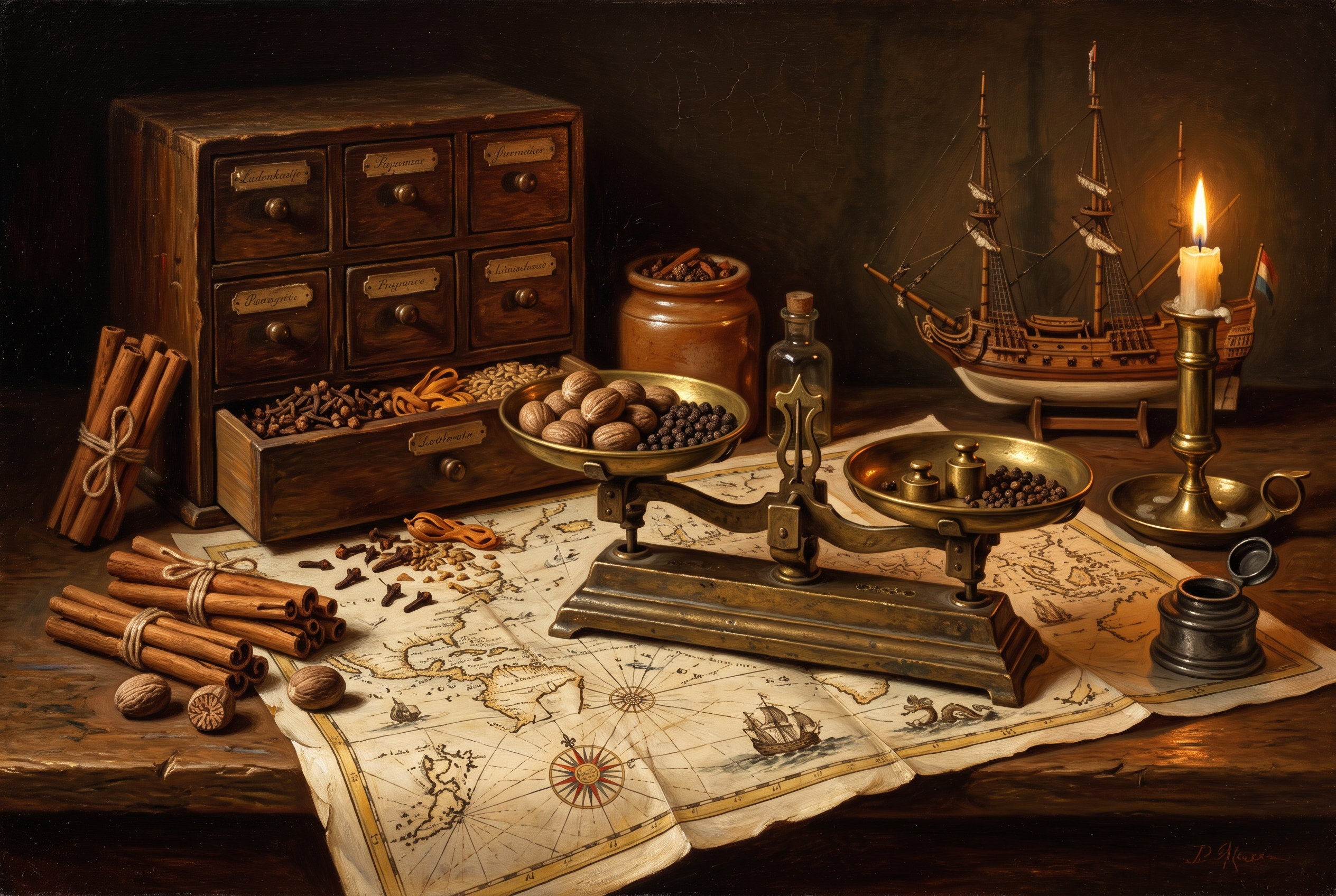
For centuries, spices reached Europe through long chains of intermediaries: grown in South and Southeast Asia, carried by sea and overland through the Indian Ocean and the Middle East, and sold on at the Mediterranean by merchants who controlled the last leg. Prices rose at every handover, and Venice grew rich on the final one. The European search for a direct sea route was an attempt to cut those middlemen out, which is what sent Portuguese ships around the Cape of Good Hope and Spanish ships west. The Dutch East India Company later industrialised the logic, seizing the specific islands where nutmeg and cloves grew. The lasting lesson is structural: whoever controls the route captures more value than whoever grows the crop.
A pound of nutmeg was once worth a serious quantity of silver in northern Europe, and it grew, at that time, on a handful of small volcanic islands you could sail past in an afternoon. Almost everything interesting about the spice trade lives in the distance between those two facts.
The spice routes are usually told as an adventure story. They are better understood as a story about intermediaries: who stood between the tree and the table, and what they were able to charge for standing there.
Why spices were worth so much
Three things made spices unusually valuable cargo. They were geographically concentrated, they were light relative to their price, and they did not spoil on a long voyage.
Pepper came mainly from the Malabar coast of southwest India and later from Southeast Asia. Cinnamon came from Sri Lanka. Cloves, nutmeg and mace came from a very small part of the Indonesian archipelago: cloves from the Maluku islands, and nutmeg and mace, both products of the same fruit, from the Banda islands. That concentration is the crucial detail. A commodity grown everywhere cannot be cornered. A commodity grown on six islands can.
The demand side is often exaggerated. The old claim that spices were used mainly to disguise rotten meat does not hold up well: anyone able to afford pepper could afford fresh food. Spices were used for flavour, for medicine, for preservation, for perfume and for display. Serving heavily spiced food announced that you had access to the far side of the world, which was the point.
How the old routes worked
Before European ships reached Asia directly, spices travelled through a long relay. Goods moved from producing islands to regional entrepots, then across the Indian Ocean on monsoon winds, then through one of two corridors to the Mediterranean: up the Red Sea toward Egypt, or up the Persian Gulf and overland through Mesopotamia and Syria.
The monsoon system mattered enormously. Winds reverse seasonally in the Indian Ocean, which meant sailing schedules were predictable but rigid: miss the season and you waited months. That rhythm shaped where merchant communities settled and which ports became permanent.
At every transfer, price rose. Not because anyone was cheating, but because each leg carried real risk, real capital and real information advantage. The overland caravan trade in Central Asia worked on the same principle, which we traced in the Silk Road and modern trade.
The final leg was the most profitable of all. Venetian merchants bought in Alexandria and Levantine ports and resold across Europe, and Venice's wealth in the late medieval period rested substantially on that position. Venice grew no pepper. It controlled a doorway.
The search for a direct route
By the fifteenth century, Atlantic-facing European powers had an obvious commercial motive to bypass the Mediterranean chain entirely. Portugal pursued the eastern option, working down the African coast over decades until Bartolomeu Dias rounded the Cape of Good Hope in 1488 and Vasco da Gama reached Calicut in 1498.
Spain backed the western option, which is how Columbus ended up in the Caribbean in 1492 looking for Asia. The point worth holding on to is that both voyages were attempts to solve the same commercial problem: too many hands between the grower and the buyer.
The Portuguese approach that followed was not colonisation of territory in the later sense. It was control of nodes: fortified positions at Goa, at Malacca, at Hormuz, chosen because they sat on passages that shipping could not avoid. That is chokepoint strategy in its earliest recognisable form, and the modern version follows the same map logic, as we set out in maritime chokepoints.
The Dutch, the company, and the Banda islands
The next phase was harder-edged. The Dutch East India Company, chartered in 1602, was an unusual instrument: a joint-stock trading company granted powers normally reserved to states, including the right to make treaties, wage war and build fortresses. It combined commercial capital with coercive force on a scale no individual merchant could match.
Its nutmeg strategy shows the logic at its most extreme. Rather than compete for cargo, the company sought monopoly control over the tiny Banda islands where nutmeg grew, and enforced it with violence whose consequences for the Bandanese population were severe. On the clove islands, the company restricted cultivation to areas it controlled and destroyed trees elsewhere, deliberately shrinking global supply to hold prices up.
This is where economics and morality diverge sharply, and it should be said plainly: the profits were extraordinary and the human cost of the monopoly was appalling. The company was a commercial success and, in the Bandas, an atrocity.
Those profits flowed home into a Republic that was becoming the wealthiest society in Europe, funding the shipping, the credit markets and the painting boom we described in the Dutch Golden Age. The same city and the same speculative money produced the tulip episode, which our story collection Tulip Fever follows chapter by chapter.
Why the monopolies ended
No spice monopoly held forever, for a reason that recurs across commodity history: biology travels. Once seedlings and growing knowledge left their original islands, cultivation spread to other tropical regions, supply expanded, and the extraordinary margins collapsed toward ordinary ones. Nutmeg and cloves became grocery items.
The route, however, kept its value. Long after pepper stopped being a luxury, the passages between the Indian Ocean and Europe remained strategically decisive, which is why so much later imperial energy went into canals and coaling stations rather than plantations.
The pattern worth taking away
Three durable lessons come out of the spice centuries.
- Concentration creates leverage. Goods grown in one small place invite control in a way that widely grown goods never do.
- Value accrues to the chokepoint, not the field. Venice, Malacca and the Cape mattered more than any grove.
- Monopolies erode from the supply side. Seeds, techniques and alternative sources undo enforcement given enough time.
If you want to see how that thinking applies to today's map without the punditry, why port cities rule the world is the natural next step, and our Turning Points scenarios let you sit inside a historical decision rather than read about it.
Disclosure, since collections and lessons are mentioned: MindSnap is our app. It runs short daily lessons, five flagship story collections and unlimited topics beyond them, at $9.99 per month or $44.99 per year, with a free daily fact if you want to try the habit first.
Next time you grind pepper without thinking about it, note the quiet historical joke: the thing that once justified ocean crossings now sits next to the salt.
Frequently asked questions
One snap tomorrow morning.
Two minutes in art, history, psychology, philosophy or economics, then the app tells you you're done.
Get MindSnap on iOSFree daily fact, forever. Pro is $9.99/month or $44.99/year.