What Was the Dutch Golden Age? A Two-Minute Tour of a Small Country's Big Century

Arts & History Editor
Last updated: August 2026
7 min read
TL;DR
The Dutch Golden Age was the seventeenth century stretch when the young Dutch Republic, a small confederation of provinces with no great natural wealth, became one of the richest and most inventive societies in Europe. Its foundations were shipping and finance: fluyt cargo ships, herring and Baltic grain, the chartered Dutch East India Company founded in 1602, and an Amsterdam exchange where company shares traded continuously. Prosperity spread widely enough that ordinary households bought paintings, which is why Rembrandt, Vermeer and the still life tradition emerged from a merchant market rather than a royal court. Tulip mania in the 1630s became its most famous fever, though a smaller episode than legend suggests. War, competition and shifting trade routes gradually ended the era by the early eighteenth century.
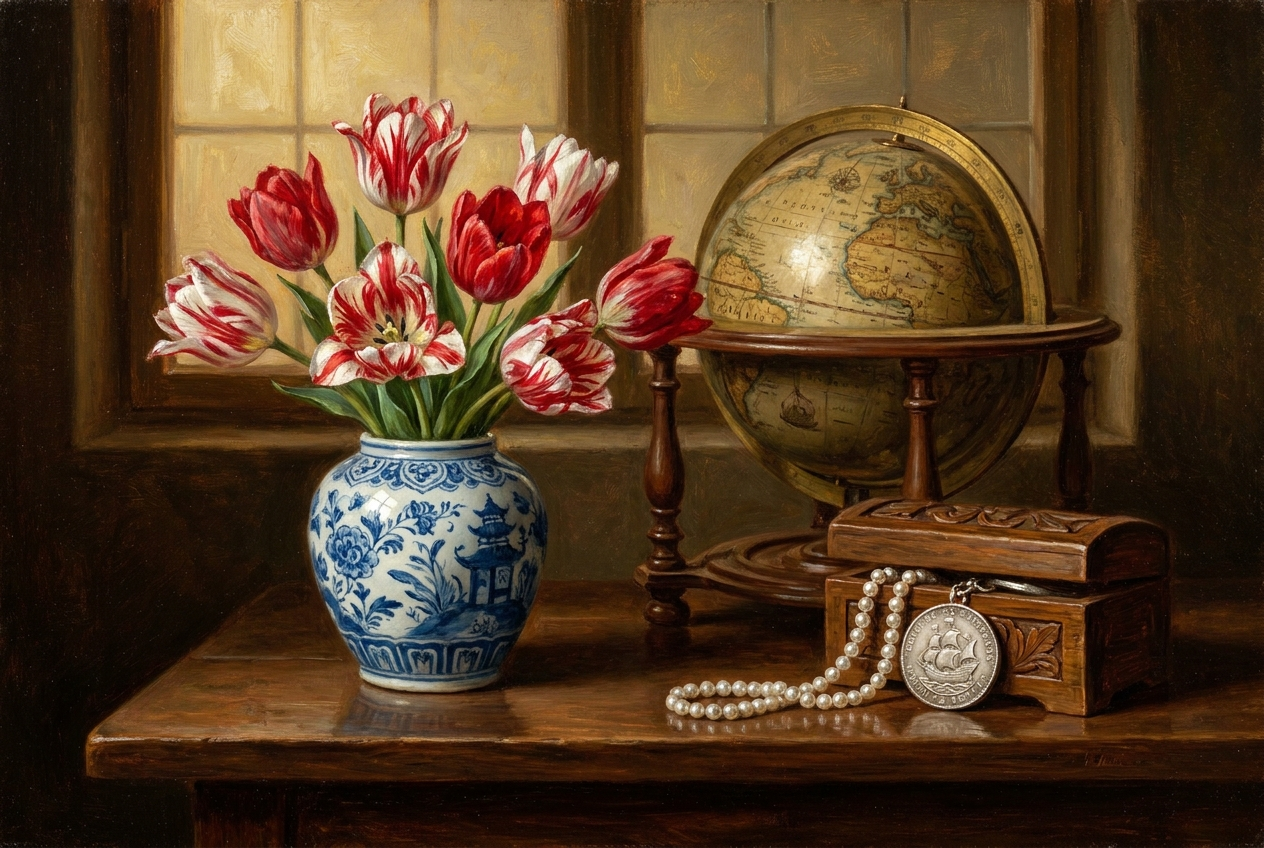
Stand in front of a Dutch still life and count the things in it. A Chinese porcelain bowl. A lemon from the Mediterranean, half peeled. Pepper. A Venetian glass. A silver knife. Now note who bought the picture: not a king, but very possibly a cloth merchant with a house on a canal and a decent but not extraordinary income.
That is the Dutch Golden Age in one frame. A small, wet, resource-poor country spent the seventeenth century becoming the trading hub of the world, and the evidence is not only in ledgers but on the walls of ordinary houses.
A republic that should not have worked
The Dutch Republic emerged from a long revolt against Habsburg Spain in the late sixteenth century. What resulted was odd by the standards of the age: a confederation of seven provinces with no monarch, considerable municipal autonomy, a great deal of commercial self-interest and a practical rather than absolute approach to religious difference.
It also had almost none of the usual ingredients of power. No large population by European standards, no mineral wealth, not much arable land and a permanent argument with the sea. What it did have was position: the mouths of major rivers opening onto the North Sea, at the point where Baltic grain and timber met Atlantic and Mediterranean trade. Geography handed it a doorway, and it spent a century monetising the doorway.
Boring ships, enormous consequences
The most underrated hero of the story is a cargo vessel called the fluyt. It was not fast, handsome or well armed. It was cheap to build, roomy in the hold and able to be sailed by a small crew, which meant lower freight costs per barrel than competitors could match. Dutch shippers used that margin to take over the unglamorous bulk trades first: Baltic grain, timber, salt and above all herring.
From that base came the spectacular part. In 1602 the Dutch East India Company, the VOC, was chartered as a single body with the right to trade, negotiate and use force east of the Cape. It was an early example of an entity we now find ordinary and would then have found strange: a permanent joint-stock company with transferable shares, raising capital from a broad public rather than funding one voyage at a time. A parallel West India Company followed in 1621.
The financial machinery grew alongside it. Amsterdam's exchange developed continuous secondary trading in VOC shares, complete with forward deals, speculation and the recognisable moods of a market. The Bank of Amsterdam, founded in 1609, gave merchants a reliable deposit and settlement institution in a continent full of debased coinage. None of this was invented from nothing, but the combination in one city was new, and it made Amsterdam the place where European capital came to work.
Why art ended up in ordinary homes
Elsewhere in Europe, ambitious painting largely served two patrons: the church and the court. The Dutch Republic was Protestant, so the vast commissions of Catholic Europe were mostly absent, and it had no royal household of the usual kind. What it had instead was thousands of households with surplus income and wall space.
So the market supplied what that public wanted, and specialisation followed. Painters became known for particular genres: winter scenes, sea battles, church interiors, tavern life, flowers, breakfast tables. Prices ranged from modest to serious, and inventories from the period show paintings in houses well down the social scale. Rembrandt van Rijn made his name with portraits and biblical drama and pushed the possibilities of light and character further than anyone around him. Johannes Vermeer, working slowly in Delft, produced a small body of interiors so quiet that they still feel like eavesdropping.
It is also a market story with market consequences, including bankruptcies. Rembrandt's own finances collapsed in the 1650s despite his fame, which we look at in why did Rembrandt die poor, and his life makes a good doorway into the whole century, which is why we built the collection Rembrandt's Shadow around it.
The famous flower bubble
No account of the era escapes the tulips. The flower arrived in Europe from the Ottoman world in the sixteenth century and became a status object in Dutch gardens, with the most prized varieties showing dramatic flames and feathering of colour. Those patterns, we now know, were caused by a virus, which meant the most valuable bulbs were also the least reliable to reproduce.
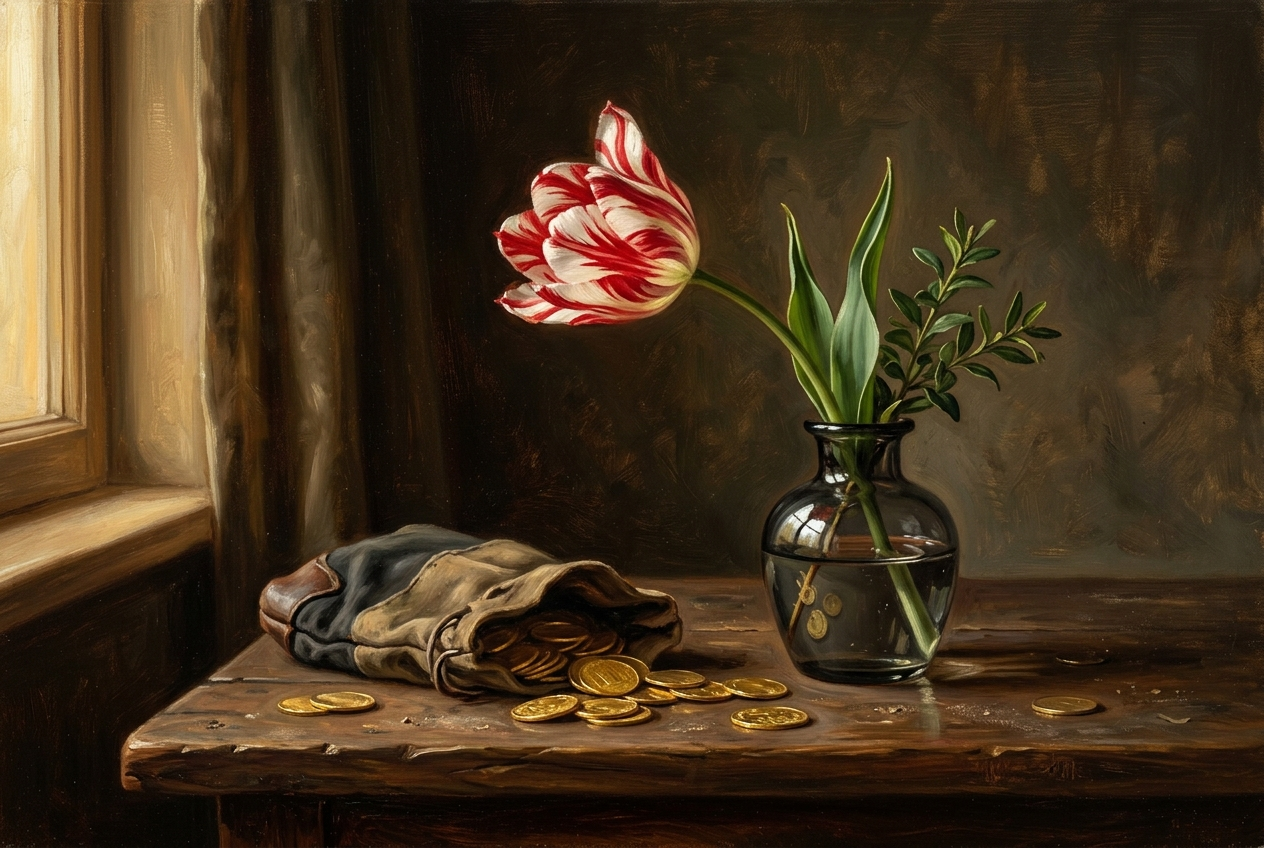
Through the 1630s, trading in bulbs and in contracts for future bulbs grew increasingly speculative, moving into taverns and out of the hands of specialist growers. In February 1637 the bidding stopped and prices collapsed. It is remembered as the first great speculative mania, and the pattern it set is genuinely instructive. It was also narrower than the legend claims: this was not a national ruin, and the sober research suggests the participants were a limited circle rather than the whole society. We separate the record from the myth in tulip mania explained, and follow it as a story in the collection Tulip Fever.
How the age ended
Golden ages rarely end with a single event, and this one faded by accumulation.
- War became expensive and constant, including three naval wars with England and a near catastrophe in 1672 when France invaded and the Dutch flooded their own land to stop the advance.
- Competitors caught up. English and French shipping, protected by navigation laws and state backing, ate into the carrying trade that had been the Dutch advantage.
- The margins in the eastern trade thinned as the VOC's costs of administration and defence rose.
- Capital shifted from risky enterprise to lending abroad, which was profitable but built less at home.
- Population growth stalled and the great urban expansions slowed.
By the early eighteenth century the republic was still wealthy and still influential, but it was no longer the pivot of the world economy. That is the ordinary fate of hubs. The trade did not stop, it simply routed elsewhere.
Why this century keeps repaying attention
What I find durable about the Dutch Golden Age is how many modern things it prefigures. A joint-stock company with public shareholders. A stock exchange with continuous trading and rumour-driven prices. A speculative bubble in an asset with a plausible story attached. Consumer demand pulling art away from patrons and towards a market. A small state punching far above its weight on the strength of logistics and finance rather than territory.
It is also unusually good material for short lessons, because so much of it hangs on decisions you can put to a reader: charter the company or fund single voyages, buy the bulb contract or sit it out, take the civic portrait commission or paint what you want. That is the format of Turning Points, where you make the call and then see what actually happened. Disclosure since I work on it: MindSnap is our app.
Two minutes is not enough to know a century. It is more than enough to change how you look at a still life. Next time, count the objects and ask how each of them got into the room.
Frequently asked questions
One snap tomorrow morning.
Two minutes in art, history, psychology, philosophy or economics, then the app tells you you're done.
Get MindSnap on iOSFree daily fact, forever. Pro is $9.99/month or $44.99/year.