Tulip Mania Explained: What Really Happened in the World's Most Famous Bubble

Arts & History Editor
Last updated: August 2026
8 min read
TL;DR
Tulip mania was real, brief and strange, but the story you know is mostly a moral fable assembled afterwards. Trading in the winter of 1636 to 1637 was largely in futures contracts on bulbs still in the ground, conducted in taverns by a small circle of merchants and artisans, and settled loosely. Prices did spike absurdly and collapse in February 1637, but historians including Anne Goldgar have shown the wider Dutch economy was not wrecked, mass ruin was rare, and most of the vivid anecdotes come from later moralists and pamphleteers rather than the records.
Every financial crash since 1637 has been compared to Dutch tulips, usually by someone who wants to sound sceptical without doing any reading. It is the perfect parable: a sober, wealthy trading nation loses its mind over flowers, pays a house price for a bulb, and collapses into ruin. The trouble is that the parable is far better constructed than the history, and most of its best details were written by people with an argument to make.
What actually happened in the Netherlands between roughly 1634 and February 1637 is stranger and more interesting than the fable, and it teaches a different lesson.
Why tulips, and why then
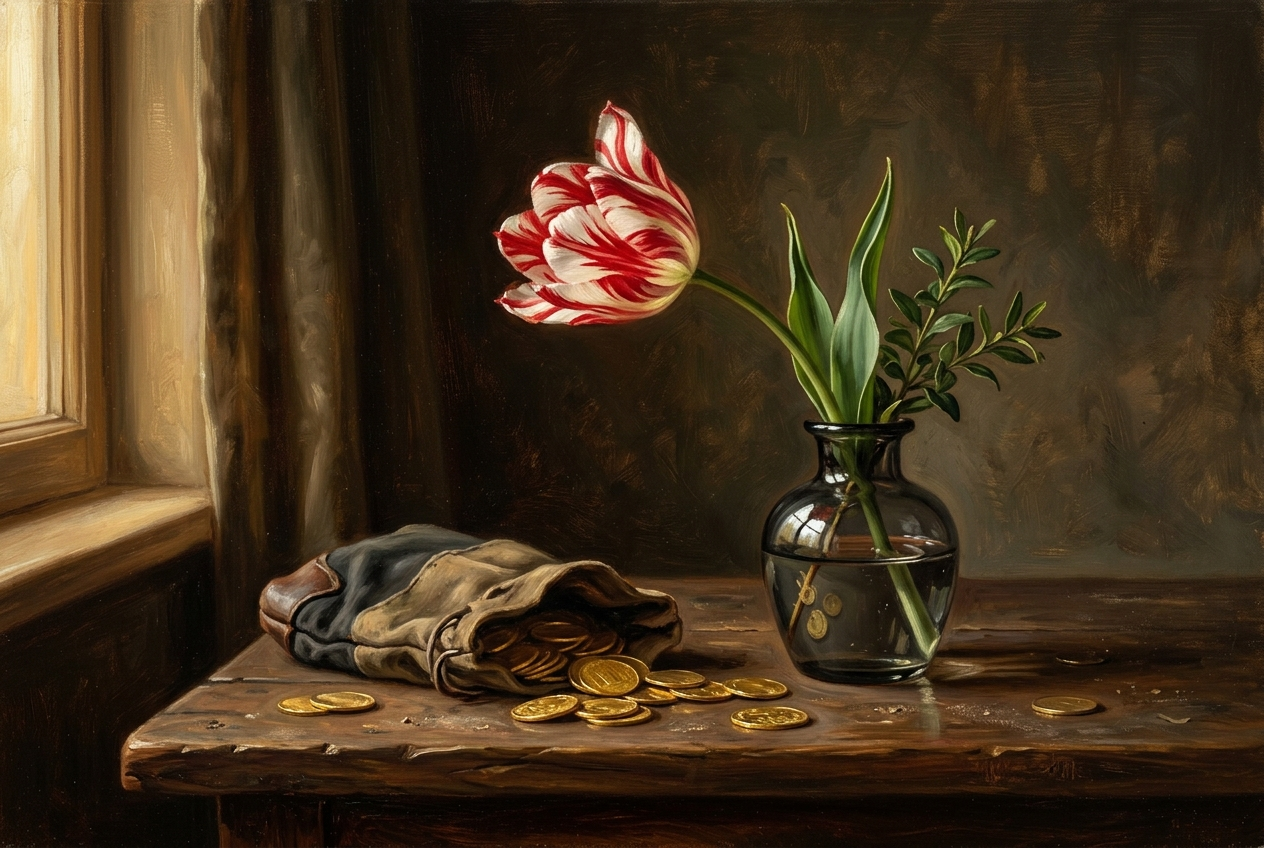
Tulips arrived in western Europe from the Ottoman world in the sixteenth century and were unlike anything already growing in Dutch gardens. They were vivid, they were new, and crucially they were unpredictable. The most prized varieties were the broken tulips, whose petals showed dramatic flames and feathering of contrasting colour. Nobody at the time knew why this happened, which meant nobody could produce it reliably. It is now understood to have been caused by a virus.
So the luxury good at the centre of the mania had three properties speculators love. It was scarce, it was fashionable among a newly rich merchant class, and its most valuable form could not be manufactured to order. On top of that, tulips reproduce slowly. A bulb produces offsets over years, so supply could not respond quickly to demand.
The setting mattered too. The Dutch Republic in the 1630s was the most sophisticated commercial society in Europe, with joint stock companies, marine insurance, an exchange in Amsterdam and a culture entirely comfortable with buying things that did not physically exist yet. Tulip speculation was not an aberration from Dutch commerce. It used its ordinary tools.
What actually traded
This is where most retellings quietly mislead. During the peak winter of 1636 to 1637, the tulips being traded were, for the most part, not in anyone's hands. They were in the ground. Bulbs are lifted in summer and planted in autumn, so through the winter months trade shifted to paper: contracts promising delivery of a specified bulb, by weight, at the coming lift.
In other words the famous mania was largely a futures market in an object nobody could inspect. The buyer could not see the bulb, could not verify the variety, and in many cases had no intention of ever taking delivery. They planned to sell the contract onward at a higher price.
Nor did this happen on the Amsterdam exchange. It happened in what participants called colleges, informal trading groups meeting in taverns, with their own rituals of bidding, small fees paid in wine and food, and no legal enforcement worth the name. Deals were sealed socially rather than institutionally, on the assumption that a merchant's reputation guaranteed the paper. That assumption is the actual load-bearing wall of the whole episode.
| The popular story | What historians find |
|---|---|
| Everyone in the Netherlands was trading tulips | A limited circle of merchants, skilled artisans and connoisseurs, concentrated in a few towns |
| Bulbs changed hands at market for cash | Mostly futures contracts on bulbs still planted, traded in tavern colleges |
| The crash ruined the national economy | No broad economic downturn traceable to it; Dutch trade continued its expansion |
| Bankrupts drowned themselves in canals | Later moralising pamphlet imagery, not documented case histories |
| Contracts were enforced, wiping people out | Most were renegotiated, discounted heavily or abandoned; courts largely declined to enforce |
How high did prices really go?
High enough to be genuinely absurd, which is the part the fable gets right. Records exist of single rare bulbs, particularly the legendary Semper Augustus, changing hands or being offered at sums comparable to a substantial Amsterdam house, and of contracts for prized varieties reaching several thousand guilders when a skilled craftsman's annual earnings were a few hundred.
Two caveats matter. First, those headline figures involved the rarest varieties in a thin market, which is a bit like judging a housing market by one record penthouse sale. Common bulbs were traded in bulk by weight at far more modest prices, and it was those cheaper contracts that saw the wildest late proportional gains as new entrants arrived. Second, a contract price is not a completed sale. Many of the most spectacular numbers were promises that were never paid.
The collapse came in early February 1637, apparently starting at an auction in Haarlem where buyers simply did not appear. Once it became clear the next buyer might not exist, the entire logic of holding paper on an unseen bulb evaporated. Prices fell to a small fraction of their peak within weeks.
The ruin that mostly did not happen
Anne Goldgar's archival work on the participants is the single most useful corrective to the fable. By tracing who was actually trading, and what happened to them afterwards, she found that the crash's financial damage was far narrower than the legend claims. The trading circle was smaller and more socially connected than 'the whole nation'. Very few documented bankruptcies can be pinned on tulip losses, and there is no evidence of a wave of suicides.
The reason is mechanical. Because these were unenforced forward contracts among people who knew each other, the resolution was social rather than legal. Cities and courts largely refused to compel payment, and disputes were widely settled by paying a small percentage of the contract price or by tearing the agreement up. If you owe a fortune on a promise nobody will enforce, you are embarrassed rather than destroyed.
What was genuinely damaged, Goldgar argues, was trust. In a commercial culture where a merchant's word substituted for a contract, thousands of publicly broken promises were a real shock to a shared social code. The crisis was about honour and reputation more than about capital, which is precisely why the moralists took such an interest.
Why the myth stuck
The lurid version was built almost immediately. Satirical pamphlets appeared in 1637 mocking the traders, complete with invented dialogues and cautionary imagery, because a Calvinist commercial society was ready-made to enjoy a story about greed punished. Two centuries later, popular writers, most influentially Charles Mackay in his 1841 collection on popular delusions, recycled those pamphlets as if they were reporting. Mackay's account is where most modern retellings ultimately come from, including the drowned bankrupts and the sailor who ate a priceless bulb thinking it was an onion.
The myth persists because it is useful. It gives every commentator a short, vivid, apparently historical way to say 'this will end badly', and it flatters the reader by implying they would never be so foolish. The same appetite for tidy hindsight shows up whenever we imagine history as a set of obvious wrong turns, which we picked apart in history's greatest what ifs.
The lesson that survives
Strip out the invented ruin and something more uncomfortable remains. Tulip mania did not require reckless idiots, an unsophisticated market or a credit collapse. It required a genuinely novel and hard-to-value asset, a social network in which everyone could see everyone else buying, and a settlement system that let people promise more than they could pay. Novelty plus visible social contagion plus loose settlement is a recipe that has not gone out of date.
It also shows how easily a story about money becomes a story about morality, and how much detail gets invented in the transition. If you like this sort of everyday economic history, the economics of everyday things works the same seam, and the most expensive colours in history covers another case where scarcity and fashion produced prices that look insane in retrospect.
Disclosure: MindSnap is our app. We built a story-driven collection around exactly this episode, Tulip Fever, which walks through the trade from the tavern colleges to the February collapse, and the tulip market also appears as one of the decisions in our Turning Points feature, where you sit in Amsterdam and choose whether to sell.
Quote the tulips if you like. Just quote the real ones: a small circle of merchants, a futures market in flowers underground, a collapse in a fortnight, and a nation that lost a great deal of trust and almost no money at all.
Frequently asked questions


One snap tomorrow morning.
Two minutes in art, history, psychology, philosophy or economics, then the app tells you you're done.
Get MindSnap on iOSFree daily fact, forever. Pro is $9.99/month or $44.99/year.