The Greatest Art Heists in History (and What They Changed)

Curiosity Columnist
Last updated: August 2026
8 min read
TL;DR
Art theft is rarely the elegant caper of the movies. The Mona Lisa left the Louvre in 1911 under a workman's smock and came back the most famous painting on Earth. Thirteen works walked out of Boston's Gardner Museum in 1990 and have never been recovered, with the empty frames still hanging. Munch's The Scream was stolen twice, in 1994 and 2004. Each theft changed something concrete: alarms, inventories, international databases, or simply how many people queue to see a picture.
Here is the strange thing about stealing a masterpiece: the more famous the work, the less you can do with it. A world-renowned painting is unsellable on any open market, instantly recognisable, and photographed in every catalogue. Which raises the question that makes these stories irresistible. Why keep doing it?
The answer varies from theft to theft, and the consequences almost never match the thieves' intentions. Below are the best-documented cases, and what each one actually changed.
1911: the Mona Lisa walks out of the Louvre
On a Monday in August 1911, when the Louvre was closed to the public, an Italian handyman named Vincenzo Peruggia lifted Leonardo's portrait off the wall, carried it to a stairwell, removed it from its frame and glass case, and walked out with the panel concealed under his clothing. He had worked at the museum and knew the routine.
It took more than a day for anyone to realise the painting was gone. Staff initially assumed it had been taken to be photographed. When the theft was confirmed, the museum closed for a week and crowds queued to look at the empty space on the wall, which tells you something about human curiosity.
The painting stayed missing for over two years. Peruggia eventually tried to sell it to a dealer in Florence in 1913, was arrested, and served a short sentence, claiming patriotic motives on the grounds that the work belonged in Italy. Leonardo had in fact brought it to France himself.
What it changed is the biggest irony in art history. Before 1911 the Mona Lisa was admired mainly by specialists. The theft made it front-page news across the world for two years and turned it into a genuine celebrity, the status it has held ever since. I have unpacked that in full in why the Mona Lisa is so famous, and there are more Louvre oddities in Louvre facts.
1990: the Gardner Museum, still an open case
In the early hours of 18 March 1990, two men in police uniforms talked their way into the Isabella Stewart Gardner Museum in Boston, restrained the two guards on duty in the basement, and spent roughly eighty minutes moving through the galleries. They left with thirteen works.
The losses are extraordinary:
- Rembrandt's The Storm on the Sea of Galilee, his only known seascape.
- Vermeer's The Concert, one of very few surviving paintings by the artist.
- A second Rembrandt, A Lady and Gentleman in Black, plus a small Rembrandt self-portrait etching.
- Works by Flinck, Manet and five Degas drawings, along with a Chinese bronze beaker and a finial from a Napoleonic flag.
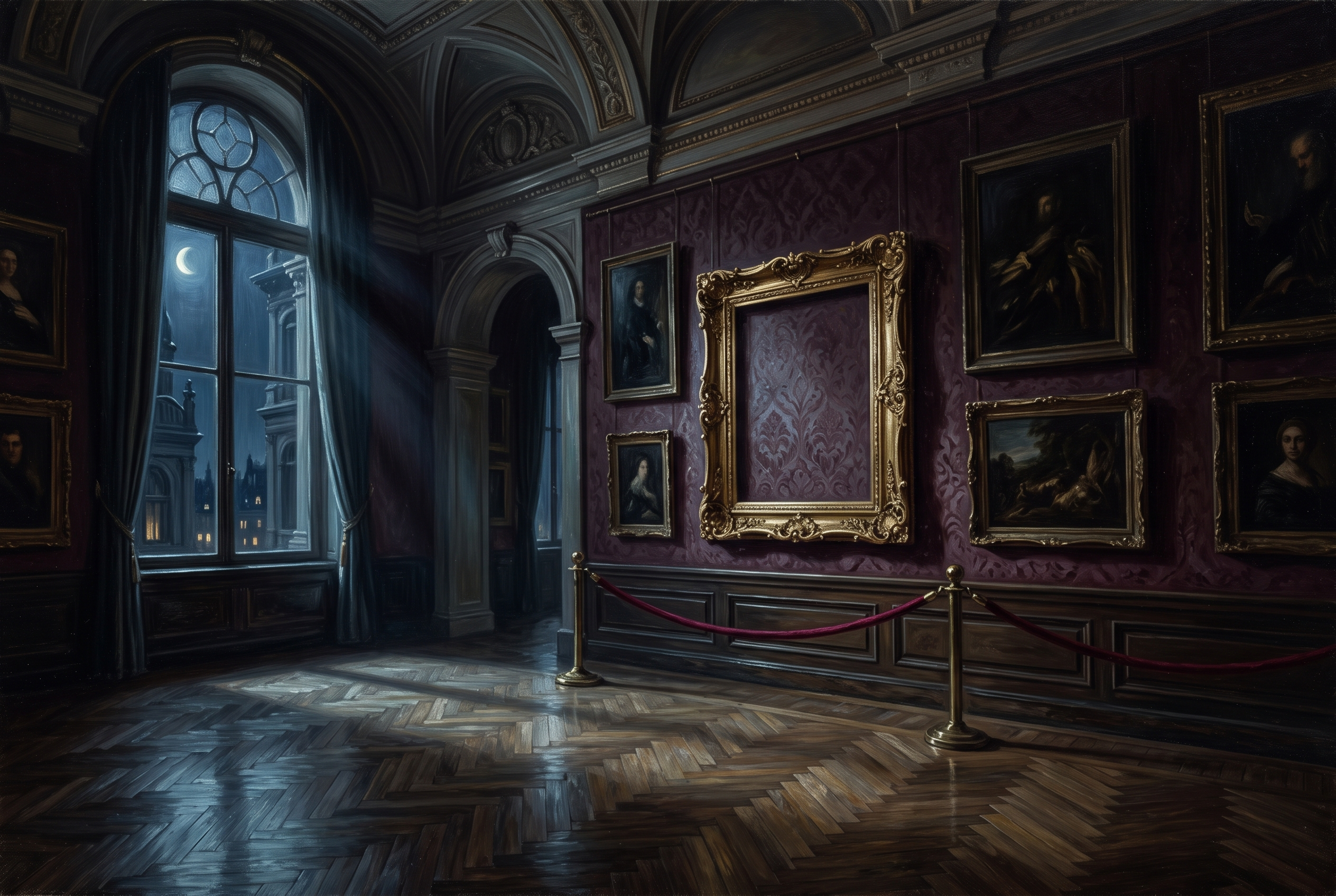
Nothing has been recovered. No one has been convicted of the theft. The FBI has publicly stated it believes the crime involved a criminal organisation in the north-eastern United States, and the museum maintains a standing reward for information leading to the return of the works. Because Isabella Stewart Gardner's will forbids changing the arrangement of her collection, the empty frames still hang in place, which is one of the most quietly devastating sights in any museum.
What it changed: it became the reference case for museum security failure, from the use of uniforms as social engineering to unmonitored night entry, and it pushed hard conversations about guard protocols, camera coverage and insurance across the sector.
1994 and 2004: two stolen Screams
Edvard Munch painted several versions of The Scream, and thieves have taken two of them.
In February 1994, on the opening day of the Winter Olympics in Lillehammer, thieves used a ladder to reach a window of the National Gallery in Oslo and removed a version of the painting in under a minute, reportedly leaving a note thanking the museum for its poor security. It was recovered later that year in a police operation.
Then in August 2004, in broad daylight, armed men walked into the Munch Museum in Oslo and took another version of The Scream along with Munch's Madonna, in front of visitors. Both works were recovered in 2006, with some damage that required conservation.
What it changed: after 2004 the Munch Museum overhauled its security substantially, and the case became a standard example of the difference between securing a building at night and securing it while it is open.
1907: the Irish Crown Jewels, an inside job with no ending
Not a painting, but too good to leave out. The regalia of the Order of St Patrick disappeared from Dublin Castle in 1907, shortly before a royal visit. They had been kept in a safe in an office to which the door key was, in effect, casually managed. The jewels have never been found and no one was prosecuted.
What it changed: it is a permanent lesson that the weakest point in any security system is procedural rather than mechanical.
2003: the Saliera, stolen through scaffolding
Benvenuto Cellini's gold salt cellar, sometimes called the Mona Lisa of sculpture, was taken from the Kunsthistorisches Museum in Vienna in 2003 by a thief who climbed scaffolding on the building's exterior. An alarm was triggered and treated as a false alarm. The piece was recovered in 2006 after the culprit was identified and eventually led investigators to where it had been buried in a forest.
What it changed: it made building works a recognised security risk in their own right, and it is the case museum staff cite when arguing that an alarm ignored is worse than no alarm at all.
What the pattern actually is
Put the cases side by side and the film-poster version falls apart.
| Year | Target | Outcome |
|---|---|---|
| 1911 | Mona Lisa, Louvre | Recovered 1913, painting became world famous |
| 1907 | Irish Crown Jewels, Dublin Castle | Never recovered, no prosecution |
| 1990 | Thirteen works, Gardner Museum, Boston | Unsolved, empty frames still displayed |
| 1994 | The Scream, National Gallery, Oslo | Recovered the same year |
| 2003 | Cellini Saliera, Vienna | Recovered 2006 |
| 2004 | The Scream and Madonna, Munch Museum | Recovered 2006 with damage |
Three things stand out. Thefts usually exploit routine rather than technology: a closed Monday, a night shift, scaffolding, a uniform. Famous works are hard to monetise, so they often end up used as leverage or simply hidden. And the cultural effect can invert the crime entirely, since fame is the one thing a theft reliably produces.
The response has been institutional. Museums now keep far more rigorous inventories with photographic documentation, stolen works are logged in international databases used by dealers and police, specialist art crime units exist in several national forces, and provenance checks before a sale are far more serious than they were a century ago. It is much harder to quietly launder a known painting today than it was in 1911.
Why the stories stick
A heist does what a wall label rarely manages: it makes you notice a specific object. You cannot really see Rembrandt's only seascape at the Gardner, and its absence probably makes more people think about it than its presence did. That is the same instinct behind our own approach, and MindSnap is our app so treat that as disclosure: every object in a museum has a story attached, and Rembrandt's own is told chapter by chapter in Rembrandt's Shadow, one of five flagship story collections that sit alongside unlimited topics you can generate yourself on the topics page.
If you want the counterpart to this piece, the case of a painting that never had to be stolen to become famous is The Night Watch, which has survived knife attacks, acid and a wall it was cut down to fit.
The empty frames at the Gardner are the most famous things in the building. They are also the point.
Frequently asked questions
One snap tomorrow morning.
Two minutes in art, history, psychology, philosophy or economics, then the app tells you you're done.
Get MindSnap on iOSFree daily fact, forever. Pro is $9.99/month or $44.99/year.