Why Is the Mona Lisa So Famous?

Arts & History Editor
Last updated: August 2026
8 min read
TL;DR
Leonardo's portrait was always respected by painters and connoisseurs, but it was not the most famous painting in the world until 1911, when a Louvre handyman named Vincenzo Peruggia walked out with it under his coat. For two years the public queued to see the empty space where it had hung. The newspapers did the rest, and fame, once established, compounds on itself.
On a Monday morning in August 1911, a painter setting up his easel in the Louvre's Salon Carré noticed four iron pegs on the wall and no picture on them. He assumed the photographers had it. By the following day, France understood that someone had stolen the Mona Lisa.
That theft is the single most useful fact for answering the question people ask in front of the painting today: why this one? The crowd, the barrier, the phones held overhead. Skill alone does not explain it, and the honest answer is a mixture of genuine artistic achievement and an accident of publicity.
Before the theft: admired, not adored
Leonardo painted the portrait, most likely of Lisa Gherardini, wife of the Florentine merchant Francesco del Giocondo, in the early 1500s. He never delivered it to the family. He carried it with him to France, where it entered the royal collection, which is why a Florentine portrait now hangs in Paris rather than Italy. After the Revolution the royal holdings became the Louvre's.
Through the nineteenth century the painting had a serious reputation among artists, critics and Romantic writers, who liked to describe the sitter as unsettling and unknowable. But it hung among other masterpieces without special protection, and a nineteenth-century guidebook would not have told you it was the reason to visit. Visitors came for the vast Italian and French canvases, not for a small dark portrait.
The technique that earns the respect
Strip the celebrity away and there is still a remarkable object. Leonardo built the face with sfumato, layer upon translucent layer of thinned paint, blended so that no edge announces itself. There are no visible outlines around the eyes or the mouth, only gradations of shadow, which is why the expression seems to shift as you move.
He also used aerial perspective, the trick of letting distance drain colour and detail so the background hazes into blue, and he set the sitter in a three-quarter pose with hands resting calmly in the foreground, a composition that portrait painters then copied for centuries. That handling of light and dark is a cousin of the technique I unpack in chiaroscuro, though Leonardo's version is softer and slower.
If you want to look at it properly rather than photograph it, the habits in how to read a painting apply here better than anywhere: start with the hands, not the smile.
1911: the two years it was missing
The thief was Vincenzo Peruggia, an Italian decorator who had worked at the museum and had helped fit protective glass to paintings. He hid overnight, took the picture from its frame in a stairwell on a Monday when the museum was closed to the public, and walked out with it wrapped up. It fitted under a coat because it is roughly the size of a large book cover.
The investigation was chaotic. The Louvre closed for a week. Guillaume Apollinaire was arrested and questioned, and he in turn implicated Pablo Picasso, who was also questioned before both were released. Officials were mocked in the press. Nobody thought to check on the former employee who had signed in at the museum.
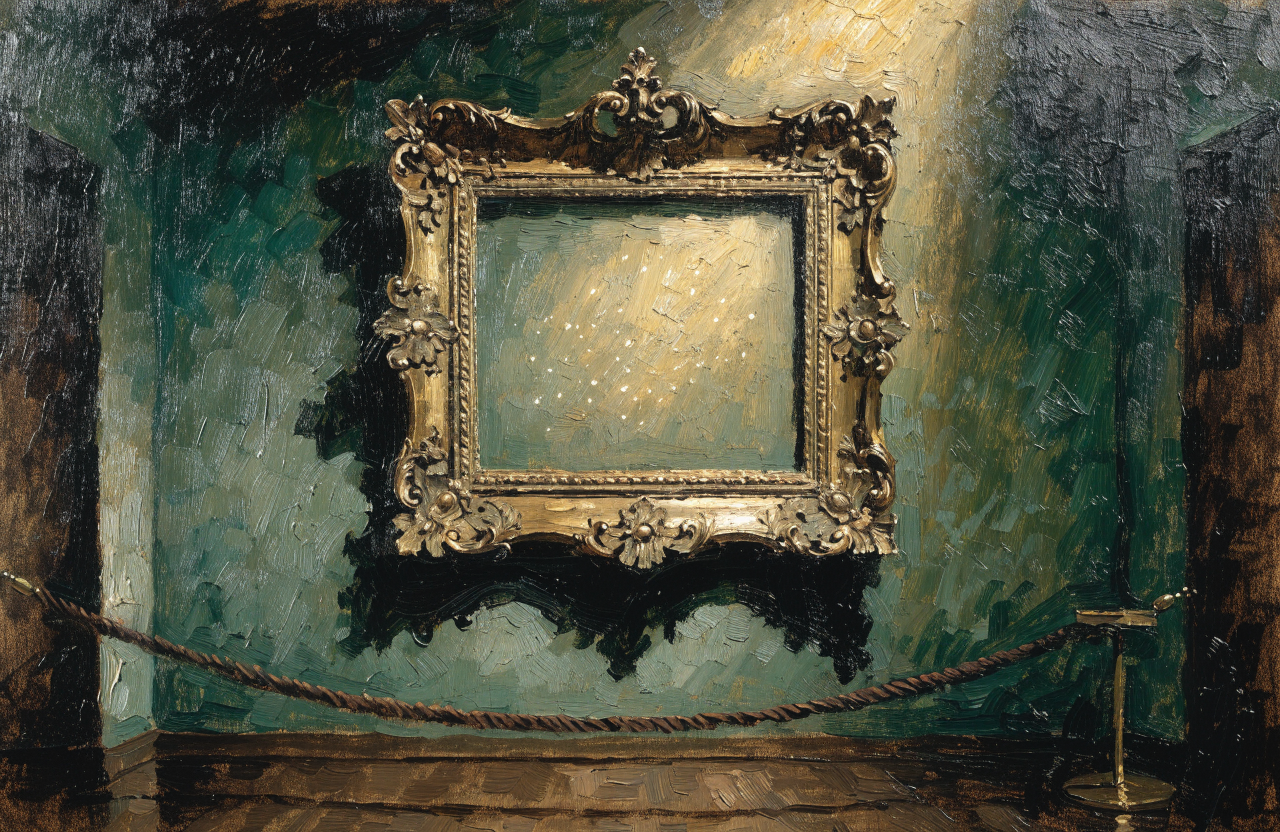
Then the strangest part. The Louvre exhibited the empty frame and the bare wall, and Parisians queued in numbers larger than the painting itself had drawn. People came to look at an absence, stood in front of four pegs, and left flowers. The story ran and ran because newspapers had recently become cheap, illustrated and national: this was one of the first art stories to be reproduced as a photograph on front pages across Europe and America.
Peruggia kept it in a trunk in his Paris lodgings for over two years, then took it to Florence in 1913 and tried to sell it to a dealer, claiming a patriotic motive of returning it to Italy. The dealer contacted the Uffizi, and Peruggia was arrested. He served a short sentence, and was treated by some Italians as a folk hero. The painting toured Italy to enormous crowds before going back to Paris.
How fame compounds
After 1913 the picture was no longer only a painting. It was the painting that had been stolen and recovered, which made it worth photographing, which made it recognisable, which made it worth writing about again.
- Marcel Duchamp's 1919 postcard defacement made it the obvious target for parody, and parody requires an image everyone already knows.
- Attacks and vandalism attempts through the twentieth century each generated another news cycle and another layer of protective glass.
- State visits and loans, including a heavily publicised trip to the United States in the 1960s, turned viewing it into an event.
- Advertising and reproduction did the rest. By the time mass tourism arrived, the painting was a checklist item, and checklist items draw crowds that draw more crowds.
This is why the room is so strange today. Most visitors are not deciding to look at a Leonardo, they are confirming an image they have known since childhood. The museum's own scale makes the imbalance sharper, as the numbers in Louvre facts suggest: thousands of works, and one queue.
What this says about how we look at art
The uncomfortable lesson is that attention is not distributed by quality. It is distributed by story. A painting with a theft attached beats an equally good painting with no anecdote, and once the gap opens it widens on its own.
The practical response is not cynicism about the Mona Lisa, which is genuinely superb, but a small act of stubbornness in any gallery: spend your best twenty minutes on the picture nobody is standing in front of. Reputation tells you where the crowd is, not where the looking is good. Our own app leans on the same instinct. MindSnap is our app, so treat that as disclosure, and our Rembrandt's Shadow collection is built around exactly this kind of biography-behind-the-canvas story rather than a list of famous names, which you can browse from the collections page.
For two years the most popular sight in Paris was an empty wall. Fame had detached from the object entirely.
Frequently asked questions
One snap tomorrow morning.
Two minutes in art, history, psychology, philosophy or economics, then the app tells you you're done.
Get MindSnap on iOSFree daily fact, forever. Pro is $9.99/month or $44.99/year.