Chiaroscuro Explained: How Rembrandt Painted With Darkness
Arts & History Editor
Last updated: August 2026
7 min read
TL;DR
Chiaroscuro is Italian for light and dark, and it describes the deliberate use of strong contrast between the two to give painted figures volume and drama. It began as a Renaissance problem of modelling form on a flat surface, hardened into theatre under Caravaggio, whose followers pushed it to the harsh spotlight effect known as tenebrism, and then travelled north into the Dutch Republic. Rembrandt is the artist most associated with it because he treated shadow as content rather than technique: he used darkness to decide where your eye went, how much you were allowed to know, and what a face was permitted to conceal. Once you know the four tricks he relied on, you can spot them in any gallery in about ten seconds.
Stand in front of a late Rembrandt and notice what you are not being shown. A hand dissolves into brown air. A collar catches light while the shoulder beneath it vanishes. Somewhere behind the sitter there is a wall, probably, though you could not swear to it in court.
This is not unfinished work and it is not the varnish. It is the point. Rembrandt is the great practitioner of chiaroscuro, and chiaroscuro is the art of deciding what to withhold.
What the word actually means
Chiaroscuro comes from the Italian chiaro, meaning light or clear, and scuro, meaning dark or obscure. In the strictest sense it names the treatment of light and shade in a picture, particularly when the contrast is strong enough to become an expressive device rather than a neutral description of a lit room.
It began as a technical problem. A panel is flat. A cheekbone is not. Renaissance painters worked out that if you graduate tone carefully from lit to shaded, the eye reconstructs a solid volume, and by the end of the fifteenth century that modelling had become sophisticated enough that figures appeared to occupy space rather than sit on a surface. Leonardo pushed the soft end of this, blurring transitions so that edges melt, a practice usually named separately as sfumato.
The word also has a narrower workshop meaning. A chiaroscuro drawing is one made on toned paper, where the artist works both downward into shadow with ink and upward into light with white heightening, using the paper itself as the middle tone. That is a useful thing to know in a print room, because it tells you the artist was thinking about light as a substance to be added rather than an absence to be left.
Caravaggio turns the lights off
The decisive shift comes around 1600 in Rome. Caravaggio takes the graduated modelling of his predecessors and replaces the gentle ambient light of the Renaissance with something closer to a single hard source in a dark room.
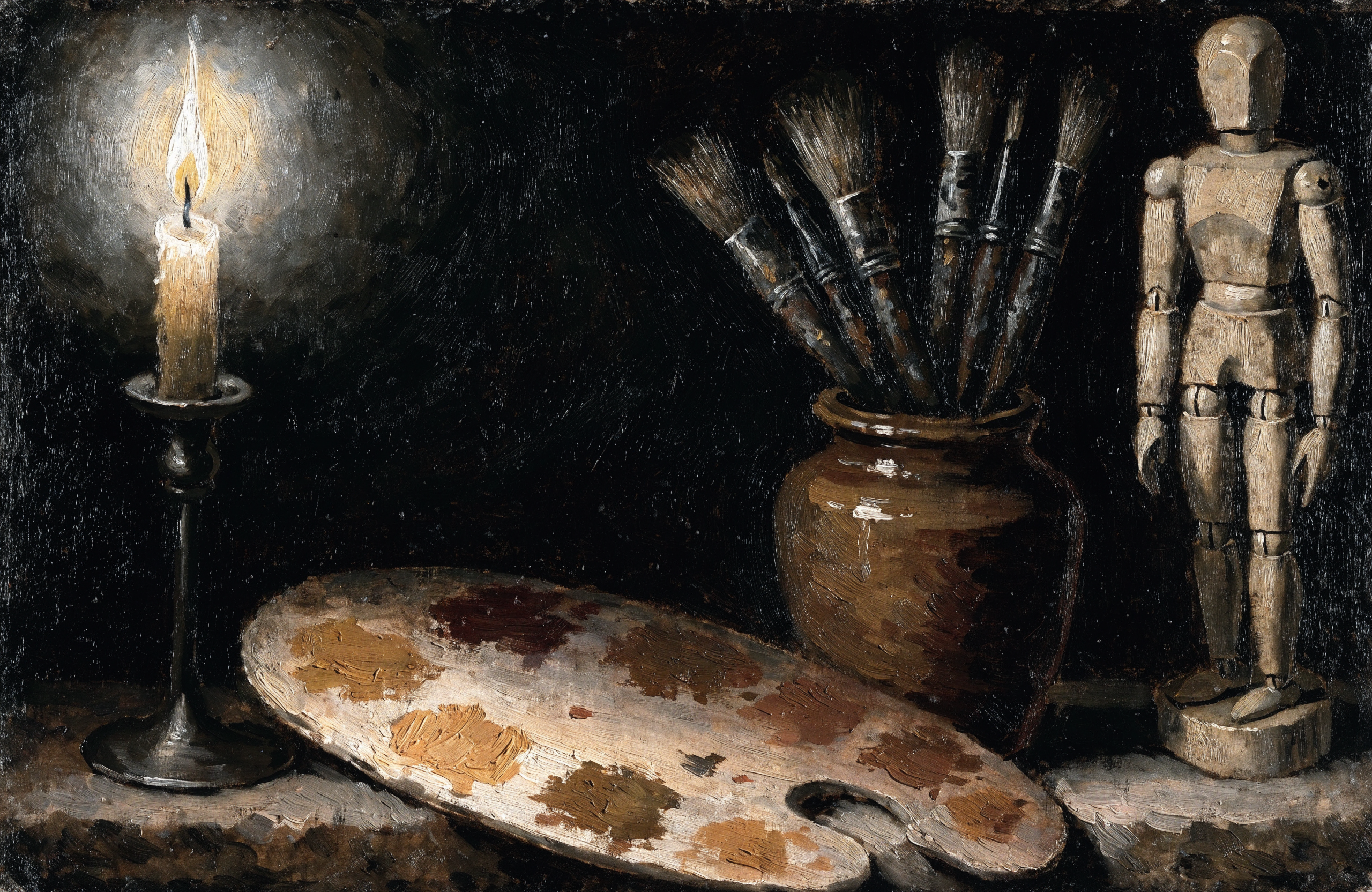
The result is theatrical in the literal sense: figures emerge from blackness as if caught in a stage light, the background gives you no architecture and no landscape to orient yourself, and the drama is concentrated entirely on a few illuminated hands and faces. Where earlier painters used shadow to describe form, Caravaggio used darkness to eliminate everything he did not want you looking at.
This extreme form acquired its own name, tenebrism, from the Italian for gloom. His imitators across Italy, Spain and the Netherlands took it up quickly, and one route north ran through the city of Utrecht, where painters who had studied in Rome brought the candlelit manner home with them. It was in the air of the young Dutch Republic by the time Rembrandt was learning to paint in Leiden.
The Republic was, at that moment, becoming the richest and most pictorially inventive society in Europe, with an art market unlike anything before it. If you want the wider setting, we sketched it in what was the Dutch Golden Age.
What Rembrandt did differently
Rembrandt inherited the vocabulary and then used it for a different purpose. Caravaggio's darkness is a stage. Rembrandt's darkness is a mind.
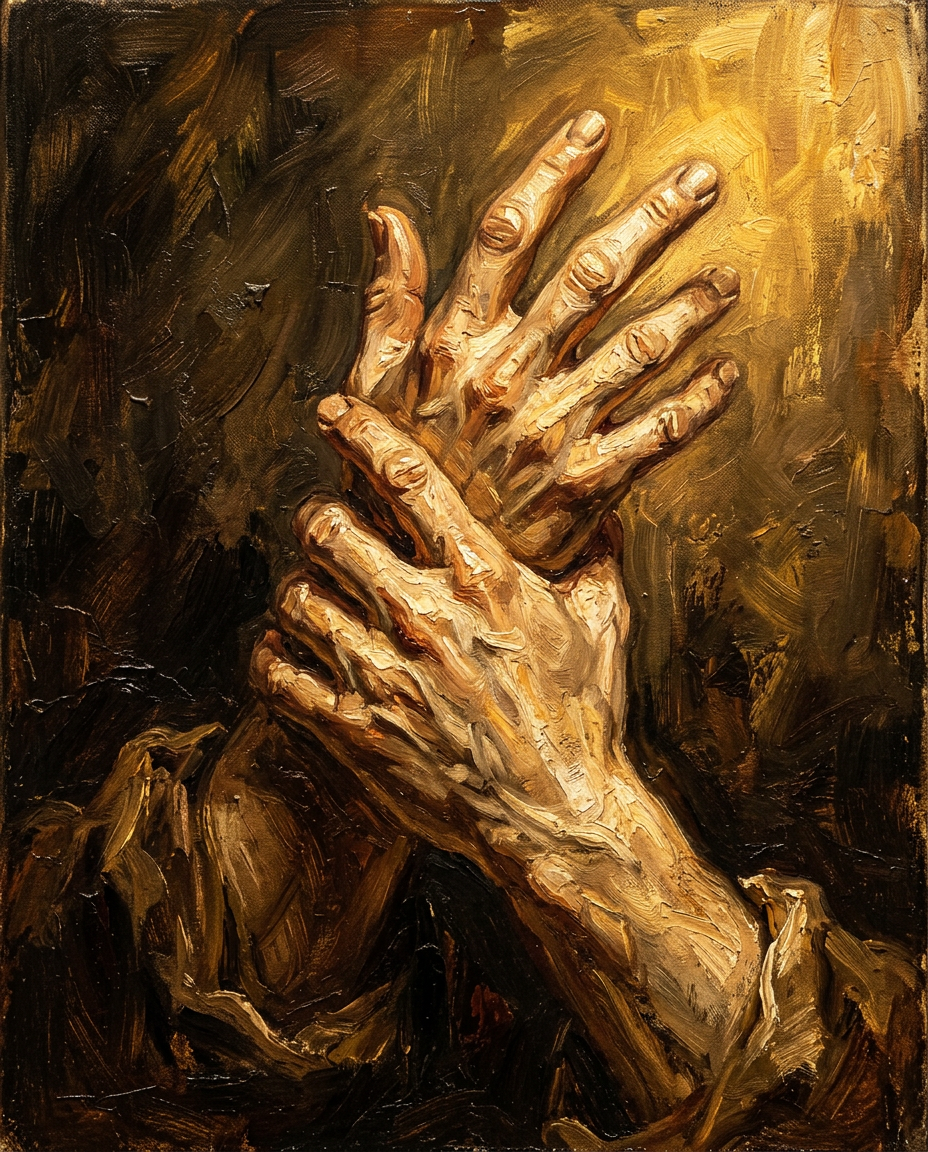
Three differences are worth watching for. First, his shadows are not black. Look closely and they are warm, full of transparent browns and reddish glazes with things half-alive inside them, so the eye keeps searching rather than stopping at a wall. Second, his light is rarely a single spotlight. It is often diffuse, seeming to come from within the picture, sometimes from an unclear source, which makes the illuminated area feel like attention rather than illumination. Third, he uses the boundary between the two as a narrative instrument: a figure may be half in light because we are being told that we understand half of them.
The late self-portraits are the clearest demonstration. The face is lit, the surroundings are gone, and the paint in the shadowed cheek is handled so loosely that it reads as thought rather than skin. We looked at why he kept returning to his own face in why did Rembrandt paint so many self-portraits.
And for the largest public example, the great civic group portrait in Amsterdam does something almost impertinent with the convention: instead of lighting every paying sitter equally, Rembrandt throws light onto a captain's gesture and a small girl in gold, and lets the rest of the company recede. We unpicked that decision in The Night Watch explained.
Four tricks to spot in any museum
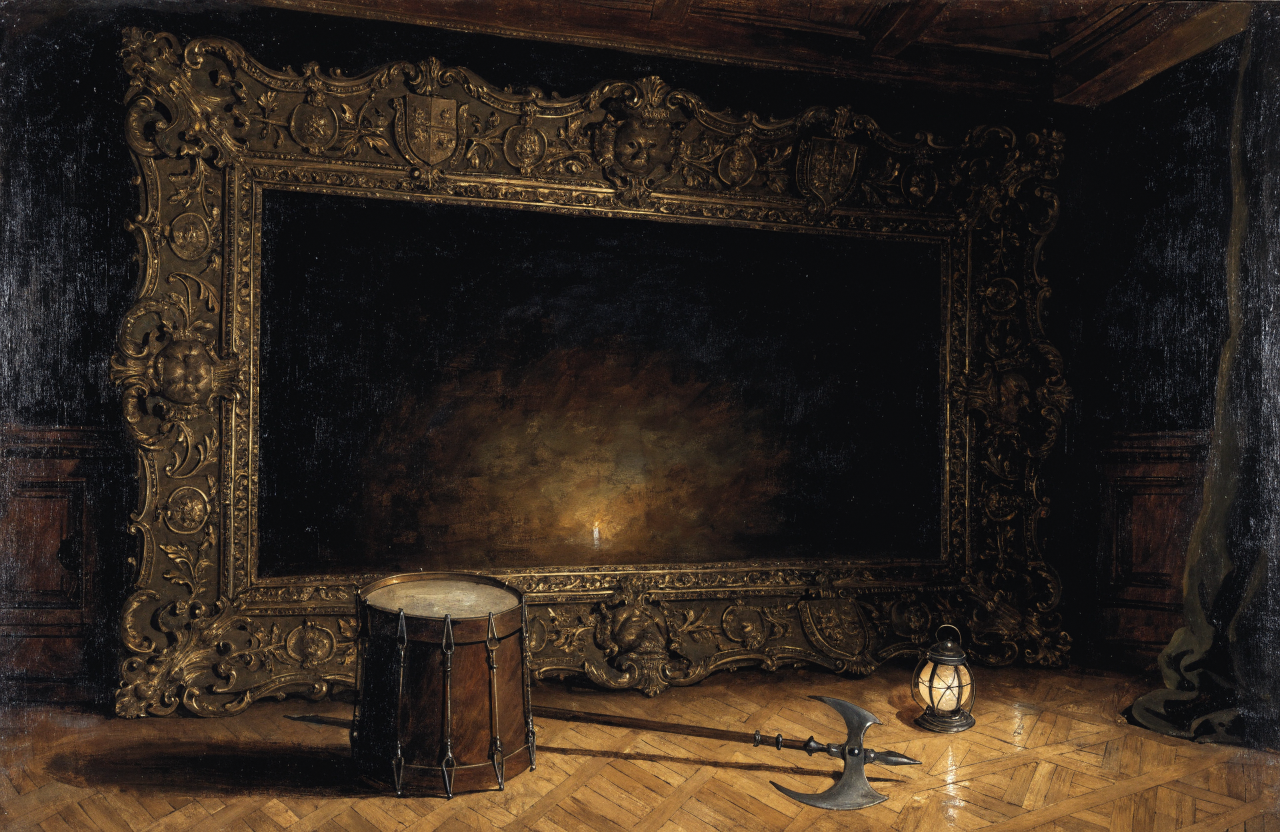
- 1Find the light source, then check whether it is possible. If the lit areas do not agree with any plausible window or candle, the artist is lighting for meaning rather than for physics, and you have found the intention.
- 2Look for the lost edge. Somewhere a contour will simply stop, dissolving into the background instead of being drawn. Painters use this to keep a figure from looking cut out, and to control how much of it registers.
- 3Check the reflected light in the shadow. In good chiaroscuro the shaded side of a face is not uniform: a faint bounce of light from a collar or a wall keeps it turning in space. Weak imitations flatten that side into one tone.
- 4Follow the brightest point. In a well-built picture there is exactly one, and it is almost always on whatever the painting is about. If the brightest thing is a sleeve, ask why the sleeve matters.
That last test is the fastest way to read intent in a gallery, and it works on photographs and film stills as well. Cinematographers still describe low-key lighting in essentially Caravaggist terms, and any thriller lit with a single hard source is quoting a Roman canvas from 1600 whether the director knows it or not.
Why it still works on us
Partly because our visual systems read strong tonal contrast as three-dimensional form before we consciously interpret anything, so a chiaroscuro face arrives with a sense of physical presence that flat lighting does not produce.
But mostly because withholding is compelling. A face half in shadow invites you to complete it, and completion is engagement. Rembrandt understood that a portrait which tells you everything has finished talking to you, whereas one that shows you a lit eye and a dark jaw keeps a question open. It is the same instinct that makes a good storyteller leave something out.
That is also the thread we follow in our multi-chapter story collection on his life and workshop, which spends a whole chapter on this technique and the rest on what it cost him: Rembrandt's Shadow. The financial reckoning behind that story is a separate matter, and a grim one, which we told in why did Rembrandt die poor.
If you would rather build the general skill first, how to read a painting gives you the wider set of questions to bring into a gallery.
Disclosure, since collections and lessons are mentioned above: MindSnap is our app. It runs short daily lessons and several flagship story collections, alongside unlimited topics beyond them, at $9.99 per month or $44.99 per year, with a free daily fact if you want to try the rhythm first.
Frequently asked questions
One snap tomorrow morning.
Two minutes in art, history, psychology, philosophy or economics, then the app tells you you're done.
Get MindSnap on iOSFree daily fact, forever. Pro is $9.99/month or $44.99/year.