The Memory Palace, Explained: How to Remember Almost Anything
Learning Science Writer
Last updated: August 2026
9 min read
TL;DR
A memory palace, or method of loci, stores information by placing vivid images along a route you already know, then walking that route to retrieve them. It works because spatial memory is unusually durable and because it forces you to turn dry facts into pictures. It is superb for ordered material such as lists, speeches and sequences, and mostly overkill for understanding ideas.
Every competitive memory record you have ever read about, the shuffled deck recalled in under thirty seconds, the hundreds of digits, the room full of strangers' names, rests on the same trick. Not talent. A building.
The technique is roughly two and a half thousand years old, and the surprising part is not that it works. It is how little effort it takes to get a usable result on your first attempt.
The story it comes from
The ancient account credits the poet Simonides of Ceos. He was performing at a banquet in Thessaly when he stepped outside, and the hall collapsed behind him, killing the guests inside and leaving the bodies unrecognisable. Asked to help identify them, Simonides found he could name every victim by recalling where each had been sitting.
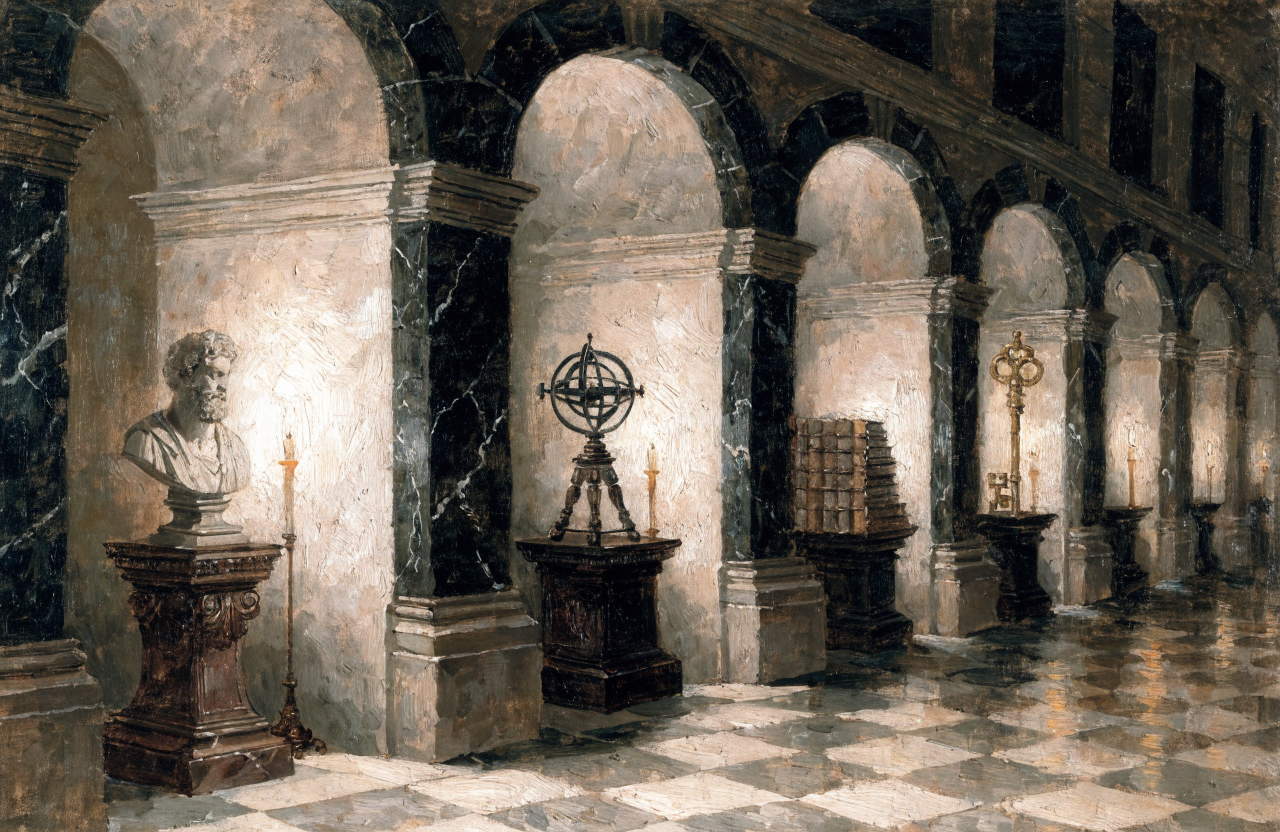
Whether or not the banquet happened as told, the moral was taken seriously. Roman orators built the observation into a working system: to remember a sequence of things, attach them to a sequence of places. Cicero describes it, and the anonymous Rhetorica ad Herennium turns it into instructions. Speakers used it to deliver hour-long arguments without notes.
Why place beats plain repetition
Human memory for space is old and generous. You can probably walk through your childhood home in your head right now, room by room, without ever having tried to memorise it. That map cost you nothing. Lists of facts, by contrast, are exactly the sort of thing memory drops fastest, as the forgetting curve shows unkindly.
A memory palace borrows the cheap structure to carry the expensive content. Two mechanisms do the lifting. First, distinctiveness: a bizarre image in a specific corner is far easier to find later than a line of text. Second, dual encoding, storing something as both a word and a picture so you have two routes to the same memory, which I have written about separately in dual coding.
There is a third, quieter reason. Order comes free. A route has a direction, so the items come back in sequence without any extra work, which is why the method is so dominant for speeches and ordered lists.
Building your first palace, in five steps
- 1Choose a route you know without thinking. Your flat from the front door to the bedroom, the walk from your desk to the coffee machine, your morning commute. Familiarity matters far more than grandeur, so do not invent a fictional castle on your first attempt.
- 2Fix ten stops along it, in a fixed order. Doormat, coat hook, kitchen sink, kettle, fridge, table, window, sofa, bookshelf, bed. Walk it mentally twice until the order feels automatic before you store anything in it.
- 3Turn each item you want to remember into one image. Concrete, exaggerated, slightly ridiculous. If you need to remember mitochondria, put a tiny power station humming in the sink. Abstract words need a hook: for justice, a set of scales tipping over.
- 4Place the image and interact with it. Do not simply set it down. Have it spill, screech, block your path, or smell wrong. The action is what makes the location sticky, and a passive image tends to evaporate within a day.
- 5Walk the route to retrieve, then walk it again tomorrow. The first walk proves it works. The second, after a gap, is what makes it last, which is the whole logic of spaced repetition.
Ten items is a deliberately small start. Most people who abandon the method do so because they built forty stops before testing whether ten worked.
Where it genuinely shines
- Ordered sequences: presidents, elements, the plot of a case, the steps of a procedure.
- Speeches and presentations, where you want structure without a script and the audience notices you reading.
- Vocabulary in a new language, where each word needs a vivid hook rather than a definition.
- Anything you must produce from memory under mild pressure, such as an exam list or a set of talking points.
Where it is overkill
The method stores. It does not explain. If you place five images for the causes of an economic crisis, you can recite five causes and still not understand how they interacted, which is a real risk when the material is conceptual rather than factual.
So skip the palace for anything whose value is comprehension: a mathematical proof, an argument you need to be able to defend, a mechanism you will have to reason with. For those, explaining the idea aloud in your own words does more in five minutes than an hour of image-building. Use the palace for the raw material, and understanding for the shape it forms.
One more honest limit: building images is slower than reading. For a shopping list, this is theatre. Reserve it for material you would be embarrassed to forget.
Common mistakes
- 1Reusing one palace for everything at once, so last month's images bleed into this week's. Keep a separate route per subject.
- 2Choosing polite images. Memory rewards the strange, so let them be loud and slightly absurd.
- 3Placing two items at one stop. It halves reliability and you will lose one of them.
- 4Never walking the route again. A palace is not a filing cabinet, it decays like anything else without a return visit.
Why place and story travel together
The method of loci is really a special case of a broader fact: we remember what is situated. A fact inside a scene, with a room and a person and a consequence, survives in a way that a bullet point does not, which is the argument in why your brain loves stories.
That is the principle our own app leans on. MindSnap is our app, so this is disclosure rather than a neutral recommendation: each daily lesson is anchored to a place and a moment rather than delivered as a list, and our Turning Points feature drops you inside a specific decision in a specific room, which is a memory palace someone else built for you. Useful, though it is no substitute for building one yourself when you need precision.
You have been carrying the shelves around for years. All the method does is put something on them.
Frequently asked questions
One snap tomorrow morning.
Two minutes in art, history, psychology, philosophy or economics, then the app tells you you're done.
Get MindSnap on iOSFree daily fact, forever. Pro is $9.99/month or $44.99/year.