How Salt Shaped Trade Routes and Empires

Learning Science Writer
Last updated: August 2026
8 min read
TL;DR
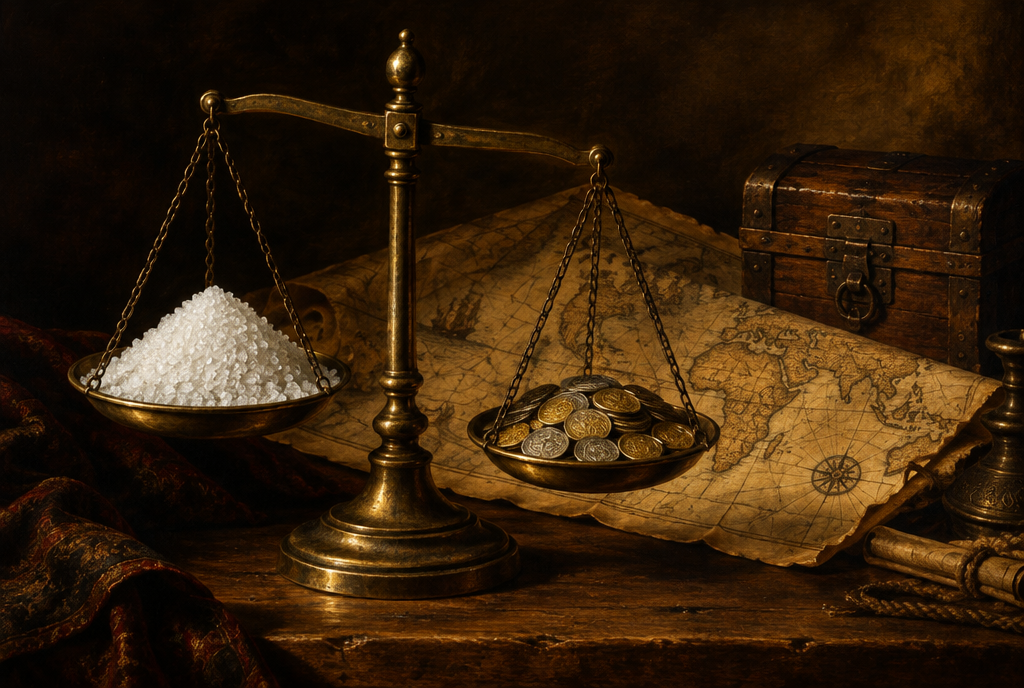
Salt looks trivial now because it costs almost nothing, which hides the fact that for most of recorded history it was a strategic resource. It was the only method of preserving food at scale before refrigeration, which meant it determined how far armies could march, how long cities could survive a bad harvest and whether fish caught in summer could be eaten in winter. Because usable deposits are unevenly distributed, salt created long distance trade: slabs mined at Taghaza in the Sahara moved south towards the gold fields, Venice built early wealth on distribution rather than production, and Salzburg's name says what paid for it. States taxed it heavily because demand is inelastic, which is also why salt taxes provoked resistance. Then refrigeration and industrial extraction dissolved the monopoly, and a commodity worth fighting over became a fifty cent staple. That arc, scarce essential plus controlled route equals power, then technology erases it, repeats across resources.
There is a shaker of it on every table and it costs less than the paper napkin beside it. That is a recent condition. For thousands of years salt was closer to a strategic mineral than a seasoning, and the reason has nothing to do with taste.
Why salt was a strategic resource
Humans need sodium to live, but the biological requirement is not what made salt valuable. The economic requirement did. Salt was the only preservation technology that worked at scale before mechanical refrigeration, and preservation is the difference between a food supply and a harvest.
Salting, brining and curing let a society move calories through time and space. Fish caught in a summer glut could feed a city in February. Pork slaughtered in autumn could last until spring. Butter, cheese, olives and vegetables could be stored rather than lost. Armies could carry rations for a campaign, and ships could cross oceans without their crews starving. Cod cured with salt underwrote Atlantic fishing economies for centuries.
Take salt away and every one of those capabilities collapses. That is what a strategic resource means: not that it is rare, but that too many other things depend on it.
The second half of the story is geography. Salt exists in enormous quantities but usable, concentrated deposits are unevenly placed: rock salt seams in a few mountain regions, coastal lagoons where evaporation works, desert pans, brine springs. Most inland populations sat far from any of them. An essential good with concentrated supply and universal demand is the precise recipe for long distance trade, and for whoever sits between the two ends.
Salt for gold across the Sahara
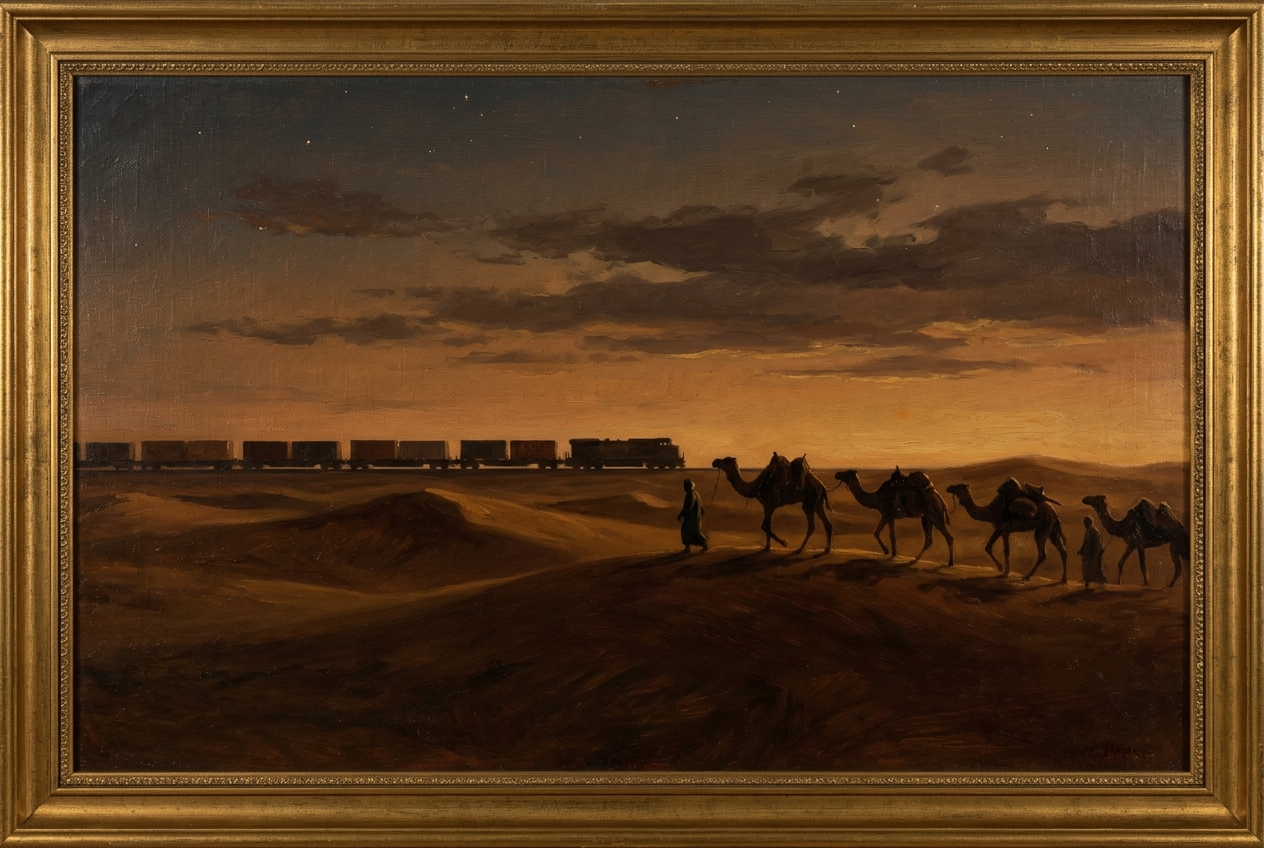
The clearest example is the trans-Saharan trade. West Africa had gold in abundance in the regions along the upper Niger, and very little accessible salt. The Sahara had salt: at Taghaza and later Taoudenni, workers cut it from the ground in slabs and loaded it onto camels.
Caravans carried those slabs south to market cities including Timbuktu and Djenné, where they met gold moving north. Both sides were trading a surplus for a scarcity, which is why the exchange was so durable. The frequently quoted claim that salt traded pound for pound with gold should be treated with caution. Rates varied hugely with distance, season and bargaining position, and the striking versions of the ratio tend to come from travellers rather than ledgers. What is not disputed is that salt was valuable enough to justify weeks of desert crossing.
The states that grew along those routes, Ghana, Mali and Songhai in succession, did not owe their power to owning either resource outright. They owed it to controlling the corridor and taxing what passed through. That is the standard shape of trade-route power, and it recurs in the Silk Road and modern trade and in the spice routes.
Roman roads and the salary myth
Rome took salt seriously enough to build for it. The Via Salaria, the salt road, ran inland from the Adriatic coast towards Rome, and the saltworks at Ostia were an early public asset. Roads built for a commodity tell you what the state considered essential.
This is where the famous claim appears: that Roman soldiers were paid in salt, and that salary derives from it. Flag this one as disputed. The Latin salarium does relate to sal, salt, and ancient writers gestured at a connection, but there is no good evidence that legionaries received wages in salt rather than coin. The likelier readings are an allowance connected to salt purchase or a term whose origin drifted. The phrase worth his salt carries the same folk etymology. Enjoy the story, do not cite it as fact.
The structural point survives the myth. A state that builds and garrisons a road for salt is treating it as infrastructure, not groceries.
Venice and Salzburg: wealth from a mineral
Venice is usually remembered for spices and eastern luxuries, but its earlier commercial base included salt from the lagoon and, more importantly, control over its distribution in the northern Adriatic and up into the Italian interior. The republic managed the trade deliberately, subsidising the movement of salt into Venice so that merchants arrived with cargo, which is a policy of building a hub rather than simply selling a product.
Salzburg is even plainer. The name means salt fortress, and the rock salt of the surrounding Alpine region funded the city's archbishops, their architecture and their political weight. Hallstatt nearby has salt mining evidence going back to prehistory, with the Iron Age culture named after the site.
In both cases the wealth came less from digging than from position: a chokepoint on a route, a monopoly right, a licence to move the essential thing.
Taxing the thing nobody can refuse
Governments noticed early that salt has an unusual economic property. Demand barely falls when the price rises, because there is no substitute and no way to stop eating. That inelasticity makes it an almost ideal tax base if a state cares only about revenue.
France built the most notorious version, the gabelle, a salt tax that persisted for centuries. It was administered unevenly across regions, with different rates and rules in different provinces, sometimes requiring households to buy a set quantity. The result was large scale smuggling, a dedicated enforcement apparatus, harsh penalties and enduring resentment, which is why the gabelle appears in the grievance literature of the late eighteenth century.
Salt monopolies were not unique to France. Various Chinese dynasties ran state salt administrations that supplied a substantial share of imperial revenue, and salt taxation appears in many other systems. The pattern is consistent: tax an unavoidable good and you get reliable money plus predictable resistance. For other examples of revenue schemes with side effects, see the strangest taxes in history.
How refrigeration ended the story
Nothing about salt changed. What changed was everything around it.
- Industrial extraction. Mechanised mining, vacuum evaporation and solution mining raised output enormously and cut the labour per tonne.
- Transport. Railways and steamships made moving heavy low value cargo cheap, which destroys the margin that long distance salt trading depended on.
- Refrigeration. Mechanical cooling, then domestic refrigerators, replaced salt as the primary way to keep food edible. Canning and later freezing did the same for other categories.
Salt remains industrially essential, used at very large volumes in chemical production, water treatment and winter road clearing. But it is no longer scarce in the way that creates power. No one taxes it for serious revenue, no one routes a caravan for it, and no city's standing depends on holding the road it travels.
The pattern to take away
Read as economics rather than trivia, salt gives a clean three step pattern. First, a scarce and genuinely essential good with concentrated supply. Second, whoever controls the deposits or, more often, the route between supply and demand accumulates wealth and political leverage, usually through tolls, monopoly rights and taxation. Third, a technological or logistical change makes the good abundant, and the structure built on scarcity dissolves without a war being fought over it.
That pattern is worth holding because it applies forward as easily as backward. Whenever you see a commodity described as strategic today, the useful questions are the same: how concentrated is supply, who controls the corridor, and what technology would make the monopoly irrelevant. Comparable dynamics show up in how the potato changed the world.
Disclosure since we are about to mention ourselves: MindSnap is our app. Its geopolitics and economics topics cover structural stories like this one in short daily lessons, alongside five flagship story collections plus unlimited topics you can follow. You can see the full range under topics.
Frequently asked questions

One snap tomorrow morning.
Two minutes in art, history, psychology, philosophy or economics, then the app tells you you're done.
Get MindSnap on iOSFree daily fact, forever. Pro is $9.99/month or $44.99/year.