The Strangest Taxes in History: Beards, Windows, and Cowardice

Curiosity Columnist
Last updated: August 2026
7 min read
TL;DR
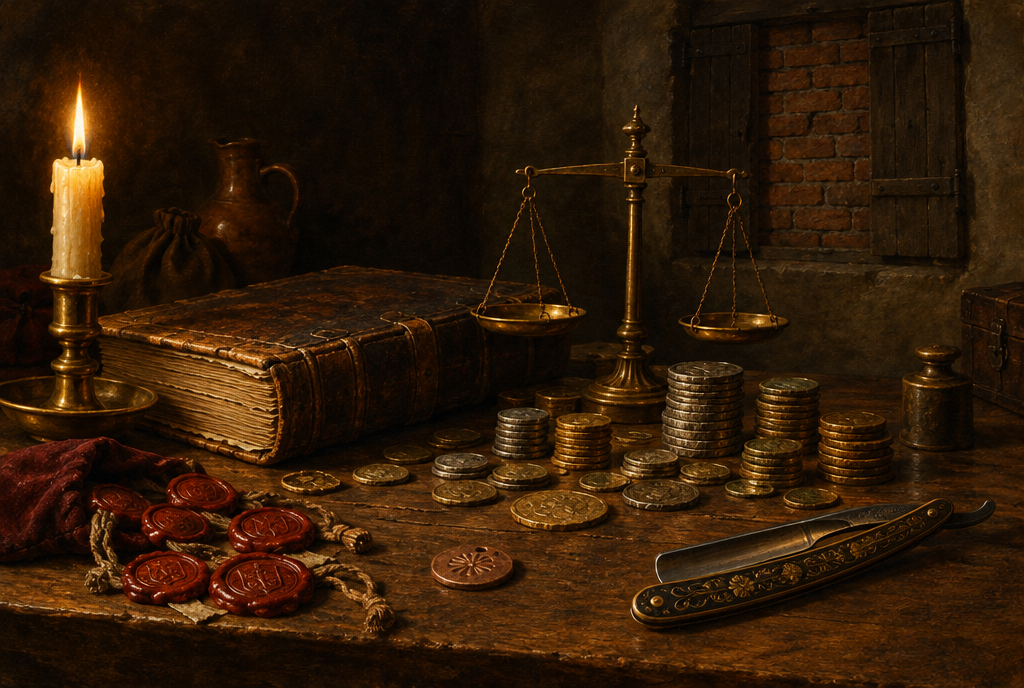
Strange taxes are usually not jokes. They are attempts to tax something visible and hard to hide, which is why governments have taxed beards, windows, hearths, candles and wallpaper. Peter the Great taxed beards and issued metal tokens as proof of payment. England's window tax led owners to brick up windows, and its earlier hearth tax required inspectors inside people's homes. Medieval English knights could pay scutage instead of turning up for military service, which acquired the nickname cowardice tax. Vespasian taxed the collection of urine from Roman public toilets and, according to Suetonius, told his son that money does not smell. In every case people adjusted their behaviour to reduce the bill, which is the real lesson: tax something and you get less of it, including things you wanted.
Every strange tax in history started as a reasonable conversation between people who needed money and could not see anyone's income. Before payroll records and bank transfers, the state's problem was not deciding who was rich. It was proving it. So officials looked for something visible, countable and difficult to hide, and then taxed that.
The results are often funny and always instructive, because taxing a proxy for wealth means people can change the proxy. Here are some of the best-documented examples, and what each one accidentally taught.
Peter the Great's beard tax
In 1698 Peter I of Russia returned from a long tour of western Europe convinced that his nobility looked archaic, and he began cutting off beards personally at court. The policy was then formalised: men who wished to keep a beard could pay for the privilege.
The rate varied by class, with wealthy merchants paying most and peasants paying a small amount, sometimes on entering a town. Payment came with a physical receipt, a metal beard token that could be carried and shown when challenged. Some surviving tokens carry an image of a beard and a moustache with a phrase indicating the tax was collected.
This was never mainly about revenue. It was cultural policy enforced through the purse, an attempt to make Russian elites look like the courts Peter had visited. The lesson: a tax is a statement about what a government wants less of, and everyone understands the statement immediately.
The window tax and the bricked-up house
England introduced a window tax in 1696 under William III, and it lasted, with changes, until 1851. The logic was straightforward and rather elegant. Income was invisible, but houses were not, and bigger houses had more windows. Count the windows from the street and you have a rough measure of wealth that requires no cooperation from the owner at all.
Homeowners solved the problem in the most direct way available. They bricked up windows. You can still see the evidence across Britain and Ireland: blank rectangles of brick set into older facades, sometimes painted to look like glass. Builders of new houses simply designed fewer openings, and landlords of tenement buildings had particular incentive to reduce the count in properties they did not live in.
Critics eventually argued that the tax was a levy on light and air, with consequences for health in crowded housing, and it was repealed. The lesson: tax a visible thing and people will make the thing less visible, even at real cost to themselves.
The hearth tax and the inspector at the door
Before windows, England tried hearths. From 1662 a tax was charged on each fireplace in a dwelling, on the same reasoning: larger and wealthier households had more hearths.
The flaw was administrative. Hearths are inside. Assessment therefore required officials, known as chimney men, to enter homes and count, which was resented far more than being counted from the pavement. The tax was repealed in 1689, and the window tax that followed was in part a fix for exactly that problem: an assessor could stand in the road.
There is an unexpected gift in this story. Hearth tax returns list households across the country, and they are now among the most valuable sources historians have for the size and distribution of English households in the seventeenth century. Tax records outlive the taxes.
Scutage, the so-called cowardice tax
Under the medieval English feudal system, a knight who held land from the crown owed military service. In practice, kings often preferred money. Scutage, from the Latin for shield, was a payment made instead of serving in person, allowing the crown to hire professional soldiers with the proceeds.
The arrangement suited both sides. A landholder with an estate to run, or no appetite for a campaign in France, could pay. The king got cash, which is more flexible than a reluctant knight. The nickname cowardice tax came later and is unfair to most of the people who paid it, since paying scutage was a normal and legal option rather than a confession.
The complaints in the historical record are mostly about how often and how heavily it was levied. Disputes over scutage and similar exactions were part of the baronial grievances that produced Magna Carta in 1215, which means a tax on not fighting sits in the background of one of the most consequential documents in English constitutional history. For more on institutions built around obligation and payment, see how medieval guilds worked.
Rome's urine tax and a famous line
Roman fullers, who cleaned and treated cloth, used urine as a source of ammonia. Public toilets were therefore a supply of industrial raw material, and collectors gathered from them.
The emperor Vespasian, who came to power in 69 CE facing serious fiscal problems, taxed that collection. According to Suetonius, his son Titus objected that the levy was beneath the dignity of the state. Vespasian is said to have held up a coin from the proceeds and asked whether it smelled, and when Titus said no, replied that it came from urine. The phrase pecunia non olet, money does not smell, comes from this exchange, and Vespasian's name survives in some European words for public urinals.
The lesson is the one every treasury eventually accepts: a state under fiscal pressure will tax whatever has a market, dignity included.
Candles, wallpaper and other taxed comforts
Britain in the eighteenth century taxed an extraordinary range of ordinary goods, because ordinary goods were where the money was.
- Candles were taxed, and unlicensed home candle-making was restricted, which meant that cheap artificial light was a taxed comfort at precisely the point in history when reading in the evening was spreading.
- Printed wallpaper was taxed, so decorators bought plain paper and applied patterns by hand or with stencils on the wall, which is a workaround that leaves visible traces in surviving interiors.
- Bricks were taxed by number, so manufacturers made larger bricks. The government responded by taxing large bricks at a higher rate, which is one of the neatest documented examples of a tax and a workaround chasing each other.
- Playing cards and dice were taxed, with the ace of spades carrying the duty stamp, which is why that card became the elaborately decorated one in English packs.
- Hair powder, worn by fashionable men and their servants, was taxed in 1795, and the fashion collapsed shortly afterwards.
Each of these behaved exactly as economists would now predict. The taxed form of a good became less common and an untaxed substitute appeared, sometimes uglier, sometimes larger, occasionally better. For more on how everyday objects carry economic history, see the economics of everyday things and the strange origins of everyday measurements.
What strange taxes teach
Three things, and they are all still relevant.
First, taxes are written for the information a state actually has. Windows, hearths and beards were taxed because they could be counted from outside a household's accounts. Modern income tax is only possible because of paperwork that did not exist in 1696.
Second, people respond, and they respond faster than the law can be rewritten. Bricking up a window is a worse house in exchange for a smaller bill, and thousands of people took that trade. Any policy that assumes behaviour will stay still is planning for a world that will not arrive.
Third, the unintended consequence is often the real story. A tax on printed wallpaper produced hand-stencilled walls. A tax on bricks produced bigger bricks. A tax on hearths produced a national household census that historians still mine. Policy shapes behaviour in ways nobody wrote down in the original bill, which is a good reason to read old laws for what people did next rather than only for what was intended.
If you like this sort of thing, it is more or less the daily diet at MindSnap, which is our app: two minute pieces on how the world got the shape it has, five flagship story collections plus unlimited topics you can request, and a free daily fact if you just want a curiosity with your coffee. Browse topics to see the range, or try Turning Points, where you stand at a real historical decision and choose. And for another angle on how economic change rewrites ordinary life, read jobs that no longer exist.
Frequently asked questions
One snap tomorrow morning.
Two minutes in art, history, psychology, philosophy or economics, then the app tells you you're done.
Get MindSnap on iOSFree daily fact, forever. Pro is $9.99/month or $44.99/year.