How Medieval Guilds Worked: Apprentices, Masterpieces, and Trade Secrets

Arts & History Editor
Last updated: August 2026
8 min read
TL;DR
A medieval guild controlled who could practise a craft in a town, and it ran a three-stage ladder: apprentice, journeyman, master. To be admitted as a master you submitted a masterwork, which is where the word masterpiece comes from. Guilds set standards, prices and membership, funded funerals and widows, and lost their grip once markets, rural production and industry grew past the town wall.
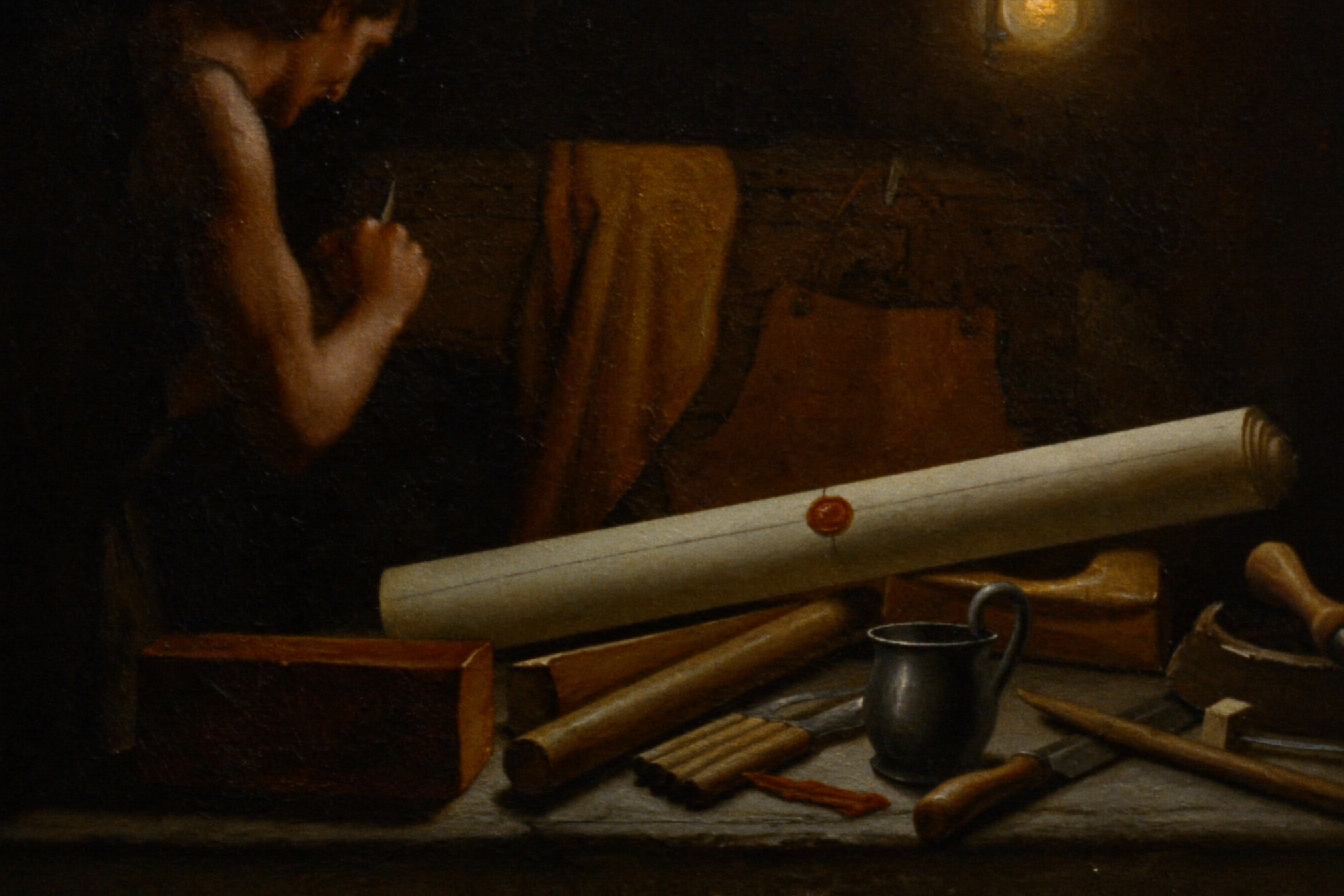
Picture a boy of twelve handed over to a goldsmith in Nuremberg, with a contract his father signed and cannot easily undo. For the next seven years he sleeps in the workshop, eats at the master's table, sweeps, grinds, fetches, watches, and is not paid. If he survives it and satisfies the men who judge him, he will one day sign his own work. That ladder, dull and rigid and occasionally brutal, produced most of the objects we now put behind glass.
What a guild was for
A guild was an association of the practitioners of one craft in one town, holding a legal privilege from the town or the crown: within these walls, only our members may make and sell this thing. Everything else the guild did followed from defending and using that privilege.
That meant setting what counted as acceptable work, controlling how many people could enter the trade, agreeing prices and often wages, inspecting workshops, punishing members who cheated, and speaking for the craft in town politics. In many cities the guilds were the town politics, filling council seats and marching as organised blocks in processions with their own banners, saints and chapels.
It is easy to read all this as either a charming brotherhood or a naked cartel. It was both, and members would not have seen a contradiction. A trade that protected its standards protected its price, and a trade that protected its price could feed its members' families.
Apprentice
Apprenticeship began young, commonly in the early teens, and ran for several years, with seven a frequent figure and the exact term varying by craft and city. A contract bound the parties: the parents often paid a fee, the master supplied food, lodging, clothing and instruction, and the apprentice supplied labour and obedience.
The teaching was almost entirely imitation. Nobody handed over a manual, partly because literacy was uneven and mostly because the knowledge was in the hands: how the metal sounded when it was ready, how the glaze looked a moment before it was too late. Guild secrecy was not paranoia in these conditions, since the technique genuinely lived in bodies and workshops rather than in text, and a craft that let it walk out of town lost the only asset it had.
Records also show the ordinary human failure rate. Apprentices absented themselves, masters were fined for beating them or for teaching nothing, and disputes went to the guild and sometimes the courts. This was a labour relationship, not a fable.
Journeyman
Finishing an apprenticeship made you a journeyman, a qualified worker who could be paid a wage but could not yet keep a shop, take apprentices, or sell under his own name. The word comes from the French journée, a day, in the sense of day-work rather than travelling, though travel was often part of the stage.
In several German crafts the journeyman years were formalised into the Wanderjahre, a period of moving between towns and workshops before applying for mastership. This was a technology-transfer system in disguise. A journeyman carried methods from one town to another, which is one reason regional styles spread across long distances without anyone publishing anything.
Many men never left this stage. Mastership required capital for tools and premises, a vacancy the guild would tolerate, and frequently the goodwill of existing masters, and as the centuries advanced guilds narrowed the gate further, favouring masters' sons and widows' husbands. A permanent class of skilled wage workers is the result, and it is one of the quiet reasons the system eventually lost its legitimacy.
Master, and the masterpiece
To be admitted as a master you generally had to submit a piece of work made to the guild's specification and judged by its officers. The German term Meisterstück and its equivalents elsewhere name exactly this: the qualifying object. Our word masterpiece descends from that examination, so its modern sense of a supreme achievement is a promotion from something much more bureaucratic. It originally meant the piece that got you your licence.
A master could open a workshop, put his mark on his output, take apprentices, sell directly, and vote in guild affairs. The mark matters more than it sounds. Hallmarks and stamps on metalwork exist because a guild wanted to know whose fault a bad piece was, which makes them one of the earliest working systems of consumer protection.
Safety net and civic power
Guilds also functioned as mutual insurance in a world without any. Dues funded support for sick members, pensions of a sort for the old, dowries and relief for widows, and a decent funeral with the whole craft attending. Membership was an identity as much as an occupation, complete with a patron saint and a place in the town's ritual calendar.
That collective muscle had political weight. Guilds bargained with lords and bishops, occasionally rioted, and in some cities effectively governed. When plague emptied the workshops in the fourteenth century, the resulting scarcity of skilled hands shifted the balance sharply toward labour for a generation, a shift we trace in our piece on how the Black Death changed Europe.
Why guilds faded
Nothing dramatic killed them. Their privilege was local, and the economy stopped being local. Merchants who wanted cheaper cloth put out work to rural weavers beyond the guild's jurisdiction. Long-distance trading networks, of the kind described in our note on the Hanseatic League, organised capital and shipping at a scale no single town's craft could regulate. Rulers keen on revenue and output grew impatient with restrictions on who could work.
Then machinery and factories broke the link between skill and production. If a machine and an unskilled operator could make the object, the seven-year ladder had nothing to defend. Legally the guilds were dismantled at different dates in different places, in France during the Revolution, elsewhere across the nineteenth century, but the substance had drained out first.
Their descendants are still visible. Professional licensing, trade certification, hallmarks and appellations, and modern apprenticeships all rest on the same bargain: restrict entry, guarantee quality, and let the guarantee carry a price. For the wider medieval picture, and the stereotypes worth discarding, start with middle ages myths.
Where to go deeper
The end of this world is the subject of one of our flagship story collections, The Day the Middle Ages Ended, which follows 1453 and what it set in motion. MindSnap, which is our app, tells that kind of history in one 2-minute lesson a day with a quiz at the end, across five flagship collections plus unlimited topics, at $9.99 per month or $44.99 per year with a free daily fact. If you would rather stand inside a decision than read about it, the Turning Points scenarios do that.
Keep reading
Frequently asked questions
One snap tomorrow morning.
Two minutes in art, history, psychology, philosophy or economics, then the app tells you you're done.
Get MindSnap on iOSFree daily fact, forever. Pro is $9.99/month or $44.99/year.