How the Humble Potato Changed the World

Curiosity Columnist
Last updated: August 2026
7 min read
TL;DR
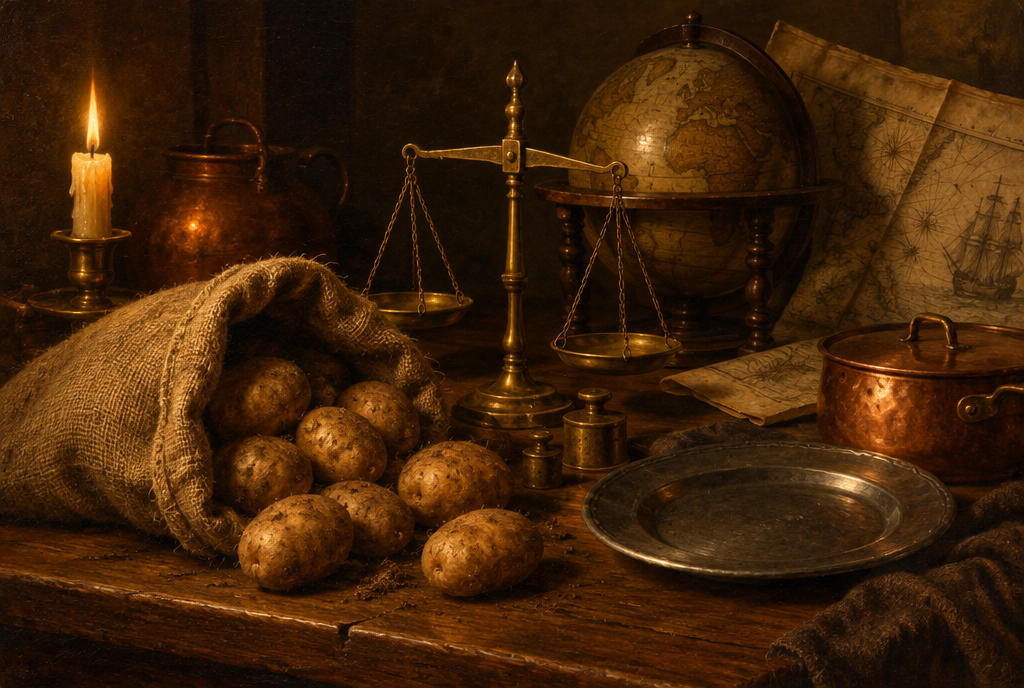
The potato was domesticated in the Andes thousands of years ago, where farmers developed an enormous range of varieties suited to different altitudes and soils. Spanish ships carried it to Europe in the sixteenth century, where it was distrusted for two hundred years: it grew underground, it was unmentioned in the Bible, and it was blamed for illness. Rulers and campaigners including Frederick the Great and the French pharmacist Antoine Parmentier pushed it with a mix of pressure and clever publicity. Once accepted, its calories per acre and reliability supported population growth and freed labour for towns. The Irish famine of the 1840s then showed the cost of depending on a narrow genetic base.
Here is a strange fact to hold in your head. For roughly two hundred years after Europeans first saw a potato, most Europeans refused to eat one. They fed them to pigs. They suspected them of causing leprosy. In some places they were grown only in botanical gardens as curiosities.
Today the potato is one of the most widely grown food crops on the planet, eaten on every continent where people cook. The path between those two states involves an Andean farming tradition of extraordinary sophistication, a king with a hard problem, and a pharmacist with a gift for publicity.
It started in the Andes
The potato was domesticated in the high Andes of South America, in the region around modern Peru and Bolivia, thousands of years before it reached Europe. Andean farmers were not growing one crop but a whole spectrum of them: thousands of varieties, in colours from cream to deep purple, selected for particular altitudes, frost tolerance, soil types and cooking uses. That diversity is still alive in Andean seed collections, and it turns out to matter enormously later in this story.
The Andes also gave the world a brilliant preservation technique. By exposing tubers to freezing nights and warm days, then treading out the moisture, farmers produced chuno, a freeze dried potato that stores for years. A crop that keeps for years is not just food. It is insurance against a bad harvest, and it can feed armies and mining camps far from where it grew.
Europe says no thank you
Spanish ships brought potatoes back across the Atlantic in the later sixteenth century, as one strand of the vast biological swap historians call the Columbian Exchange: maize, tomatoes, chilli peppers, cacao and potatoes travelling east, wheat, sugar, horses and cattle travelling west.
Most of those newcomers were accepted faster than the potato. The resistance had a logic to it, even if the logic was wrong.
- It grew underground and produced no grain, which made it look unlike proper food to societies organised around bread.
- It appears nowhere in the Bible or in classical authorities, which for early modern Europe was a genuine argument against it.
- It belongs to the nightshade family, whose leaves and green tubers really are toxic, so early bad experiences reinforced suspicion.
- It was blamed for illnesses including leprosy, and rumours of that kind travelled faster than agricultural advice.
- It was associated with poverty and with animal feed, and food carries status as much as calories.
The result was two centuries of a crop sitting almost unused in a continent that repeatedly went hungry.
The publicity campaign
What changed was not persuasion by argument but a mixture of state pressure and showmanship.
Frederick the Great of Prussia is the most cited example. He wanted a crop that would keep his population fed through poor grain years and through wars fought across his fields, and he pushed potato cultivation hard with orders, free seed tubers and instructions. Peasants were unenthusiastic. The much repeated anecdote that he posted guards over a royal potato field to make the crop look valuable enough to steal is a good story and probably a legend, but the underlying campaign was real, and the association stuck so firmly that visitors still leave potatoes at his grave.
France produced the better documented publicist. Antoine Augustin Parmentier, an army pharmacist who had eaten potatoes as a prisoner of war and noticed that they had not harmed him, spent years campaigning for the crop. His methods were unashamedly promotional: hosting dinners of potato dishes for fashionable guests, presenting potato flowers to the king and queen, and understanding that what the potato needed was not nutritional data but glamour. French dishes still carry his name.
Behind both campaigns lay hard state interest. Grain fields can be burned or requisitioned by an army. Potatoes sit in the ground, hard to see and hard to steal in bulk, and they yield a great many calories from a small plot. A ruler who could feed a population through a bad year had fewer riots and more soldiers.
Why the numbers worked
Once adopted, the potato changed the arithmetic of European farming.
Per acre, potatoes produce substantially more food energy than the grain crops they were planted alongside, and they will grow in cool, damp, poor soils where wheat struggles. They need no milling, no baking and no bakery, which removes cost and infrastructure from the chain between field and dinner. With milk or a little dairy alongside, a potato based diet is nutritionally decent, including vitamin C, which is why potato eating regions saw less scurvy than you might expect.
Historians argue about how much credit the potato deserves, and sensible ones avoid single cause explanations. But the broad view is that potatoes contributed significantly to European population growth from the later eighteenth century, and that a more secure food supply on smaller plots freed labour to leave the countryside for towns and workshops. A crop that lets fewer farmers feed more people is a precondition for urban industry, and it arrived in the same decades that industry did.
The potato also travelled as commerce, moving along the same trade networks that carried other new goods and habits into European life. The pattern of a foreign product becoming an everyday necessity is the same one visible in the spice routes and in how coffeehouses changed Europe.
The dark lesson
Then the arithmetic turned. By the 1840s a very large share of Ireland's population depended on potatoes for the bulk of its calories, and the varieties grown were genetically narrow: a handful of types, propagated from tubers rather than seed, planted across enormous areas.
When the water mould known as potato blight arrived, that uniformity meant there was nothing in the fields with any resistance. Crops rotted in the ground across successive seasons. The famine that followed killed around a million people and drove roughly a million more to emigrate, permanently reshaping Ireland's population and spreading an Irish diaspora across the English speaking world. The disaster was worsened by land tenure, by exports continuing during hunger and by the inadequacy of the relief response, which is why historians treat it as a political catastrophe as well as a biological one.
The agricultural lesson is blunt and still current. A crop is fragile in proportion to how similar its plants are to each other. The Andes, where potato diversity is measured in thousands of varieties, had built a buffer over millennia. Europe imported the crop and left the buffer behind.
The potato now
Today potatoes are grown almost everywhere, and the largest producers include China and India, which would have surprised every eighteenth century campaigner who thought of this as a European rescue crop. Breeders draw on Andean genetic material to improve disease resistance, which means the varieties in the ground now owe a direct debt to farmers working at altitude thousands of years ago.
It is a good story to keep in your pocket, because it contains almost everything at once: migration of plants, the stubbornness of food culture, the difference between a fact and a fashion, and the risk hidden inside a very good solution. That last shape, the sensible decision that carries its own danger, is what our Turning Points scenarios are built from, and there are plenty more small histories like this one across topics. MindSnap is our own app, so treat that as a recommendation with an interest declared.
Frequently asked questions
One snap tomorrow morning.
Two minutes in art, history, psychology, philosophy or economics, then the app tells you you're done.
Get MindSnap on iOSFree daily fact, forever. Pro is $9.99/month or $44.99/year.