The Dutch East India Company: How the First Multinational Worked

Arts & History Editor
Last updated: August 2026
9 min read
TL;DR
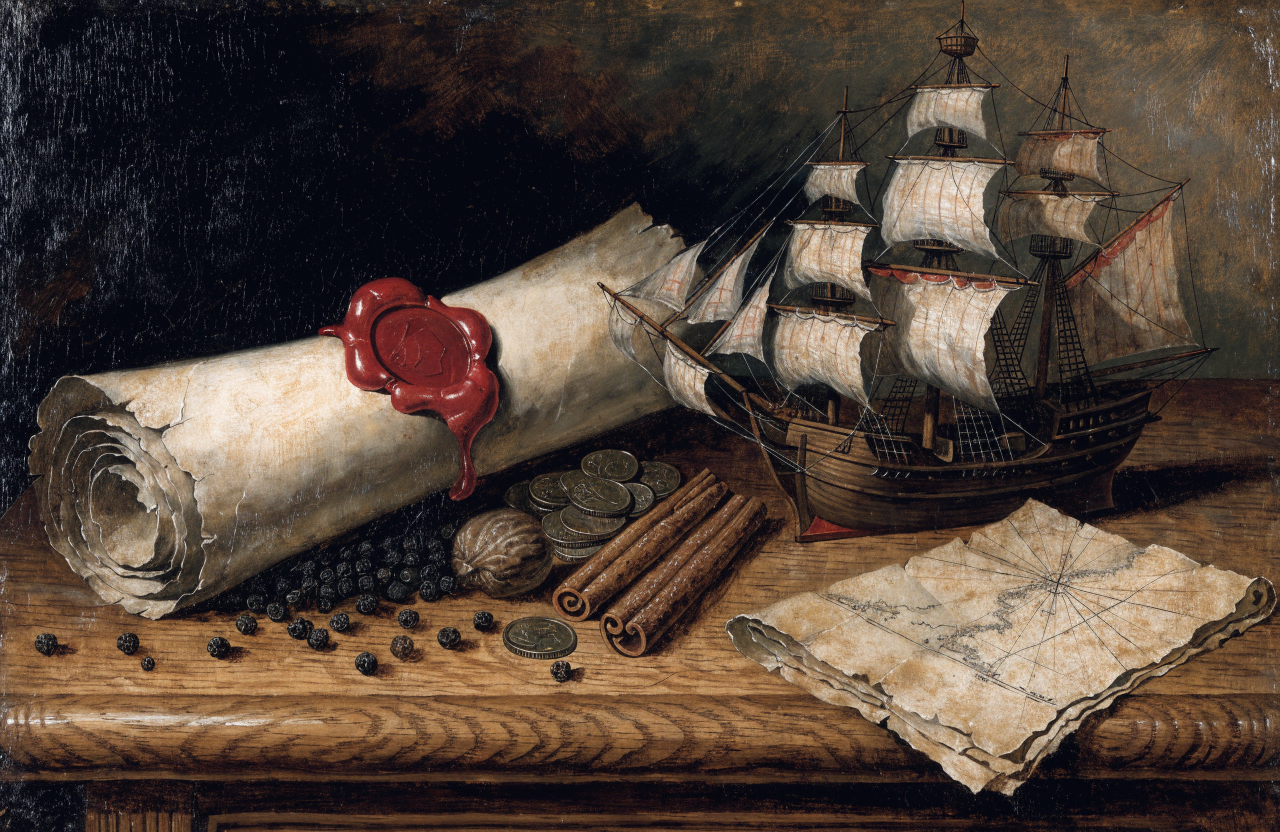
The Dutch East India Company, the VOC, was chartered in 1602 and became the first company whose shares ordinary people could buy and sell on an open exchange. Pooled capital and tradeable shares let a small republic fund enormous, risky voyages. The same charter also gave it powers usually reserved for states: forts, fleets, treaties and war. It paid dividends for most of two centuries, ruled violently in the Indies, and was dissolved in 1799.
In March 1602 the Dutch republic did something quietly radical. Rather than let a dozen rival merchant syndicates bankrupt each other chasing the same pepper, the government forced them to merge into one chartered body: the Verenigde Oostindische Compagnie, the United East India Company, known ever after by three letters, VOC.
The charter ran for twenty-one years and granted a monopoly on Dutch trade east of the Cape of Good Hope. That much was conventional for the era. What followed was not.
The problem the VOC was built to solve
A voyage to the Indies took two years or more. Ships were lost, crews died, and a single expedition might return with a fortune or with nothing. No individual merchant could absorb that risk repeatedly, and the older model, funding one voyage at a time and dissolving the partnership when the ships came home, meant every trip started from scratch.
The VOC's solution was permanent capital. Investors put money into the company rather than into a specific voyage, and the company kept trading. Losing one ship no longer wiped out an investor, because their stake was spread across everything the VOC did. If you want the geography that made these voyages worth the risk, our piece on the spice routes covers why a few small islands mattered so much.
The genuine innovation: shares you could sell to a stranger
The subscription of 1602 raised an enormous sum from more than a thousand investors, and here is the part that changed finance: those stakes were transferable. If you wanted your money back before the company paid out, you did not petition the directors, you sold your share to someone else at whatever price the two of you agreed.
Amsterdam built the institution to make that easy. A dedicated exchange emerged where VOC shares changed hands continuously, with prices moving on news of fleets, wars and harvests. Almost every feature we associate with modern markets appeared there in embryo: brokers, price quotations, short selling, options-like contracts, and pamphlets complaining that the whole thing was speculation rather than commerce.
The subscription lists also show something socially remarkable. Alongside wealthy merchants sat modest investors: shopkeepers, artisans, widows, servants. Ordinary Amsterdammers held slices of an intercontinental enterprise, which is why the VOC is usually called the first public company rather than merely the first big one.
| Single-voyage partnership | VOC after 1602 | |
|---|---|---|
| Capital | Raised per voyage, then dissolved | Permanent, held by the company |
| Risk | Concentrated in one fleet | Spread across all operations |
| Exit | Wait for the ships or the wind-up | Sell your share on the exchange |
| Liability | Often personal | Limited to the sum invested |
| Investors | A closed circle of merchants | More than a thousand, many of modest means |
Limited liability, and why it mattered
A VOC shareholder risked what they had put in and no more. That sounds unremarkable now because it is the foundation of nearly every company you interact with, but it was the hinge that let strangers fund something they could not supervise. Without it, no cautious person would attach their whole household to a venture run by men they would never meet, halfway around the world, for years at a time.
This machinery ran in the same city, and often the same taverns, as the speculative frenzy of the 1630s tulip trade. If you want that story in narrative form, our flagship collection Tulip Fever walks through it chapter by chapter, and the shorter explainer on tulip mania covers what actually happened versus the legend.
A company with the powers of a state
The charter did not stop at trade. It authorized the VOC to build fortresses, maintain armed fleets, appoint governors, sign treaties with foreign rulers, imprison and execute, and wage war in its own name. In practice it functioned as a sovereign power operating under a commercial constitution.
Its capital in Asia was Batavia, on Java, from where a network of trading posts stretched to Japan, where for two centuries the Dutch held the only European foothold, permitted to trade at a small artificial island in Nagasaki harbour. Governance sat with a board of directors, the Heeren XVII, seventeen men in the Netherlands issuing instructions that took a year to arrive.
The record worth stating plainly
The VOC's financial ingenuity is genuinely admirable, and its conduct in the Indies frequently was not. It enforced monopolies with violence. It destroyed spice trees to keep prices high. In the Banda Islands in 1621 its forces killed or deported most of the indigenous population and replaced them with an enslaved workforce on confiscated plantations. It traded in enslaved people and built its plantation economy on forced labour.
None of this was incidental to the business model, it was how the monopoly was made to pay. A history that celebrates the joint-stock company without naming what the dividends were extracted from is not a history, it is a brochure.
How it declined
The end came slowly. Rivals, especially the English, ate into the trade. Shipping and garrison costs grew relentlessly while margins on spices thinned as pepper and cloves became ordinary goods rather than luxuries. Corruption among officials, who often did better on private trade than on their salaries, drained the company from inside. Directors kept paying dividends to keep shareholders calm, sometimes out of borrowed money, which hollowed out the balance sheet further.
War with Britain in the 1780s was close to fatal. In 1799 the Dutch state let the charter lapse and took on the company's debts and territories. The VOC's possessions became a colonial empire administered by government, which is how a corporate venture became a nation's imperial project.
Why it still matters
Almost everything about how modern capital works has a first draft in Amsterdam: shares traded among strangers, prices that move on rumour, liability that stops at the investment, and the awkward fact that a company can grow powerful enough to act like a government while answering to shareholders instead of citizens.
It is also a useful case for thinking about decisions under uncertainty, which is what our interactive Turning Points scenarios are built around: you get the information a decision-maker actually had, then choose. The VOC's directors were not villains in their own accounts, they were men optimising a monopoly, and the results were both the Amsterdam exchange and the ruins in Banda.
MindSnap is our app, and this is the kind of story it is built for: a two-minute lesson with a real narrative rather than a list of dates. There are five flagship story collections spanning art, history, psychology, philosophy and economics, plus unlimited topics you can add to your daily rotation, so a thread like this one connects to the wider range of topics rather than sitting alone.
Frequently asked questions
One snap tomorrow morning.
Two minutes in art, history, psychology, philosophy or economics, then the app tells you you're done.
Get MindSnap on iOSFree daily fact, forever. Pro is $9.99/month or $44.99/year.