How Oil Paint Changed Art Forever

Arts & History Editor
Last updated: August 2026
7 min read
TL;DR
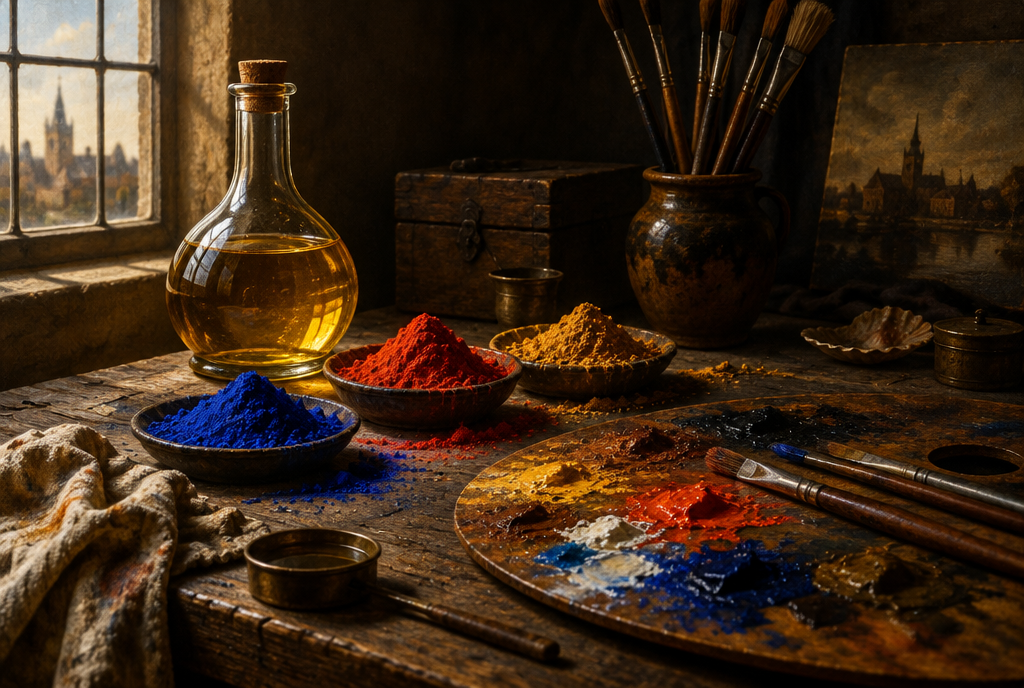
Before oil, European panel painters mostly worked in egg tempera, which dries in minutes and cannot be blended once set, so form had to be built from thousands of small deliberate strokes. Oil, usually linseed, dries slowly and stays workable for hours or days. That single physical property changed what painting could depict: soft gradations, wet skin, metal that glints, fabric with weight, and deep translucent shadow built from layered glazes. Jan van Eyck did not invent oil paint, a story that traces back to Giorgio Vasari's sixteenth century account, but he and his contemporaries in the Low Countries refined it into a system of extraordinary precision. Rembrandt later pushed it the other way, into thick impasto and glazed darkness. In 1841 John Goffe Rand's collapsible metal tube made paint portable, and the Impressionists walked outdoors with it.
Most accounts of art history move through subjects and styles: religious panels, then portraits, then landscapes, then light broken into dabs. It is a reasonable story and it leaves out the thing that made much of it possible. A painter can only depict what the material on the brush will allow, and around the fifteenth century that material changed.
The problem with egg
Egg tempera is pigment ground into egg yolk thinned with water. It is durable, it holds colour beautifully, and it dries almost immediately. That last quality is the difficulty. A stroke laid next to another cannot be softened into it, because the first is already set.
So tempera painters built form by hatching: hundreds of fine parallel strokes, each slightly different in tone, accumulating into a cheek or a fold of cloth. The results can be magnificent, and the discipline required is formidable. But there is a look you cannot escape. Transitions stay slightly crisp, shadows stay a little flat, and every decision is effectively permanent. You cannot rework a face, only paint over it.
There is also a colour constraint. Tempera dries lighter and somewhat opaque, so deep saturated darks are hard to reach, and the most expensive pigments had to be used sparingly on a surface that did not let them glow. We wrote about what those pigments cost in the most expensive colours in history.
What oil does differently
Grind the same pigment into linseed oil instead and the working properties invert. The paint stays wet for hours, sometimes days. That means two strokes can be blended where they meet, so a gradation from lit cheek to shadow can be continuous rather than assembled.
It also allows glazing: a thin transparent layer of dark or saturated colour brushed over a dried layer beneath. Light passes through the glaze, bounces off the lighter paint below and comes back out, which produces a depth no single opaque mixture achieves. A red glazed over a warm underlayer looks lit from inside.
And crucially, oil forgives. You can scrape back, wipe out, repaint a hand tomorrow, adjust a composition weeks later. Painting stopped being an act of execution and became a process of revision, which changed not just surfaces but ambition.
Van Eyck: the refinement, not the invention
The popular version says Jan van Eyck invented oil painting in the 1420s. He did not. Oil as a binder appears in European painting well before him, described in medieval treatises and found in surviving work, including on sculpture and decorative surfaces. Analysis has since identified oil binders in objects centuries older than Van Eyck, and recent scholarship has traced oil-based paint far earlier still outside Europe.
The invention story largely descends from Giorgio Vasari, writing in the mid sixteenth century, long after the fact and with a taste for clean origin narratives. Treat it as a legend with a real core.
What Van Eyck and his Netherlandish contemporaries genuinely did was work out how to control the medium: which oils, how prepared, in how many layers, over what ground, to what effect. Stand in front of the Arnolfini portrait or the Ghent Altarpiece and the achievement is not that oil was used but that it was mastered. Brass reflects, a dog's coat has individual hairs, a woollen gown has heft, and a window throws convincing light across a room. That precision is a technical accomplishment as much as an artistic one.
Light, texture and the arrival of real shadow
Once painters could grade tone continuously, dramatic lighting became a subject in itself. The Italian development of strong light against deep dark depended on a medium that could hold both ends of the range in one passage, and we unpacked that language in chiaroscuro explained.
Oil also made surface a form of expression. Because the paint holds a mark, the thickness of the stroke carries meaning: a sharp ridge of white reads as a highlight on metal, a soft smear reads as breath or cloud. Painters gained a second vocabulary alongside colour and drawing.
Rembrandt takes it to the edge
Rembrandt is the clearest demonstration of how far the medium could be pushed in both directions at once. His darks are built from thin glazes, layered so the shadow has depth rather than flatness, and you sense space continuing into it rather than a wall of black.
His lights go the opposite way, into impasto: paint loaded so thickly that a sleeve or a fold of collar stands physically off the panel, catching real light in the room. Up close, passages look almost crude. Step back and they resolve into cloth. That is only possible with a medium that can be heaped and will hold its shape while it slowly hardens.
In the late self-portraits the technique and the subject stop being separable. Damaged, reworked, scraped and rebuilt surfaces describe a face that has also been lived in. Our flagship collection Rembrandt's Shadow follows that arc from the miller's son to the bankruptcy sale, and if you want to see how the same question feels from inside a decision, the scenarios in Turning Points put you in the room where the choice is made.
1841: the tube that let painters leave the studio
For four centuries oil paint had a practical limit: it had to be prepared, stored and used near where it was made. Artists or assistants ground pigment into oil by hand and kept it in pig bladders pricked with a tack, which leaked, dried out and were hopeless to carry.
In 1841 the American portrait painter John Goffe Rand patented a collapsible metal tube with a screw cap. It sounds like a footnote. It was not. Paint became sealable, portable, reusable and commercially manufacturable, which meant a painter could put a dozen colours in a bag, walk into a field and work in front of the subject until the light changed.
Within a generation the Impressionists were doing exactly that. Painting outdoors, fast, chasing weather and time of day, is a practice the tube made feasible. Renoir reportedly said that without paint in tubes there would have been no Impressionism, and whether or not the phrasing is exact, the logic holds.
The pattern worth keeping
Oil paint is a good reminder that artistic revolutions often begin as material ones. A slower drying time gave painters blending, glazing and revision. A metal tube gave them the outdoors. In both cases the new thing did not tell anyone what to paint, it simply removed a constraint, and the imagination went where the constraint had been.
Disclosure since we are mentioning ourselves: MindSnap is our app. Its art history lessons run about two minutes a day and cover this kind of material and technique story alongside five flagship story collections plus unlimited topics you can follow. If you would like the practical companion to this piece, how to read a painting walks through what to look at first.
Frequently asked questions
One snap tomorrow morning.
Two minutes in art, history, psychology, philosophy or economics, then the app tells you you're done.
Get MindSnap on iOSFree daily fact, forever. Pro is $9.99/month or $44.99/year.