Why the Most Valuable Tulips Were Sick: The Virus Behind Tulip Mania

Curiosity Columnist
Last updated: August 2026
6 min read
TL;DR
The tulips that commanded the wildest prices in 1630s Holland, flame-striped varieties like Semper Augustus, were diseased. Their feathered patterns came from what is now called tulip breaking virus, spread by aphids, which disrupted the flower's pigment and produced those streaks. The same infection weakened the plant, so broken bulbs multiplied slowly and unpredictably, which made them scarce, unrepeatable and therefore expensive. Nobody knew the cause for roughly three centuries, and the mechanism was only pinned down in the twentieth century. Today's flame tulips are healthy bred lookalikes, so the pattern that once cost a canal house is now available at a garden centre.
Here is a fact that improves almost any conversation about financial bubbles. The most expensive flowers in Dutch history, the ones whose prices are still quoted three hundred years later as proof that humans lose their minds in groups, were ill. Not delicate. Not temperamental. Infected, by a virus, and the infection was the entire reason anyone wanted them.
The mania itself is a story worth telling properly, and I have done that in tulip mania explained. This piece is about the single strangest detail inside it.
What made a tulip worth a fortune
Ordinary tulips arrived in the Low Countries from the Ottoman world in the sixteenth century and were admired immediately: bold, symmetrical, a clean block of colour on a strong stem. Handsome, but reproducible, and anything reproducible struggles to become a status object.
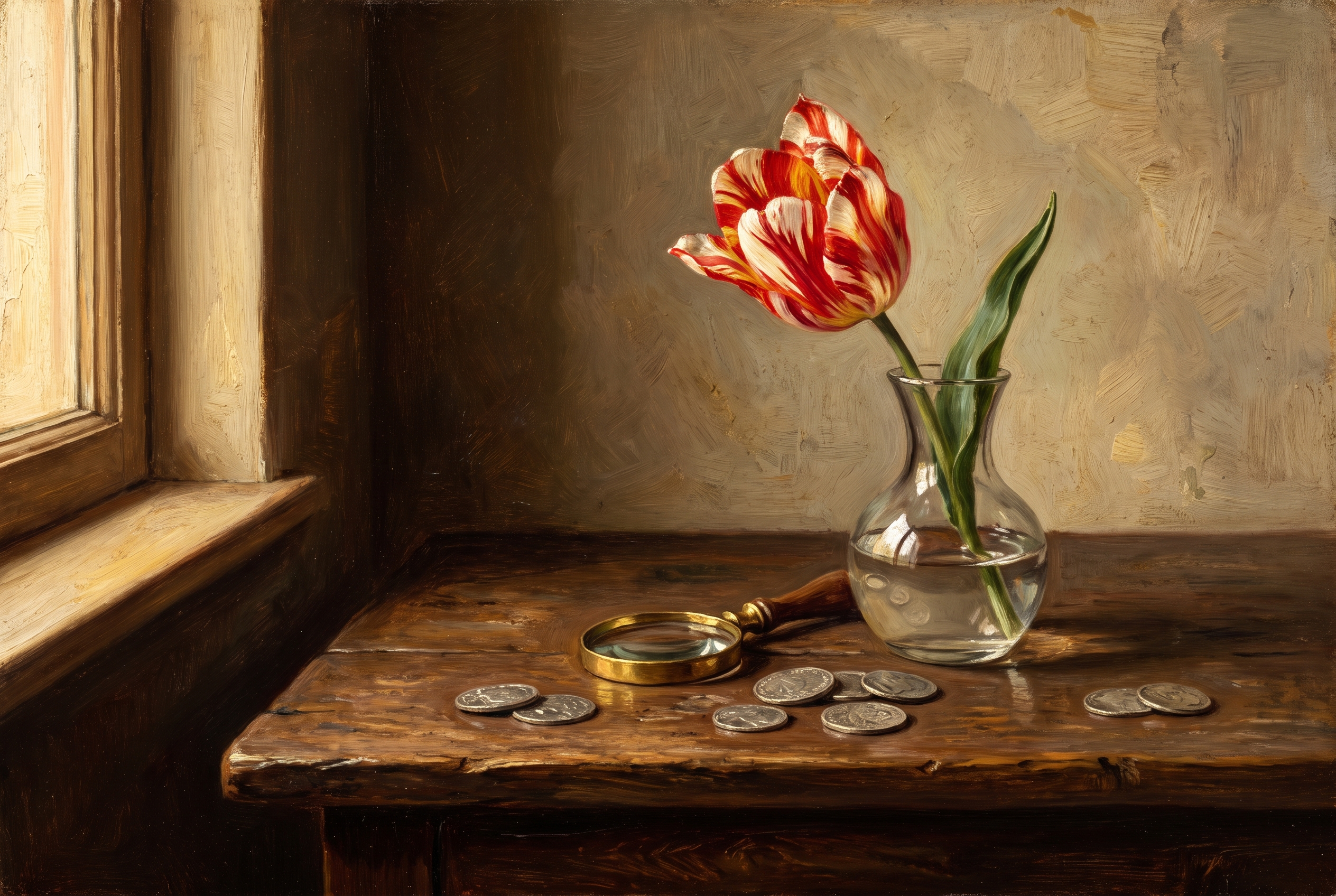
The prizes were different. These were the broken tulips, so called because their colour appeared broken: a base of red or purple slashed with white or cream in feathers, flames and fine hairlines, no two flowers identical. Growers gave them grand names, Semper Augustus, Viceroy, Admiral van Enkhuizen, and painters put them at the front of still lifes because they looked like something painted rather than grown.
Semper Augustus became the legend of the group, a white flower slashed with deep crimson, famously rare and famously expensive, with contemporary accounts describing very few bulbs in existence and prices that sound like property transactions because they were compared to property. That comparison, rather than any modern conversion, is the honest way to describe what people paid.
The cause nobody could see
Seventeenth century growers had theories. Poor soil, particular manures, mysterious sympathies between plants, the influence of nearby varieties. Some of the folk practices came close to working by accident, since a few involved planting broken bulbs near other stock, which is not a bad way to spread an aphid-borne infection.
The actual explanation is a plant virus, now called tulip breaking virus, carried between plants by aphids, chiefly the peach potato aphid. Once inside, the virus interferes with the flower's anthocyanin pigment, the layer that sits over the tulip's underlying base colour. Where the virus suppresses that pigment, the paler base shows through, and the result is the flame and feather pattern in irregular streaks that follow no repeatable plan.
That is why the flowers were unique. The pattern was not a trait, it was damage, distributed differently in every bulb. And the identification came late: the viral nature of the effect was established in the twentieth century, once virology existed as a discipline, roughly three centuries after the market that valued it collapsed.
Scarcity was a symptom
The commercial consequence is the part that makes the story genuinely instructive. Tulips can be grown from seed, but a seedling does not inherit the broken pattern reliably and takes years to flower. The only dependable route was offsets, small daughter bulbs the mother plant produces beside itself, which carry the infection with them.
The trouble is that an infected plant is a weakened plant. Broken tulips grew less vigorously, produced fewer offsets, and sometimes declined until the line gave out altogether. So the supply of the most desirable flowers could not be scaled, no matter how much money was waved at it.
- The pattern was unpredictable, so no grower could promise a specific flower in advance.
- Propagation was slow, since offsets were few and took years to reach flowering size.
- The stock was fragile, and a celebrated variety could weaken and disappear.
- Verification was impossible in winter, because a bulb in a sack looks like every other bulb, and much of the trading happened out of bloom.
Put those together and you have a market with genuinely limited supply, no way to inspect the goods at the moment of sale, and a product whose value rested on an appearance nobody could reliably reproduce. The speculation that followed had a real foundation. Rarity was not invented by the traders. It was viral.
A quieter correction to the legend
It is worth saying that the popular version of tulip mania is more colourful than the record supports. The extraordinary prices attached to a small number of rare bulbs among a fairly narrow circle of dealers, much of the frantic trading happened in taverns as contracts for future delivery rather than cash for flowers, and the collapse in early 1637 ruined far fewer people than the moralising pamphlets afterwards suggested. Those pamphlets did a great deal to build the myth. The Dutch economy did not fall over.
What survives scrutiny is the odd, verifiable core: the most prized ornamental plants in Europe were valuable because they were diseased, and nobody involved knew it.
The irony in modern gardens
Walk into a garden centre in autumn and you can buy flame-striped tulips for the price of a coffee. Varieties like Rembrandt-style tulips sell exactly the look that once invited comparisons with canal houses.
They are impostors, in the best sense. Modern striped tulips are healthy cultivars bred to produce stable patterns through genetics rather than infection, because commercial growers have spent a century removing virus from stock rather than cultivating it. Infected bulbs are now destroyed, since a virus in a bulb field is a business problem. The pattern has been domesticated and the disease discarded, which means the flower that made people lose their heads is not really available any more. You can buy the picture, not the pathology.
There is something pleasing about that reversal. The seventeenth century paid extraordinary sums for a symptom it could not explain or reproduce, and the twenty first century produces the same appearance cheaply and reliably by understanding the mechanism well enough to route around it.
Why this nugget sticks
Most facts about bubbles are about human psychology. This one is about biology quietly setting the stage: a virus limited the supply, the limited supply created the prestige, and the prestige did the rest. It is a useful reminder that manias usually begin with something genuinely scarce before enthusiasm takes over.
If you want the full account, from the flower's arrival out of the east to the auction where nobody bid, that is the Tulip Fever expedition, told in chapters. Disclosure: MindSnap is our app, so the recommendation is not a neutral one. If you would rather test your instincts than read, the historical decision scenarios at Turning Points let you sit in a 1637 tavern and decide whether to sell. And for the neighbouring question of why certain pigments cost more than gold, there is the most expensive colours in history.
Frequently asked questions
One snap tomorrow morning.
Two minutes in art, history, psychology, philosophy or economics, then the app tells you you're done.
Get MindSnap on iOSFree daily fact, forever. Pro is $9.99/month or $44.99/year.