Why Dutch Artists Painted Skulls: Vanitas Still Lifes Explained

Arts & History Editor
Last updated: August 2026
7 min read
TL;DR
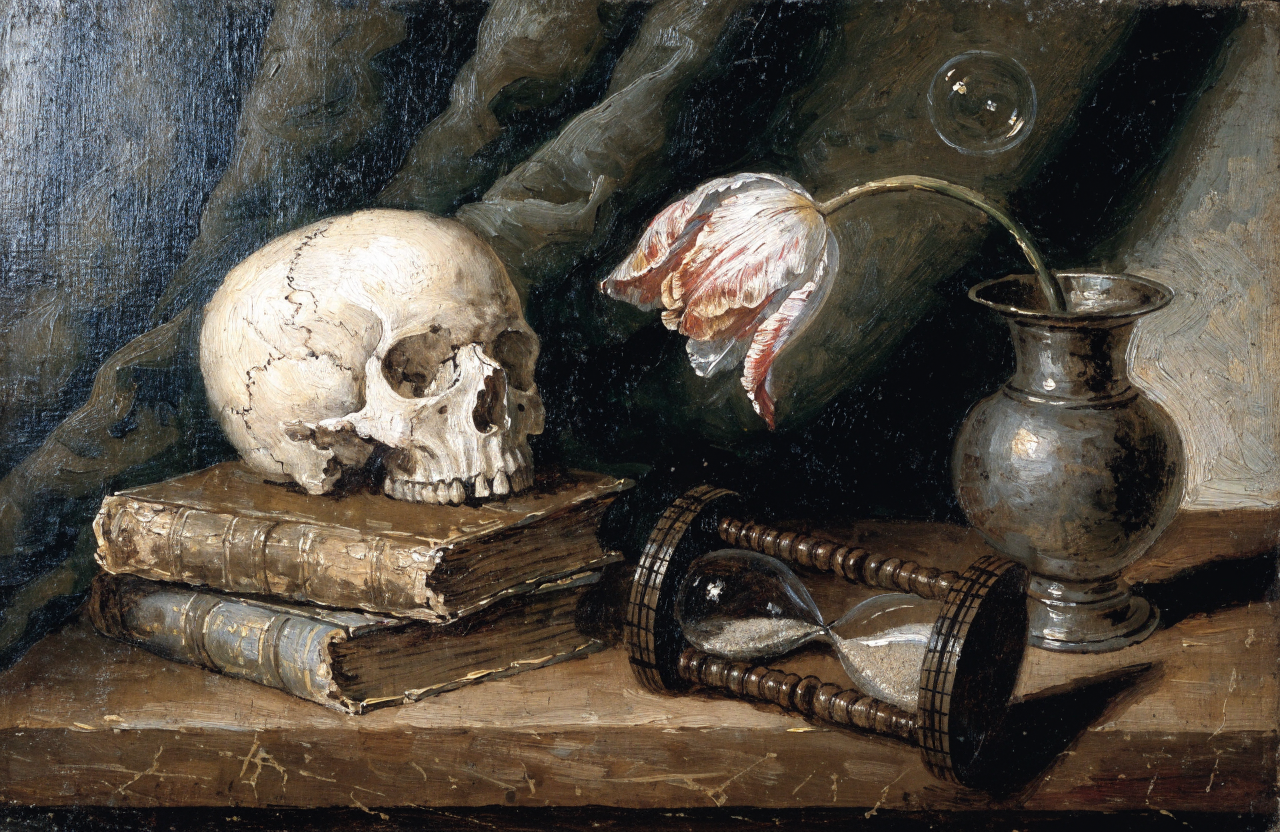
A vanitas is a still life built as an argument: everything you are looking at will end. The genre flourished in the seventeenth-century Dutch Republic, where Calvinist moral seriousness met sudden, dizzying merchant wealth, and Leiden became its workshop. The objects are a vocabulary: skull for death, snuffed candle for the moment of it, hourglass for time, soap bubble for fragility, wilting tulip for luxury that rots, books and instruments for learning that outlives nobody. Learn six symbols and you can read almost any of these paintings on sight.
There is a particular kind of painting that stops people in Dutch galleries, usually with a small unsettled laugh. A table, expensively dressed. A silver ewer, a half-peeled lemon, a violin lying on its side. And in the middle of it, unhurried and quite unapologetic, a human skull.
The word for these is vanitas, from the opening of Ecclesiastes in the Latin Bible: vanitas vanitatum, omnia vanitas. Vanity of vanities, all is vanity. The English word vanity misleads us slightly. The sense is closer to emptiness, or breath, or something that will not hold. These paintings are not scolding you for being proud of your hair. They are telling you that the table itself is temporary.
Why the richest republic in Europe painted death
The genre reached its height in the Dutch Republic in the first half of the seventeenth century, and the timing is the interesting part. This was a society doing extraordinarily well. Ships came home from Asia with cargoes worth more than houses. A merchant class with no aristocratic titles was suddenly buying paintings by the hundred, hanging them in ordinary rooms rather than palaces.
Set against that was a Calvinist culture that was deeply suspicious of exactly this. Wealth was evidence of diligence, which was good, and an invitation to attachment, which was dangerous. A vanitas resolved the tension elegantly. You could own a gorgeous painting of gorgeous objects, rendered with obvious relish, so long as the picture also reminded you not to love them. The genre let a Dutch merchant admire his own world and moralise about it in the same glance.
Leiden was its hub. The university town produced a dense cluster of specialists, David Bailly, Harmen and Pieter van Steenwijck, Jan Davidsz de Heem for a period, who refined the format into something almost scholarly. Leiden's students and professors were a natural audience for a painting about the limits of learning, and the city's painters obliged them with skulls resting on law books.
This is also the Leiden that produced a miller's son with an unusual gift for darkness, which is where our Rembrandt's Shadow collection begins. The vanitas habit of mind, wealth and mortality held in one frame, sits right behind his work.
The vocabulary: how to read one
Vanitas painters worked with a shared symbolic vocabulary, and once you know it the paintings become almost talkative. Here are the terms that do most of the work.
- Skull. The blunt centre of the genre. Often placed on books or ledgers, so that knowledge and money physically hold it up.
- Snuffed candle or smoking wick. Not death in general but the instant of it, and the thread of smoke is the point: still visible, already gone.
- Hourglass or pocket watch. Time as a measured, running quantity rather than an abstraction. Watches were new and expensive, which sharpens the joke.
- Soap bubbles. Homo bulla, man is a bubble. Beautiful, iridescent, and structurally doomed. Often paired with a child blowing them.
- Wilting flowers, especially tulips. Luxury with a decay clock attached, and in the Netherlands a very specific financial memory.
- Musical instruments and sheet music. Pleasure that exists only while it sounds, then stops. A lute with a broken string is a whole sentence.
- Coins, purses, jewellery. Value that cannot be carried out. Sometimes shown spilled, as if already leaving.
- Books, globes, scientific instruments. Scholarship, which outlasts the scholar but not the world.
- Mirrors, peeled lemons, opened watch cases. Things whose insides are shown: beautiful surface, sour or mechanical interior.
The tulip in the vase is not decoration
Of all the symbols, the tulip carries the most local charge. A cut tulip was already a fine emblem of transience: expensive, imported, spectacular, over within days. But in the Dutch Republic it meant more than that.
In the winter of 1636 and 1637, contracts for rare bulbs reached prices that later generations found impossible to believe, and then collapsed. The most prized varieties were the flamed and feathered ones, and the streaking was caused by a virus that weakened the plant. The most valuable tulip in the market was, quite literally, a sick one. A painter putting a striped tulip beside a skull in 1640 was not reaching for an abstraction. He was pointing at something his buyers remembered. We tell that story properly in tulip mania explained, and follow the bulb trade week by week in the Tulip Fever collection.
Reading one in a museum, in about ninety seconds
Next time you are standing in front of one, try this sequence. It works on almost every example.
- 1Find the light source and follow it. Vanitas painters use raking light from one side, and whatever it lands on hardest is the argument.
- 2Name the objects out loud. Do not interpret yet. Skull, watch, lute, lemon, glass, letter.
- 3Sort them into two piles: things that take effort to acquire, and things that mark time passing. The painting is the collision between the piles.
- 4Look for the interruption. A snuffed wick, a broken string, an overturned glass, a lifted corner of cloth. Something in the picture has just stopped.
- 5Then read the small print. These painters loved inscriptions, half-hidden on a page or a knife blade, and they usually tell you the moral directly.
If step one feels unfamiliar, our short guide to how to read a painting covers the same habits of looking for any picture, and chiaroscuro explained covers what that raking light is actually doing.
Why the genre faded, and why it still lands
By the eighteenth century the vanitas was thinning out. Taste moved toward lighter subjects, the religious argument lost its urgency, and the format risked becoming a formula. A skull can only surprise you so many times. What survived was the underlying move: putting the end of something inside the picture of it, which you can find in nineteenth-century still life and in a good deal of photography since.
What still lands, I think, is the honesty about wanting things. A vanitas does not pretend the silver is ugly. It paints the silver superbly, better than a painter who did not care about silver ever could, and then sets a skull beside it. That is a more interesting position than renunciation, and it explains why these pictures survive rooms full of grander subjects.
If you want the wider Dutch context, the boom that paid for all this is covered in the Dutch Golden Age explained.
The painter loves the silver. That is why the skull works.
Frequently asked questions
One snap tomorrow morning.
Two minutes in art, history, psychology, philosophy or economics, then the app tells you you're done.
Get MindSnap on iOSFree daily fact, forever. Pro is $9.99/month or $44.99/year.