What Is a Sphere of Influence? The Concept That Quietly Shapes Maps

Learning Science Writer
Last updated: August 2026
9 min read

TL;DR
A sphere of influence is an area where one state expects its preferences to carry weight in another state's decisions without governing that state directly. Sometimes the arrangement is written down, as in the nineteenth century agreements that divided regions into zones on paper. More often it is informal, resting on trade dependence, credit, infrastructure, military reach and simple proximity. Historically the concept let great powers avoid the cost of occupation while keeping the benefits of control, which is also why it has always been contested: the states inside a sphere rarely agree that they are in one. Reading it as a structural pattern rather than a moral category is the most useful way to use the term.
Borders are the part of a map you can see. Influence is the part you cannot, and it often explains more about how a region behaves than the lines do.
A sphere of influence describes the second thing: a zone in which one state's preferences shape another state's choices, without formal rule, annexation or occupation. The state inside the sphere keeps its flag, its government and its seat in international bodies. What narrows is the practical range of decisions it can take without friction.
Formal and informal versions
The formal version is a written arrangement between powers about territory belonging to neither of them. In the nineteenth and early twentieth centuries this was ordinary diplomatic practice. Officials drew lines through regions they had not visited, agreeing which of them would have priority in commerce, railways, loans and advice.
The informal version is more common and harder to see. No document assigns the sphere. It emerges from accumulated dependence: a single dominant trade partner, credit that can be withdrawn, an energy pipeline with one direction, a port built and operated by a foreign firm, a military presence nearby that nobody needs to mention. Formal spheres end when the agreement lapses. Informal ones end when the dependence does, which takes considerably longer.
The levers
Influence is mechanical, and it helps to list the mechanisms rather than treat it as atmosphere.
- Trade concentration. When most of a country's exports go to one buyer, that buyer's preferences become domestic economic policy without anyone drafting a treaty.
- Credit and debt. Lending shapes behaviour twice, once through the conditions attached and once through the renewal that may or may not come.
- Infrastructure. Railways, pipelines, cables and ports have geography built into them. Whoever finances and routes them decides which direction a region faces for decades.
- Military proximity. Bases, fleets and the plain distance to a border alter calculations long before any force is used, which is the whole point of them.
- Institutions and elites. Shared legal systems, officer training, scholarships and language create a professional class fluent in one partner's way of doing things.
None of these requires occupation, which was always the attraction. Occupation costs money, generates resistance and demands administration. Influence delivers a usable share of the same outcome at a fraction of the price.
Historical examples
The Monroe Doctrine era
In 1823 the United States declared that further European colonisation in the Americas would be treated as unfriendly. For decades this was more statement than capability, since enforcement depended largely on British naval interests running in a similar direction. As American economic and naval strength grew later in the century, the declaration hardened into an expectation about whose views mattered in the hemisphere.
The Great Game
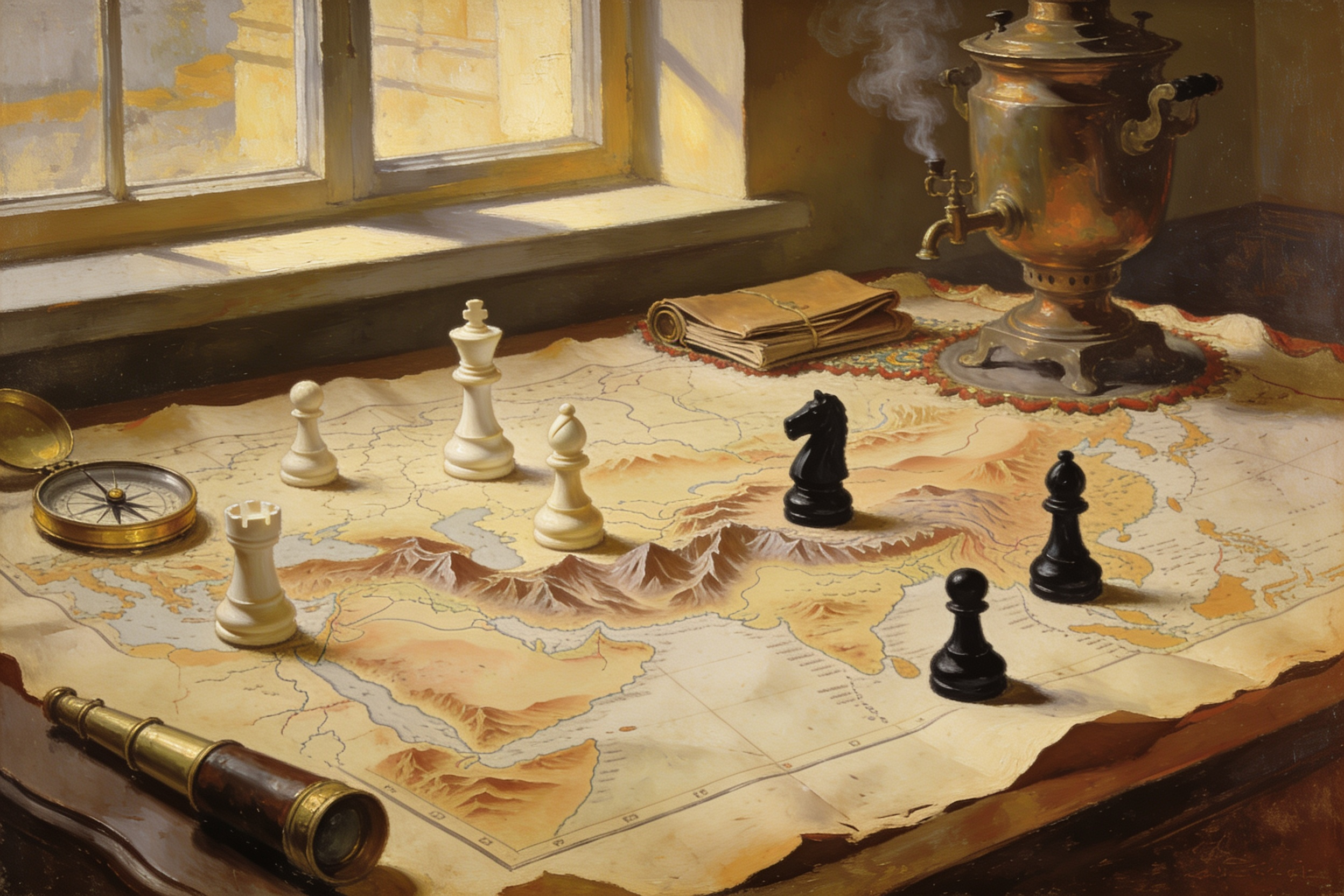
Across the nineteenth century, British and Russian officials manoeuvred over the approaches to Central and South Asia, mostly through surveys, subsidies, missions and boundary agreements rather than large wars. It produced the textbook artefacts of influence politics: buffer territories, demarcated zones and one famously thin corridor drawn to keep two empires from touching. We walk through the episode in the Great Game, and the adjacent logic in what is a buffer state.
The Congress of Berlin, 1878
The Berlin congress rearranged territory and recognition in southeastern Europe by agreement among the major powers, adjusting which states existed, which were autonomous and which powers had standing where. It is a clear case of the formal mode: the map changed in a conference room, and the populations affected were represented thinly or not at all.
Cold War blocs
The second half of the twentieth century organised much of the world into two blocs held together by alliance treaties, basing rights, aid, trade arrangements and ideological alignment. Both sides described their own arrangements as voluntary partnership and the other side's as domination, which is a permanent feature of the vocabulary rather than an anomaly of that period.
How geography builds spheres
Influence is not distributed randomly. It pools where geography concentrates movement. A strait that most of a region's cargo must pass through, a mountain range with three usable passes, a river basin shared by six states, a coastline with only one deepwater harbour: each of these creates a place where a small amount of control produces a large amount of leverage.
This is why spheres tend to be stable even as governments change. The chokepoint does not move. Rail gauges, pipeline routes and port ownership outlast the ministers who negotiated them, and they keep pointing a region's trade in the same direction long afterwards. The structural version of this argument runs through geography and power, and you can see the same reasoning applied in the Turning Points scenarios, which ask you to decide with the map in front of you. Disclosure: MindSnap is our app, so read that as a description of how we teach the material.
Why the term is contested
Three objections come up repeatedly, and all three are reasonable.
- 1It describes states as objects. A sphere is defined from the outside, by the influencing power, and the country inside it usually rejects the label and can point to decisions it took independently.
- 2It can smuggle in acceptance. Saying a region falls within a sphere sounds descriptive but is easily read as saying it ought to, which is why diplomats use the phrase carefully and often deny it applies to them.
- 3It is hard to measure. Trade concentration and basing agreements are countable. How much a given decision was shaped by expectation rather than preference is not, so claims about spheres tend to outrun the evidence available for them.
Because of this, the most defensible use of the term is analytical and retrospective. Applied to documented historical arrangements, it clarifies a lot. Applied to live disputes, it quickly becomes an argument about legitimacy dressed as a description, and that is a different kind of conversation from the one this piece is having.
What the pattern teaches
Strip away the vocabulary and a durable structural observation remains. Power rarely needs to take a place over in order to shape it. It needs to matter more to that place than that place matters to it, which is a question about trade shares, credit, routes and distance, and those are measurable.
That asymmetry, not ideology and not intention, is what the concept actually tracks. Reading maps for it, alongside the trade routes and terrain covered in topics, tends to explain more about why regions align the way they do than reading the borders alone ever will.
Formal empire draws the border. Influence decides which way the roads run, and the roads usually last longer.
Frequently asked questions


One snap tomorrow morning.
Two minutes in art, history, psychology, philosophy or economics, then the app tells you you're done.
Get MindSnap on iOSFree daily fact, forever. Pro is $9.99/month or $44.99/year.