How Two Monks Smuggled the Secret of Silk Out of China

Arts & History Editor
Last updated: August 2026
7 min read
TL;DR
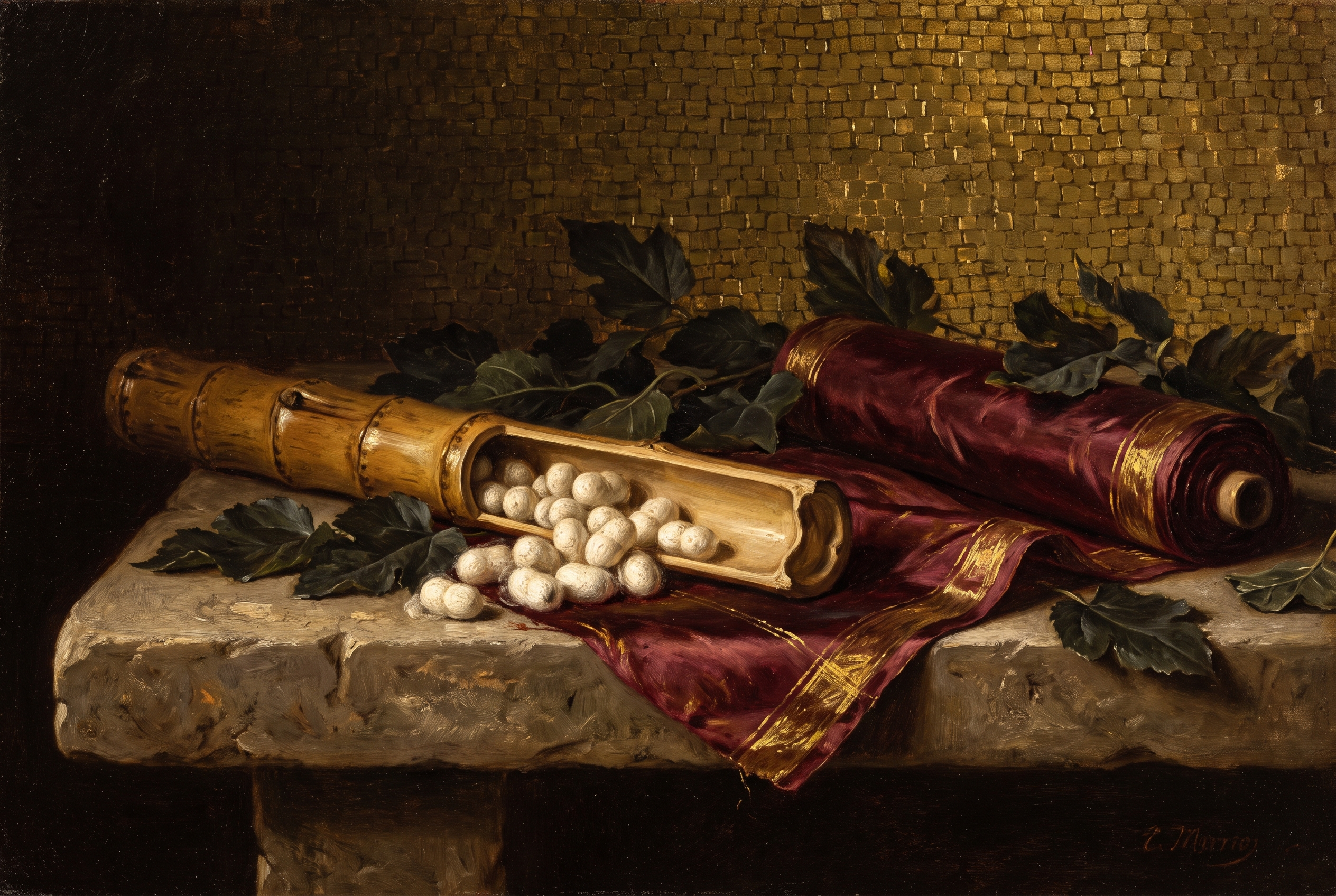
For roughly two thousand years China was the only place on earth that knew how to make silk, and it guarded the knowledge as a state secret. Around 552 CE, according to the historian Procopius, two monks arrived at the court of the emperor Justinian in Constantinople claiming they could end Byzantium's dependence on foreign silk, and later tradition says they carried silkworm eggs hidden in hollow canes. Whether the detail is true or not, sericulture did take root in the Byzantine empire soon after, imperial workshops were established, and a commodity that had drained Byzantine gold eastward for centuries became something the empire could produce itself. It is one of the earliest recorded acts of industrial espionage, and it reshaped Mediterranean trade.
Some technologies are secrets, and some secrets are strategy. For most of antiquity silk was both. It was produced in China, exported west along overland and maritime routes, and desired at every court it reached, yet nobody outside East Asia could explain how it was made. Theories in the Roman world included the idea that it was combed from trees.
The truth was stranger and more fragile: silk comes from the cocoon of Bombyx mori, a domesticated moth whose caterpillars eat mulberry leaves and spin a single continuous filament. Anyone with eggs, mulberry trees and the knowledge of how to manage both could make silk. Which is precisely why, for centuries, the eggs did not leave.
A monopoly held for two millennia
Chinese sericulture is ancient, with archaeological traces of silk production reaching back thousands of years, and the craft was tied closely to the state and to the household economy. Exporting finished cloth was profitable. Exporting the means of production was not, and Chinese law treated the smuggling of eggs or the knowledge of rearing as a serious offence.
That monopoly is what made silk into money. Bolts of it functioned as payment, tribute and diplomatic gift, and demand in the Mediterranean was effectively unlimited among those who could afford it. The result was the flow of precious metal eastward that Roman moralists complained about for generations, a pattern of long-distance dependence we trace forward in what the Silk Road teaches about modern trade.
The secret did loosen before Byzantium acquired it. Sericulture reached Korea and Japan, and by roughly the fifth and sixth centuries it was practised in Central Asia, in Khotan and neighbouring oasis kingdoms. There is a persistent legend that a Chinese princess married to a Khotanese ruler smuggled eggs out in her headdress. The point is that knowledge had travelled part of the way west, and this is likely where the monks in our story got theirs.
Why silk mattered so much to Byzantium
For the eastern Roman empire silk was not a luxury problem. It was a fiscal and diplomatic one. Silk clothed the court, signalled rank, paid for alliances and dressed the church, and the state controlled its trade and dyeing tightly, with the deepest purple reserved for imperial use.
The supply, however, came through intermediaries, principally the Sasanian Persian empire, which sat across the overland routes and with which Byzantium was frequently at war. That meant Byzantium's most politically important commodity could be taxed, throttled or cut off by its main rival. Justinian tried to route around the problem with diplomacy, seeking maritime supply through Ethiopian and Arabian partners and negotiating over prices, with limited success.
Understanding that vulnerability is the key to the whole episode. This was not aesthetic longing. It was a state trying to remove a strategic chokepoint, in an empire whose wider machinery we describe in what was the Byzantine empire.
Procopius and the monks
Our source is Procopius of Caesarea, the principal historian of Justinian's reign and a man who had served on campaign with the general Belisarius. In a passage of his Wars he reports that certain monks arrived from India, a term used loosely in this period for lands well to the east, and told the emperor that they could arrange for silk to be produced in Roman territory so that the Romans need no longer buy it from Persians or anyone else.
Procopius records that Justinian promised them great rewards and encouraged them to prove it, and that they returned with the means of producing silkworms, explaining the rearing of the worms and their feeding on mulberry leaves. The conventional date given for this is around 552 CE.
Here is where honesty about sources matters. The celebrated detail that the eggs were concealed inside hollow walking canes or bamboo staves is the version everyone repeats, but it is not a plain reading of the earliest account: it is elaboration that entered the tradition later and became inseparable from the story. Nor do we know who the monks were, where exactly they obtained their eggs, or whether one journey or several are compressed into the anecdote. What is not in dispute is the outcome. Sericulture was established in Byzantine territory in the sixth century and never left.
It is also worth noting why hiding eggs in a cane is at least plausible. Silkworm eggs are tiny and can be transported in a dormant state, so the physical smuggling problem is small. The hard part is the knowledge: when to warm the eggs, how to feed the larvae continuously, how to kill the pupa without cutting the filament, how to reel the thread. That knowledge is what the monks were really selling.
The imperial workshops that followed
Byzantium did not treat its new industry as a free market. Production and the most valuable dyeing and weaving were organised under state supervision, with workshops attached to the imperial establishment and strict control over which patterns and colours could be made or sold, and to whom. Mulberry cultivation spread through Greece, Syria and parts of Anatolia, and later through Sicily and southern Italy.
The consequences were layered.
- Fiscal relief: gold that had flowed east for cloth could stay inside the empire, and silk became an export rather than only an import.
- Strategic independence: Persia lost a lever it had used for generations, though not immediately or completely.
- Diplomatic currency: Byzantine silks, woven with distinctive imperial motifs, became prestige gifts that turn up in western European church treasuries for centuries afterwards.
- A durable European industry: from the Byzantine and Islamic Mediterranean, sericulture passed to Italy, where cities including Lucca, Venice, Florence and later Lyon in France built substantial silk economies. The craft guild structures that governed them are described in how medieval guilds worked.
The monopoly did not simply transfer. It fragmented, and every fragment became a local industry with its own patterns and reputation.
Early industrial espionage, and why it recurs
Strip away the robes and the canes and the structure of this story is familiar. A state holds a process secret because the secret is worth more than the product. A rival state cannot buy its way out of dependence, so it buys the process instead. Transfer happens through people rather than documents, because the knowledge is tacit. Once transferred, it cannot be recalled.
The same script runs through porcelain, through Venetian glass, through the cotton machinery that Britain tried and failed to keep at home in the eighteenth century. Silk is simply the earliest well documented case, and it is unusually clean because the smuggled object was small enough to hide and alive enough to reproduce.
There is a lesson about power in it as well. Byzantium survived as long as it did by repeatedly converting other people's advantages into its own, whether that meant Greek fire, fortifications or an eastern moth. That habit runs through The Day the Middle Ages Ended, our narrative collection on Constantinople's long defence, and the same city's architectural ambition is the subject of Hagia Sophia explained.
If you would rather stand inside these decisions than read about them, the Turning Points scenarios put you in the position of the people making them. Disclosure: MindSnap is our app, and Turning Points is one of its features.
What to remember
Two monks, an emperor with a supply problem, and a handful of eggs that may or may not have travelled inside a cane. The anecdote is charming, the sourcing is thinner than the retelling suggests, and the consequence is beyond argument: after the sixth century, the Mediterranean made its own silk, and the oldest monopoly in the world was over.
Frequently asked questions

One snap tomorrow morning.
Two minutes in art, history, psychology, philosophy or economics, then the app tells you you're done.
Get MindSnap on iOSFree daily fact, forever. Pro is $9.99/month or $44.99/year.