How the Suez and Panama Canals Rewired World Trade

Arts & History Editor
Last updated: August 2026
8 min read
TL;DR
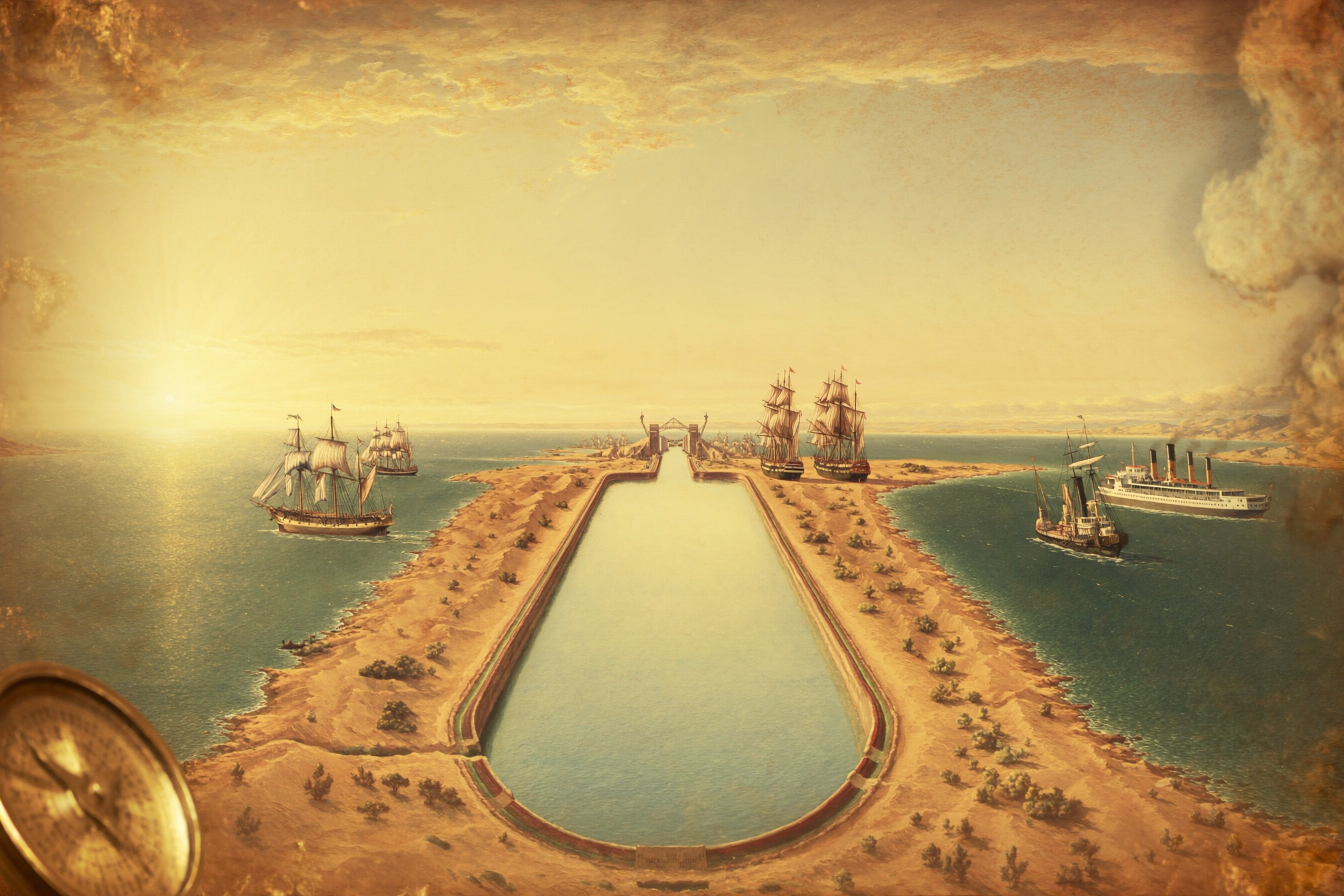
Suez opened in 1869 and Panama in 1914, and between them they redrew the map of shipping. Suez cuts through a low, flat, sea level isthmus, so it needed no locks, and it removed the voyage around southern Africa from the Europe to Asia route. Panama crosses a narrow but mountainous isthmus with a continental divide in the way, so it needed a lock system and an artificial lake, and it removed the voyage around South America's southern tip. Both were staggeringly costly in human life, particularly Panama's first, failed French attempt. Both created the same strategic feature as a natural strait: a single narrow point that a large share of world trade has to pass through, with a limit on how many ships and how large a ship can pass.
Almost every important sea route in history was decided by geography that nobody chose. A strait, a cape, a prevailing wind. Two of the most important routes in use today were decided by engineering instead, and they are the reason a container ship leaving Rotterdam for Singapore does not go anywhere near South Africa.
Suez and Panama do the same job in very different terrain, and the difference in terrain explains almost everything else about them.
The problem canals solve
Look at a globe rather than a flat map. Two thin necks of land separate oceans that would otherwise be neighbours. The Isthmus of Suez joins Africa to Asia and separates the Mediterranean from the Red Sea. The Isthmus of Panama joins North to South America and separates the Atlantic from the Pacific.
Without them, ships take the long way. Europe to Asia means rounding the Cape of Good Hope at the southern tip of Africa. Atlantic to Pacific means rounding Cape Horn or threading the Strait of Magellan at the storm-battered bottom of South America. Both detours add many thousands of nautical miles, weeks of sailing, fuel, crew wages and cargo sitting idle in a hold instead of earning money in a warehouse.
Cutting a ditch through a few tens of miles of land to delete several thousand miles of ocean is one of the highest leverage ideas in the history of trade. It is also, as both projects proved, brutally hard.
Suez: flat, sea level, no locks
The idea was ancient. Pharaonic and later rulers dug channels linking the Nile to the Red Sea, and various versions were maintained and abandoned over centuries. The modern canal, driven by the French diplomat and promoter Ferdinand de Lesseps and built with Egyptian labour under the Egyptian ruler Said Pasha and his successor, opened in 1869 after roughly a decade of work.
The geography was unusually kind in one specific way. The isthmus is low, and the Mediterranean and Red Sea sit close enough in level that no locks were required. That single fact makes Suez a simple machine: a sea level trench with lakes along the route, no gates, no water lifting, no pumps.
Everything else was hard. The route runs through desert with no fresh water, so water had to be brought in. Early excavation relied heavily on manual labour under conditions that were, by any reading of the record, appalling, before mechanical dredgers took over the bulk of the digging. Deaths among the workforce were very high, and estimates vary widely enough that anyone quoting a precise figure to you should be treated with suspicion.
The effect on shipping was immediate and structural. A route between Europe and Asia that had required rounding an entire continent now ran through Egypt, which changed which ports mattered, which coaling stations were worth holding, and how quickly goods and people moved between the two ends of the world's busiest trade axis.
Panama: mountains, locks and a lake
Panama is narrower than Suez and vastly more difficult. The isthmus is only around fifty miles across at the canal, but a continental divide runs down it, and the rock rises well above sea level. There is no flat ditch to be dug.
De Lesseps, fresh from Suez, tried anyway, and the French effort begun in 1881 attempted a sea level cut through that high ground. It failed on two fronts. The engineering was wrong for the terrain, with the excavation defeated by landslides in the Culebra cut, and the health situation was catastrophic. Yellow fever and malaria killed workers in enormous numbers, and at the time nobody involved understood that mosquitoes transmitted either disease. The company collapsed in financial scandal.
The United States took over the project in the early 1900s, following Panama's separation from Colombia, and changed both elements. Engineering first: instead of cutting down to sea level, the design lifts ships up over the divide using locks, crosses a large artificial lake created by damming the Chagres River, then lowers them down the other side. Public health second: a sustained sanitation and mosquito control campaign, led by William Gorgas and based on the then new understanding of disease transmission, cut mortality dramatically. The canal opened in 1914.
Two things are worth taking from that comparison. The same promoter with the same reputation failed in one place and succeeded in another because terrain does not care about track records. And a civil engineering project was solved as much by entomology as by excavation.
Locks, dimensions and why ship size is a political fact
Because Panama uses locks, it has a hard physical ceiling on the size of vessel that can transit. That ceiling has shaped shipbuilding for over a century: designers built to fit the chambers, and the resulting maximum dimensions became a standard class of ship. When a larger set of locks opened in 2016, a new and bigger class followed.
Suez has no locks, so its constraint is different: depth, width and air draft rather than lock chambers, and it has been deepened and widened repeatedly, including the addition of a second lane along part of its length.
Panama has a further constraint that a sea level canal does not: it runs on fresh water. Every transit spends water from the lake system, and that supply depends on rainfall in the watershed. A lock canal is therefore hostage to hydrology in a way a trench is not, and in dry periods the number of daily transits has to be managed.
Canals as chokepoints
Strategically, an artificial waterway behaves like a natural strait. A large share of world trade funnels through a passage a few hundred metres wide, and there is a finite number of ships per day that can pass. That combination is the definition of a chokepoint, and it is why the same short list of places, Suez, Panama, Hormuz, Malacca, Gibraltar, Bab el-Mandeb, appears in every discussion of shipping risk.
The general logic of these bottlenecks, and why an alternative route is rarely a real substitute, is the subject of maritime chokepoints explained. The vocabulary matters too, since strait, channel and canal get used interchangeably and only one of them is man-made: we sorted the terms out in strait versus channel versus canal.
The other half of the story is what travels through. Canals shortened routes, but the reason a modern ship can carry so much so cheaply is the standard steel box, which we covered in how the shipping container shrank the world. Shorter route plus cheaper handling is the combination that made long distance supply chains ordinary. Older versions of the same trade, running overland and through monsoon sailing seasons, are sketched in the spice routes explained.
The pattern worth remembering
The deeper lesson is the one geography keeps teaching. Trade follows the cheapest path, and whoever controls the cheapest path has leverage they did not have to earn twice. Digging a canal does not remove that dependency, it relocates it.
If you like history where one narrow passage decides events, that is most of the appeal of the Bosphorus too. Disclosure: MindSnap is our app, and this kind of material is what we build our two minute lessons from, across five flagship story-driven collections plus unlimited topics. The browser version, if you want to try the format, is Turning Points.
Frequently asked questions
One snap tomorrow morning.
Two minutes in art, history, psychology, philosophy or economics, then the app tells you you're done.
Get MindSnap on iOSFree daily fact, forever. Pro is $9.99/month or $44.99/year.