Why Do Countries Build Brand New Capital Cities?

Learning Science Writer
Last updated: August 2026
7 min read

TL;DR
States build new capitals for a small set of recurring structural reasons: to sit neutrally between rival regions rather than favour one, to pull settlement and administration into a neglected interior, to move government away from an exposed coast or border, and to relieve pressure on a crowded primary city. The costs are equally predictable. Purpose built capitals are expensive, they take decades to feel lived in, and they usually end up sharing power with the older economic capital they were meant to replace. Washington, Canberra, Ottawa, Brasilia and Ankara are the classic illustrations of the pattern.
Most capital cities were never chosen. They grew: a river crossing became a market, the market became a court, the court became a state, and the capital was wherever power already happened to be. Then there is the other kind, the capital that exists because a committee argued about a map. Washington, Canberra, Ottawa, Brasilia, Ankara in its modern role, and a long list of planned administrative cities since.
Deliberate capitals are unusual and enormously expensive, which makes the reasons for building them worth studying. They are not vanity projects, or not only that. They are attempts to solve a specific problem of geography and politics with a location.
Reason one: neutrality between rivals
The commonest reason is that choosing an existing city would have meant choosing a side.
The United States is the textbook case. In the 1790s northern and southern states each had reasons to resist the other holding the seat of government, and the compromise was a new district on the Potomac, on the boundary between the sections, belonging to no state. Australia repeated the logic more than a century later. Sydney and Melbourne both wanted the capital, neither would accept the other, and the constitutional settlement created a federal territory in New South Wales but at a required distance from Sydney. Canberra was the answer to a rivalry, not to a shortage of cities.
Ottawa came from the same instinct in a different form. Selected in the 1850s as the seat of government for the Province of Canada, it sat near the boundary between predominantly French speaking and English speaking populations and was smaller and less exposed than the obvious contenders. In each case the new capital works precisely because it is nobody's home team.
This is the recurring insight of federal design. A capital that belongs to one region is a permanent argument. A capital that belongs to the union is a shared object, and its blandness is a feature.
Reason two: opening the interior
The second motive is developmental. Many countries have a coastline crowded with people and money, and a vast interior with neither. Moving the capital inland is an attempt to drag investment, roads and population toward the middle.
Brasilia is the outstanding example. Brazil's population had long clustered along the Atlantic, and relocating the federal capital to the central plateau in 1960 was explicitly meant to pull the country inward. Judged narrowly, it worked: a city of millions now exists where there was open savanna, and the road and air links built to serve it reshaped the interior. Judged as a whole, it was more complicated. The cost was enormous, and the interior did not become the economic heart of the country. Sao Paulo did that anyway.
The same logic appears across many countries in the modern era. A capital placed in a neglected region is a way of committing a state's own budget to that region for decades, because a capital cannot be abandoned once the ministries are there.
Reason three: security and distance
The third motive is defensive. Coastal capitals are visible, reachable and vulnerable to naval power, and border capitals can be reached in a day's march. An inland capital buys distance.
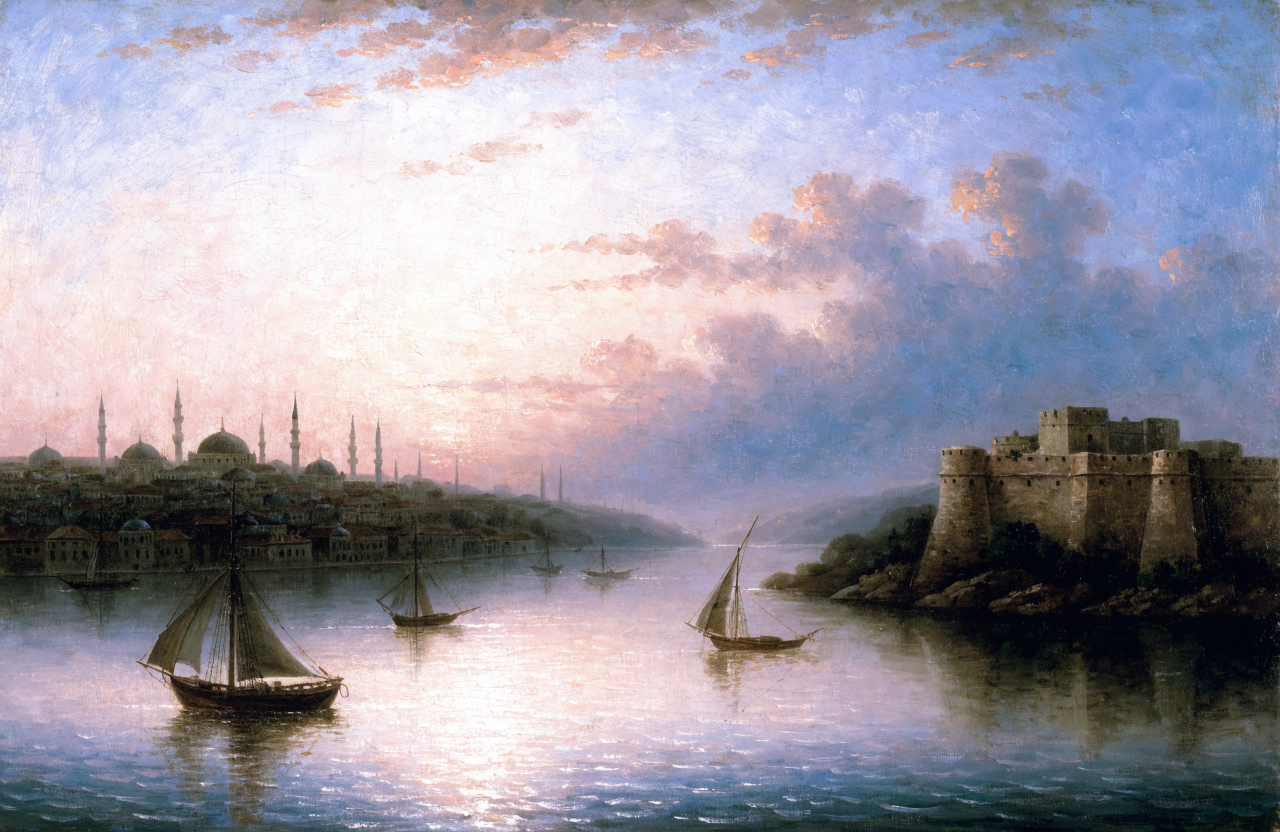
Turkey's shift to Ankara in the 1920s belongs to this pattern. Istanbul was magnificent, historic and extremely exposed: a coastal city on a strait, under Allied occupation after the First World War, with a foreign presence embedded in its commerce. Ankara sat inland on the Anatolian plateau, defensible and central to the new state's territory, and had already served as the base of the national movement. The move separated the new republic from an imperial capital whose geography had become a liability. That geography, and why it made Istanbul both irreplaceable and hard to hold, is the subject of the Bosphorus strait's history.
Historically the same reasoning produced inland capitals across many regions. Where seaborne raiding or invasion was the main threat, rulers put the treasury and the court where ships could not reach.
Reason four: relieving a city that has outgrown itself
The most modern motive is congestion. When one metropolis holds a disproportionate share of a country's population, traffic, land values and administrative activity, moving the government out is one of the few levers available.
Planned administrative capitals of the last several decades often carry this justification, sometimes combined with flood risk, water stress, subsidence or seismic exposure in the existing capital. The argument is straightforward: government is one of the few employers a state can relocate by decree, and moving hundreds of thousands of jobs creates a second centre of gravity.
Whether it relieves the original city is genuinely contested. Businesses and universities rarely follow the ministries, and the old capital often keeps growing regardless. What reliably changes is where officials live and where lobbyists must travel.
The trade-offs nobody puts on the plaque
Purpose built capitals share a set of predictable disappointments.
- They are extraordinarily expensive, and the spending competes with schools, ports and health systems for a generation.
- They take decades to feel lived in. A city designed all at once tends to lack the small scale mess that makes older cities pleasant, and the criticism that a planned capital feels like an office park is levelled at almost every one of them.
- They often end up as political capitals only, with the economic capital remaining elsewhere. New York, Sydney, Sao Paulo, Istanbul and Toronto never surrendered their commercial primacy.
- They can concentrate the political class in a bubble, physically distant from the population it governs, which is either a virtue or a vice depending on your theory of government.
- Car dependence is common, because mid twentieth century plans in particular were drawn around driving.
The counterargument is that a capital is not supposed to be the most exciting city in the country. It is supposed to be a place where the machinery of state can operate without being captured by one region, one industry or one crowd. Measured against that, several of these cities have done their job well for a very long time.
What the pattern tells you
Look at any purpose built capital and you can usually read the anxiety that produced it. A capital sitting on a regional boundary was built to stop a quarrel. A capital far inland was built either for defence or to colonise the map. A capital next to an older, larger city was built to unclog it.
Geography sets the menu, and politics chooses from it, which is the same relationship you can see in mountains as borders and in the way access to shipping shapes states in landlocked countries and trade. None of these choices was inevitable, and each one looked reversible at the time. If you like standing at that moment before the decision is made, our Turning Points scenarios are built around exactly those forks, and you can browse the wider set of subjects in topics. MindSnap is our app, in the interest of being plain about it.
Frequently asked questions


One snap tomorrow morning.
Two minutes in art, history, psychology, philosophy or economics, then the app tells you you're done.
Get MindSnap on iOSFree daily fact, forever. Pro is $9.99/month or $44.99/year.