Who Were the Varangian Guard? Vikings in the Service of Byzantium

Arts & History Editor
Last updated: August 2026
7 min read
TL;DR
In 988 the emperor Basil II, fighting for his throne, received about six thousand Rus warriors from Vladimir of Kiev and used them to crush his rivals. Those men became the Varangian Guard, the emperor's personal troops, and the institution lasted centuries. Emperors trusted them precisely because they were foreigners: no Constantinopolitan family ties, no political faction, and a salary paid by the palace. They fought with long axes, guarded the emperor's person, and served far from home in Italy, Syria and the Balkans. A young Norwegian named Harald Sigurdsson served among them before returning north as Harald Hardrada and dying at Stamford Bridge in 1066. Some of them scratched runes into a parapet in Hagia Sophia. After 1204 the guard faded, its ranks increasingly English and its purpose absorbed into other units.
Climb to the upper gallery of Hagia Sophia in Istanbul and, on a marble parapet, you can find something scratched into the stone. The letters are runes. They are worn and incomplete, and one reading gives a Norse name, something like Halfdan, carved by a bored man on duty far from anywhere he would have called home.
It is the most human trace left of one of the odder arrangements in medieval history: for centuries, the Christian emperor in Constantinople was guarded by axe carrying northerners.
Six thousand men and a bargain
The guard begins with an emperor in trouble. Basil II came to sole power as a young man in the 970s and spent the first years of his reign fighting rebel generals from his own aristocracy, men with armies, provincial power bases and a plausible claim to be a better ruler.
He needed soldiers who owed nothing to any of them. Around 988 he made an agreement with Vladimir, ruler of the Rus in Kiev, whose people were themselves of Scandinavian descent and long connected to Constantinople by the river routes. Vladimir sent roughly six thousand warriors. In return he received an imperial marriage, a Byzantine princess named Anna, and the arrangement is bound up with his own turn to Christianity.
Basil used them immediately and to devastating effect against his rivals. Having found what a personal force of outsiders was worth, he kept them. The word Varangian, from the Greek Varangoi, derives from a Norse term connected to oath or pledge, which is exactly what these men were: sworn men, paid by the palace.
Why an emperor preferred foreigners
The logic looks strange until you consider how Byzantine emperors usually fell. Not to foreign invasion, most of the time, but to their own commanders, their own courtiers, their own guards, in coups organised inside the city by men with families, patrons and factions in it.
A Norseman from Uppland had none of that. He had no cousins in the Senate, no estate outside the walls, no faction to be recruited into and no future in the city beyond his contract. His interests ran entirely through the person who paid him, which made him, paradoxically, safer to arm than a local.
This is the same calculation that produced the Ottoman Janissaries centuries later: elite troops drawn from outside the ruling class, loyal to the ruler rather than to any noble house, and formidable partly because of it. The parallel and its long term risk are worth reading side by side in our piece on the Janissaries, because the Ottoman version eventually became the political force it was designed to guard against.
What they were actually like
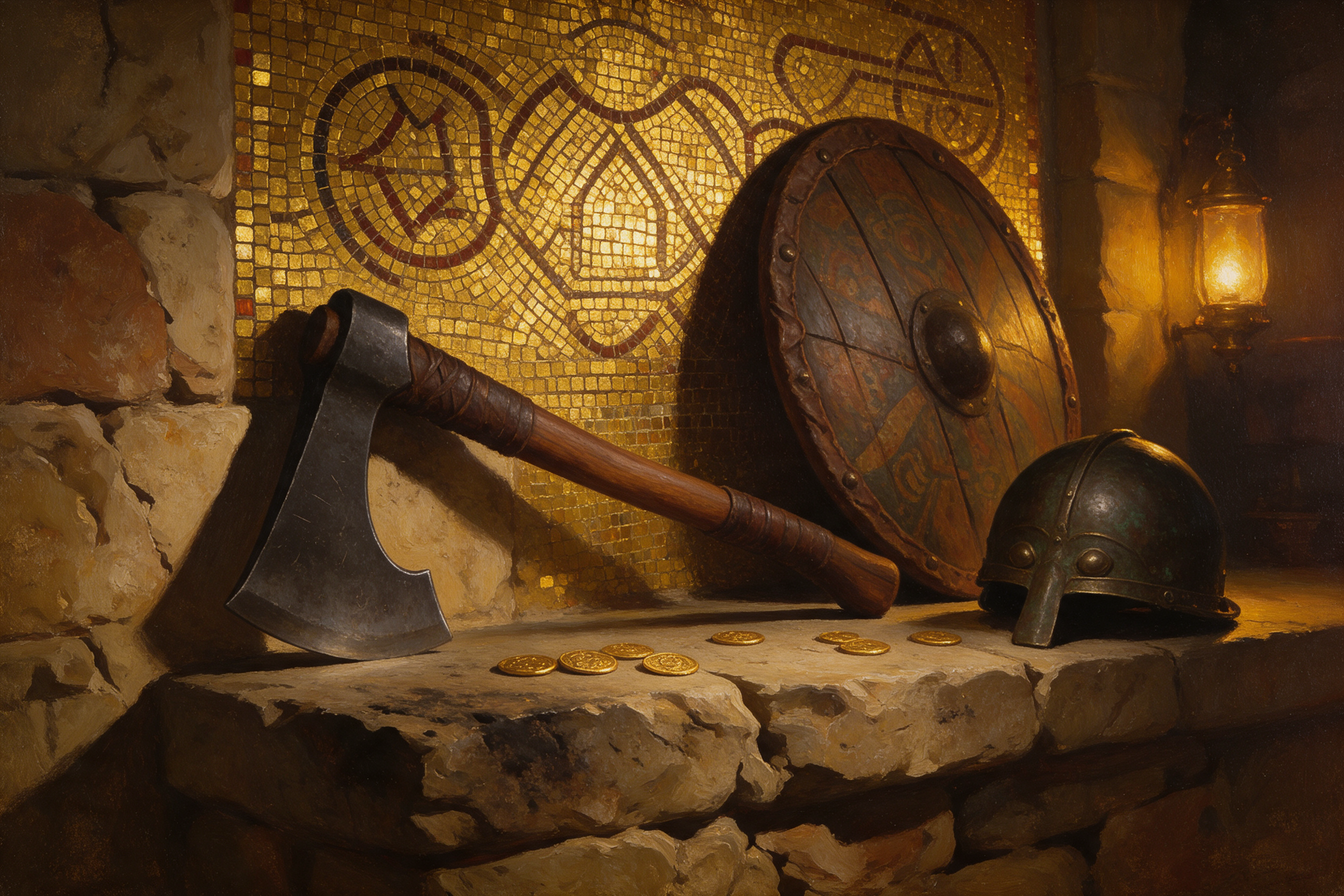
Byzantine writers describe them with a mixture of admiration and unease. Their signature weapon was the long two handed axe, and they appear in Greek sources as the axe bearing guard. They stood near the emperor at ceremonies, travelled with him on campaign, and were used as shock troops when a line needed breaking.
The princess and historian Anna Komnene, writing in the twelfth century, treats them as fiercely loyal and notes their tradition of regarding fidelity to the emperor as an inheritance passed down among them. Other writers remark, less admiringly, on their drinking.
Service was lucrative. Guardsmen drew good pay, shared in plunder, and by custom had rights to a distribution from an emperor's estate on his death. Men came south to get rich and a fair number went home having done it, which is why Scandinavian sagas and runestones carry references to Greece and to men who died there.
They also travelled a long way for it. Varangians appear campaigning in southern Italy against Normans and Lombards, in Syria and Armenia against Arab forces, in the Balkans against Bulgarians and Pechenegs, and at sea. Guarding the emperor meant going wherever the emperor went.
The most famous guardsman
In 1030 a Norwegian teenager fled his homeland after his half brother, King Olaf, was killed at the battle of Stiklestad. Harald Sigurdsson went east through Kiev and on to Constantinople, and spent years in the Varangian Guard. Icelandic and Norse sources put him on campaign in the Mediterranean, in Sicily, and in Asia Minor, rising to command among the Varangians.
He left with a considerable fortune, went back north, and became Harald Hardrada, king of Norway, a name that means hard ruler and was evidently earned. In 1066 he sailed to England to press a claim to its throne and was killed at Stamford Bridge by Harold Godwinson's army, days before Godwinson marched south to meet William at Hastings.
It is one of history's better connections. The year that decided the English succession involved a man who had once stood guard in Constantinople, and the sagas that describe his Byzantine service are among our more colourful sources on the guard itself, colourful being the operative caution.
From Norse to English
The composition of the guard drifted over time. After 1066, England produced a supply of displaced fighting men with reason to leave, and by the twelfth century the guard included a substantial English and Anglo Danish element alongside Scandinavians. Chroniclers describe Englishmen serving the emperor in numbers, which is a quiet epilogue to the Norman Conquest that rarely makes the textbooks.
The end came with the wider catastrophe. The Fourth Crusade sacked Constantinople in 1204, the empire fragmented, and the restored state after 1261 was a smaller, poorer thing that could not sustain a standing force of expensive foreign professionals. Varangians are still mentioned into the fourteenth century, increasingly as a ceremonial title rather than an active corps, and then the references stop.
The empire itself held on, much reduced, until 1453. If you want the story of how that ending arrived, we cover it in the fall of Constantinople, and the wider arc of the state the Varangians served is in what was the Byzantine empire.
Why this story sticks
The Varangian Guard endures in the imagination because it collides two worlds that our mental filing system keeps apart. Vikings belong to cold rivers and longships. Byzantium belongs to mosaics, silk and imperial protocol. For four centuries they were the same story, connected by the rivers of eastern Europe and by the ordinary human fact that a young man with a weapon will travel a very long way for good pay.
It is also a lesson in how rulers actually think about danger. Basil II armed strangers because his enemies were his own class. That kind of decision, sensible from the inside and odd from the outside, is exactly the sort we explore in Turning Points, which is a MindSnap feature, MindSnap being our app: you stand where the decision maker stood, with the information they had, and choose. The Byzantine chapters sit near the story of the empire's final century in our collections.
Frequently asked questions
One snap tomorrow morning.
Two minutes in art, history, psychology, philosophy or economics, then the app tells you you're done.
Get MindSnap on iOSFree daily fact, forever. Pro is $9.99/month or $44.99/year.