What Was Greek Fire? The Secret Weapon That Saved Constantinople

Arts & History Editor
Last updated: August 2026
7 min read
TL;DR
Greek fire was a liquid incendiary sprayed from bronze siphons on Byzantine warships, first deployed in the 670s and credited with breaking the Arab sieges of Constantinople in 674 to 678 and 717 to 718. It clung to timber and kept burning on the surface of the sea, which made it terrifying in a way that ordinary fire arrows were not. The empire treated the formula as a state secret held by a small number of families, and guarded it so tightly that the knowledge was eventually lost. Historians think it was petroleum based, probably light crude thickened with resins and heated under pressure, but the exact recipe is unknown and every reconstruction is an educated guess.
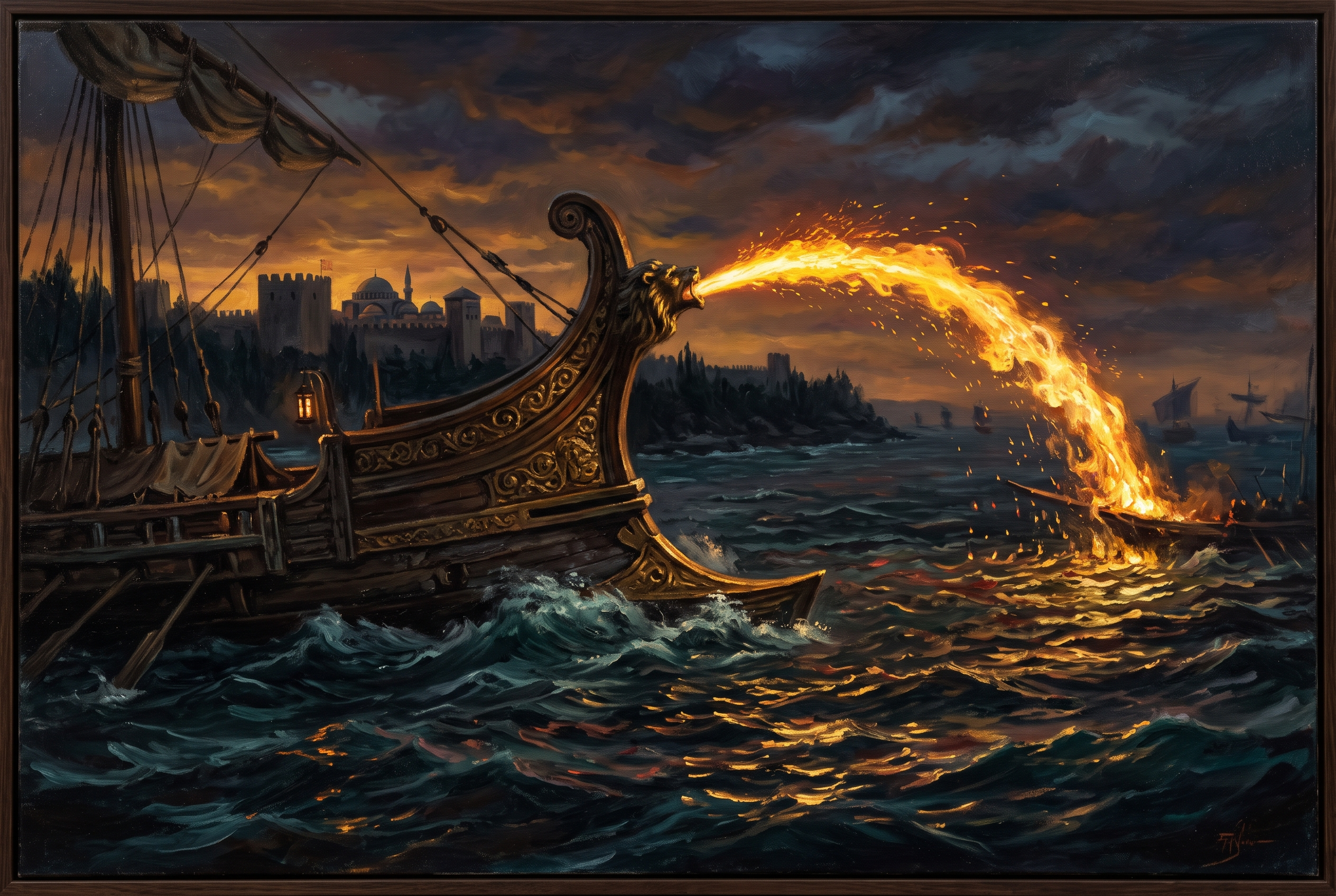
In the summer of 678 an Arab fleet lay off the coast near Constantinople after years of pressure on the city. Byzantine ships came out to meet it, and something happened that the sources describe with a kind of stunned repetition. Fire came from tubes in the prows of the Roman ships, struck the enemy vessels, and did not go out. It ran across the water. Men who jumped overboard to escape it found that the sea was burning too.
That weapon has a plain enough name in the Byzantine sources: liquid fire, sea fire, Roman fire. The label Greek fire is a later western coinage. Whatever it was called, it did something no medieval weapon was supposed to do, and it helped keep an empire alive for centuries.
Where it came from
The tradition credits a man named Kallinikos, an architect or engineer described as a refugee from Heliopolis in Syria, who arrived in Constantinople around 670 and brought the technique with him. That is what the chronicler Theophanes reports, and it may be broadly true, though the neat story of one inventor arriving at the perfect moment has the shape of a legend and should be held loosely. What is clear is that a serious incendiary weapon entered Byzantine naval service in that period, during the reign of Constantine IV.
The timing mattered enormously. The empire had lost Syria, Egypt and North Africa within a generation. Arab fleets had learned to fight at sea, and Constantinople was the prize. A defensive technology that could destroy ships faster than they could be built was worth more than any single victory in the field.
How it worked, as far as we can tell
The delivery system is better documented than the fuel. Byzantine dromons, the fast galleys that were the empire's standard warship, carried a bronze tube, the siphon, often mounted in the bow and sometimes decorated as an animal's head. Behind it sat a heated, sealed reservoir and a pump, probably a force pump worked by hand, which pressurised the mixture so it could be projected as a jet or spray rather than poured.
Three properties made it devastating.
- It stuck. Thickened liquid adhered to timber, rigging and sails instead of bouncing off, so a single hit could take a ship.
- It floated and kept burning. Fuel lighter than water spread across the surface, trapping crews who abandoned ship.
- Water made it worse, not better. Sailors' one instinct for fighting fire was useless, which multiplied the panic. Sources say sand and vinegar were the recognised countermeasures.
There were smaller versions too: hand-held siphons for close work, and sealed clay pots of the compound thrown like grenades. It was not a magic beam. It had a short range, it was hazardous to its own operators, and it was far less useful in a stiff wind or a rough sea. Byzantine admirals used it as a decisive close-range tool inside a wider tactical repertoire rather than as an opening move.
The two sieges it saved
The first great test was the Arab campaign against Constantinople traditionally dated 674 to 678. Rather than a single continuous blockade, this was a sustained multi-year effort based on nearby positions, with repeated attempts to control the sea approaches. Byzantine ships equipped with the new fire inflicted heavy losses, and the campaign eventually collapsed, with the retreating fleet reportedly wrecked further by storms.
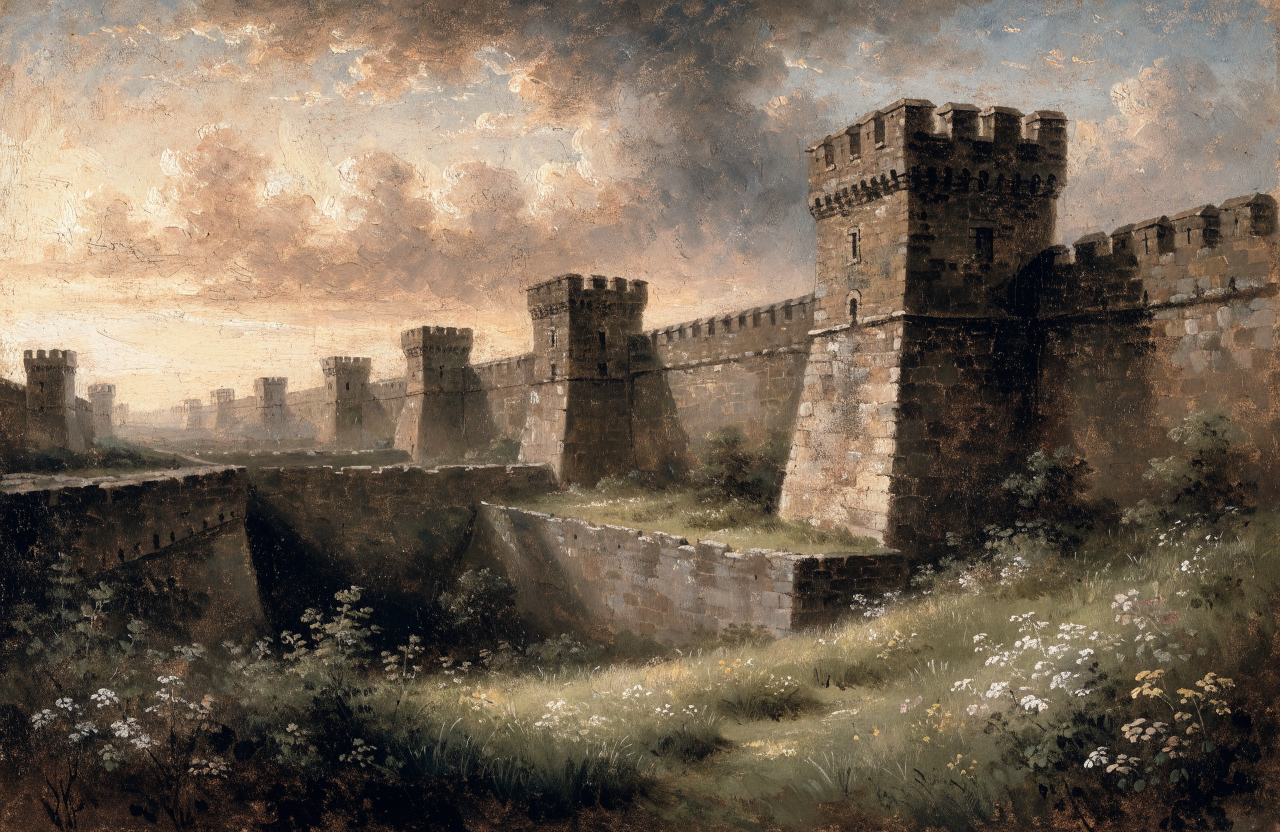
The second was the great siege of 717 to 718, when a very large Umayyad army and fleet invested the city by land and sea. Emperor Leo III used the fire against fleets in the Bosphorus and the Sea of Marmara. Combined with a brutal winter, supply failure, disease and Bulgar attacks on the besiegers' land forces, the assault broke. That failure is one of the genuine hinge moments of European history, and it happened behind walls that also refused to fall: the layered defences I describe in the Theodosian Walls explained.
The pattern held for centuries. Fire was used against Rus fleets in the tenth century, against rival Byzantine claimants, and in various sieges. It never won a war by itself. It made attacking the capital by sea an expensive gamble, which for a state fighting on many fronts was exactly the strategic effect required. The wider story of how that state kept surviving is worth reading alongside this: I sketch it in what was the Byzantine Empire.
The secret that was kept too well
The empire understood that its advantage lay in exclusivity, and it behaved accordingly. The formula and the operation of the siphons were treated as state secrets, entrusted to a small number of families and craftsmen. In the tenth century the emperor Constantine VII wrote to his son that the fire had been revealed by an angel to the first Christian emperor, with a solemn instruction that it be shared with no other nation, and that anyone who gave it away should be cursed. That is propaganda in the service of security policy, and it appears to have worked: rivals used incendiaries, but nothing that behaved quite the same way.
The strategy had an obvious flaw. Knowledge held by very few people is knowledge one bad generation can lose. Political chaos, the catastrophe of the Fourth Crusade in 1204, and the shrinking of the empire's technical base all took their toll. By the later medieval centuries the weapon has vanished from the record as a going concern.
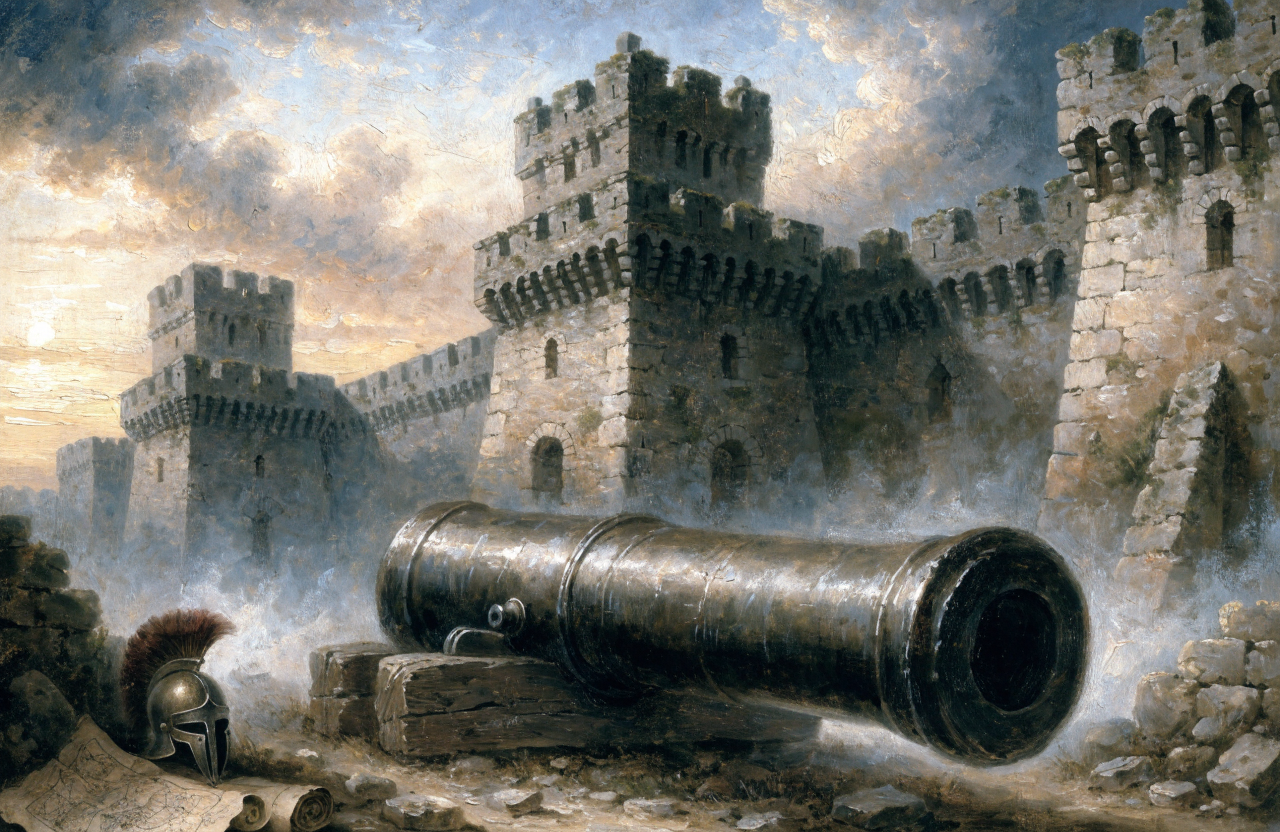
That absence had consequences. When the Ottomans brought enormous cannon to the walls in 1453, the defenders had incendiaries but nothing resembling the sea fire of the eighth century, and the sea was no longer the safe flank it once had been. The full account of that final siege sits in our collection The Day the Middle Ages Ended, and in the fall of Constantinople in 1453.
What was actually in it
Nobody knows, and any source that states a recipe confidently is guessing. The consensus is that the base was petroleum, most plausibly light crude skimmed from natural seeps around the Black Sea and the Caucasus, which the Byzantines could obtain and which behaves the way the accounts describe. Resins or pitch would thicken it so it clung and burned longer. Some reconstructions add sulphur, naphtha or quicklime, though the popular theory that quicklime made it ignite on contact with water fits the texts poorly, since the sources describe a heated, pressurised apparatus rather than a self-igniting liquid.
Two legends deserve flagging as legends. It did not burn underwater, and it was not unquenchable: sand, vinegar and old urine appear in the sources as effective countermeasures, and the fire could be starved like any other. It also was not a Byzantine invention from nothing. Incendiary mixtures were ancient. What was new was the combination of a thickened petroleum fuel with a pump and siphon that let a ship spray it accurately, and the institutional discipline to keep the whole system in-house for three hundred years.
That is the real lesson of Greek fire, and it is a modern one. The weapon's power came less from chemistry than from a monopoly, and the monopoly was maintained by secrecy that eventually devoured the knowledge it protected. If you like decisions with that shape, where the clever choice contains its own failure, the scenarios in Turning Points are built out of them.
Frequently asked questions
One snap tomorrow morning.
Two minutes in art, history, psychology, philosophy or economics, then the app tells you you're done.
Get MindSnap on iOSFree daily fact, forever. Pro is $9.99/month or $44.99/year.