Illuminated Manuscripts: How Books Were Made Before Print

Arts & History Editor
Last updated: August 2026
8 min read
TL;DR
Before print, a book was an object built from animals, minerals and years. A single large Bible could consume the skins of an entire herd, months of a scribe's eyesight and pigments that cost more than gold. Scribes left complaints in the margins, libraries chained their volumes to the desks, and then the printing press made the whole economy obsolete within a lifetime. Disclosure: MindSnap is our app.
Somewhere in a twelfth-century monastery, a monk finished a page, dipped his pen and wrote in the margin, in the small script reserved for things not meant to be read aloud: thank God it will soon be dark. He was not being poetic. He was cold, his hand hurt, and the light was going.
That is the detail that changes how you look at a medieval manuscript in a museum case. The gold and the blue read as luxury, and they were. But they sit on top of an enormous quantity of ordinary human labour, carried out by people who found it as tedious as you would.
The book began as a herd
Paper reached Europe late and slowly. For most of the Middle Ages the writing surface was parchment, made from the skins of calves, sheep or goats. Preparing it was a butcher's process before it was a scholar's one: soak the skin in lime to loosen the hair, scrape it clean, stretch it on a frame under tension, scrape again with a curved knife until it is thin and even, then smooth it with pumice and chalk.
The arithmetic is what startles people. A large format Bible might require the skins of a hundred or more animals. Vellum, the finest grade, came from very young calves, so the most beautiful pages in Europe were also the most expensive in livestock. Before a single word was written, the book represented a substantial part of a farm.
This is why parchment was so often recycled. Scrape the old text away, write over it, and you have a palimpsest, a page carrying a ghost. Some of the most important recoveries in the history of scholarship come from these erasures, where a discarded ancient text survived underneath a newer one that mattered less.
Ink, and the oak gall
The standard European ink was iron gall, and its recipe is a small piece of chemistry that predates chemistry. Wasps lay eggs in oak twigs, the tree responds by forming a hard growth called a gall, and those galls are rich in tannin. Crush them, soak them, add iron sulphate, thicken with gum arabic, and the result is a dark ink that bites into the surface rather than sitting on it.
That biting quality is why medieval writing survives so well and why conservators worry about it. Over centuries the iron can eat through the page, so some manuscripts are slowly being destroyed by the very ink that made them permanent.
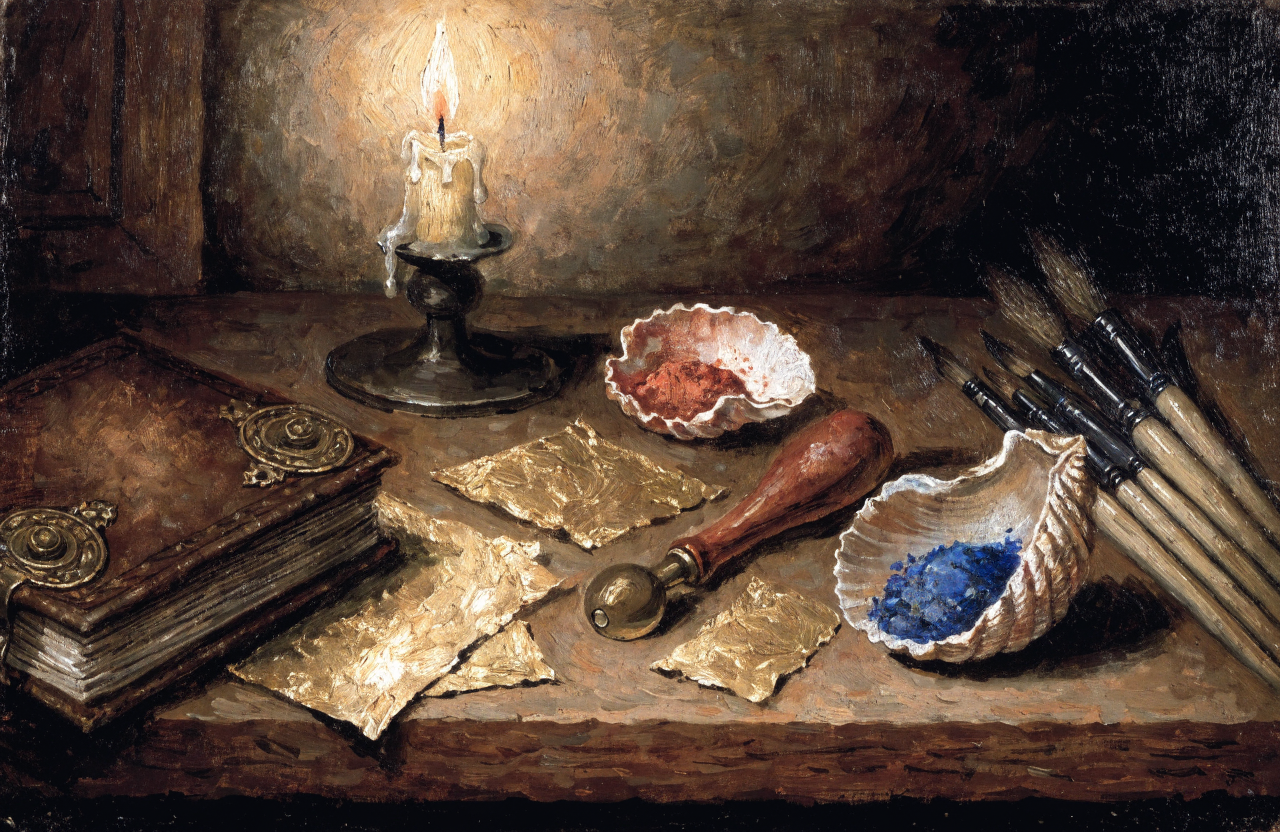
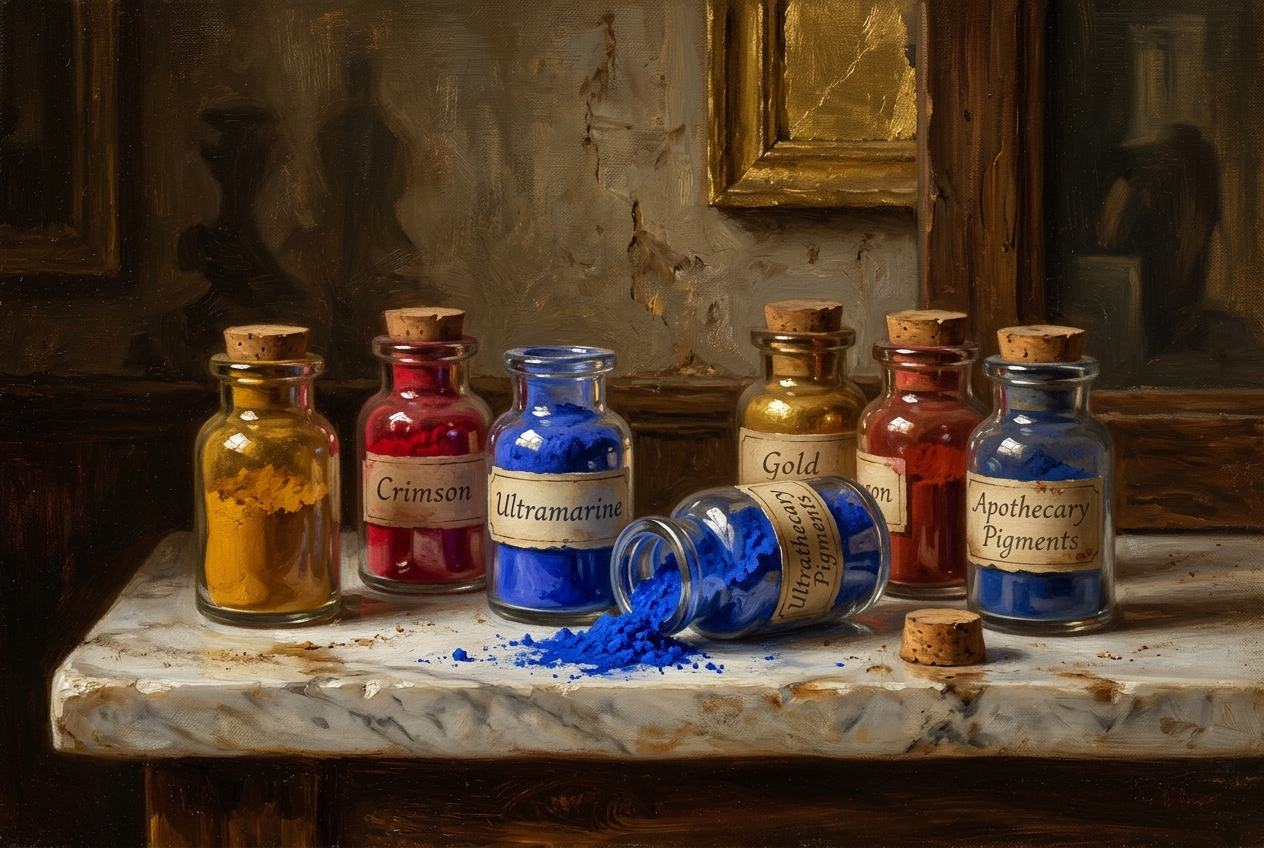
Then came the decoration, which is where the word illuminated comes from: pages lit up with metal. Gold leaf was laid on a raised ground of gesso and burnished with a stone or a tooth until it caught candlelight. For colour, the palette was mineral and organic: vermilion from mercury sulphide, verdigris from corroded copper, and above all ultramarine, ground from lapis lazuli hauled overland from what is now Afghanistan. It routinely cost more by weight than gold, which is why it was reserved for the Virgin's robe. I told that story at greater length in the piece on the most expensive colours in history.
A day in the scriptorium
The room itself was usually plain, sometimes just a corner of a cloister with desks arranged for light. Candles were often forbidden near the parchment, for the obvious reason, so the working day ran with the sun. Winter shortened it cruelly.
Copying was a division of labour. The scribe ruled the page with a hard point or lead, wrote the main text, and left gaps. A rubricator came behind and added headings and initials in red, from the Latin ruber. An illuminator painted the miniatures and the gold. A corrector checked the text against the exemplar. A binder assembled the gatherings into wooden boards covered in leather, sometimes with metal bosses and clasps to keep the parchment from buckling.
The pace was slow and the physical toll real: cramped hands, ruined eyes, cold. Which is why the marginalia are so human. Scribes complained about the ink, the vellum, their colleagues and the weather. Some drew rabbits committing atrocities, or a monkey playing bagpipes, or a snail besieging a knight. Others left the medieval equivalent of a signature sigh: now I have written the whole thing, for Christ's sake give me a drink.
Not every book was a Bible in a monastery, either. By the thirteenth century, university towns supported commercial workshops producing legal and medical texts for students, and wealthy laypeople commissioned books of hours, small private prayer books that became the personal luxury object of late medieval Europe.
Why the books were chained
Chained libraries look like paranoia until you price the contents. A book was worth as much as a house or a small farm, it was portable, and there were no copies to fall back on. So institutions ran their reading rooms the way a jeweller runs a shop: volumes fixed by chain to a rod along the desk, long enough to open and read, too short to walk away with.
Borrowing existed but was hedged with deposits and oaths, and some manuscripts carried a book curse, a formal written malediction promising anathema, disease or damnation to any thief. The theology is questionable. The security logic was sound.
What the press swept away
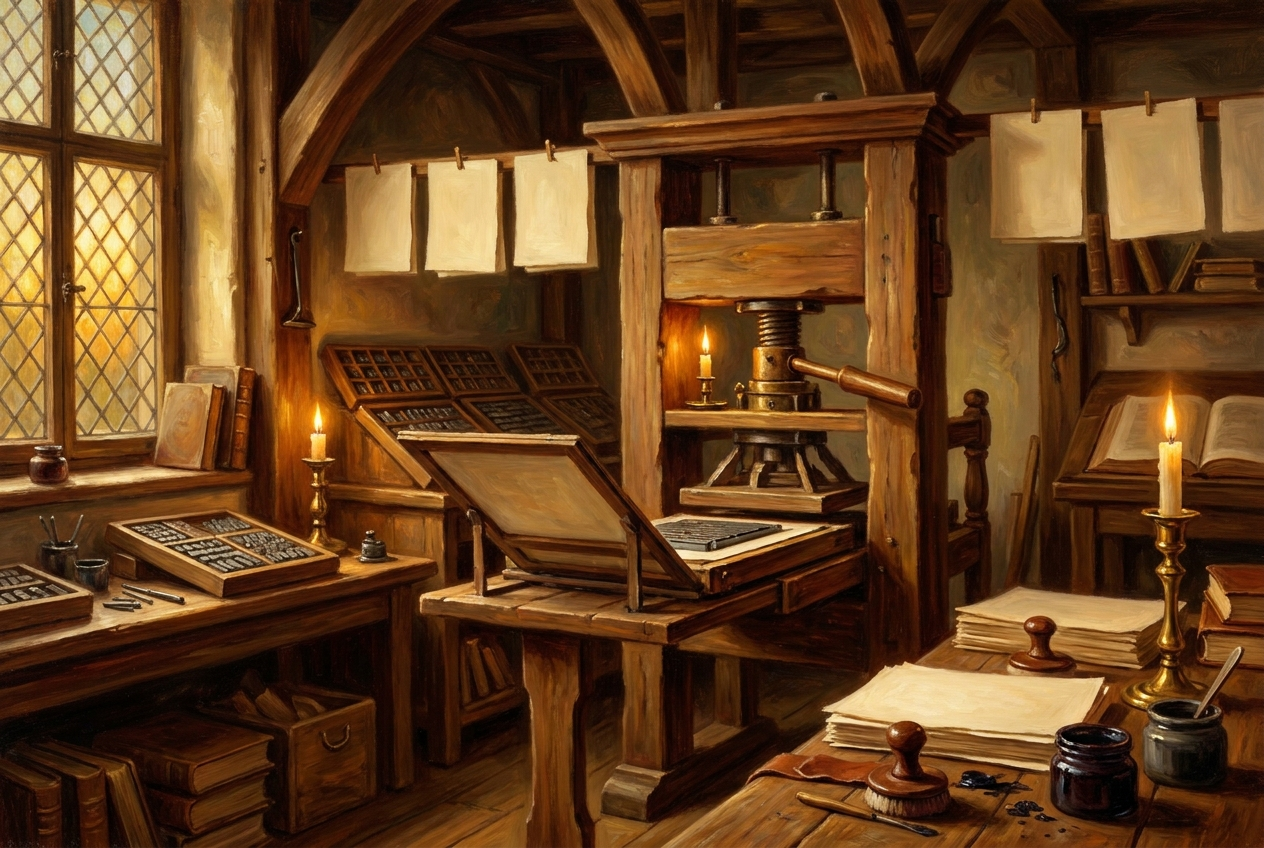
Then, in the middle of the fifteenth century, Johannes Gutenberg's movable type turned the whole economy inside out. The bottleneck had never been demand or literacy alone, it was the human hand, and the press removed it. Prices fell by an order of magnitude within decades, and a text could exist in hundreds of near-identical copies, which changed not only who could read but what it meant to cite something. The wider consequences are in my piece on how the printing press changed the world.
The transition was not tidy. Early printers imitated manuscript letterforms so closely that buyers sometimes could not tell the difference, and left spaces for initials to be painted by hand afterwards, so the earliest printed books are hybrids. Illumination survived for a while as pure luxury, then dwindled to the ceremonial.
It is worth resisting the usual framing here, in which the Middle Ages were dark until printing arrived. The scriptorium was the institution that carried classical texts across a thousand years, and its scribes were the reason there was anything for the press to print. I unpick more of that in seven myths about the Middle Ages. The end of that world came from many directions at once, one of which was the fall of Constantinople and the scholars who fled west with their libraries, the story told in The Day the Middle Ages Ended.
If you like history at the moment it pivots, the interactive Turning Points scenarios put you inside a few of those decisions rather than reading about them from outside. And a small disclosure since I work here: MindSnap is our app, and this is the sort of story it exists to tell in two minutes a day.
The next time you see one of these books under glass, look past the gold. Look for the ruling lines, faint under the script, and the small scratched corrections. Somebody sat in the cold making those, and hoped it would soon be dark.
Thank God it will soon be dark. A scribe's marginal note, and the most relatable sentence in medieval literature.
Frequently asked questions
One snap tomorrow morning.
Two minutes in art, history, psychology, philosophy or economics, then the app tells you you're done.
Get MindSnap on iOSFree daily fact, forever. Pro is $9.99/month or $44.99/year.