How the Printing Press Changed the World

Arts & History Editor
Last updated: August 2026
8 min read
TL;DR
Johannes Gutenberg did not invent printing, and he did not invent movable type. Printing with movable type existed centuries earlier in East Asia, where Bi Sheng made ceramic type in the eleventh century and Korean workshops cast metal type well before 1450. What Gutenberg assembled in Mainz was a system: a durable metal alloy, an oil-based ink that stuck to it, a hand mould for casting type quickly and a screw press adapted to paper. The result collapsed the cost of a book, made identical copies possible and gave the Reformation and the new sciences a distribution network.
Before the press, a book was a building project. A single Bible could take a scribe most of a year, consume the skins of a couple of hundred animals for parchment, and cost as much as a small house. Books were not scarce because nobody wanted them. They were scarce because every copy required a human being to move a pen across a surface for months.
That world had its own remarkable infrastructure. Monastic scriptoria trained copyists, standardised scripts and corrected texts. By the thirteenth century university towns like Paris and Bologna had commercial workshops renting out sections of approved texts so several copyists could work in parallel. Manuscript culture was sophisticated, and it had a hard ceiling: the copy rate of a hand.
What Gutenberg actually built
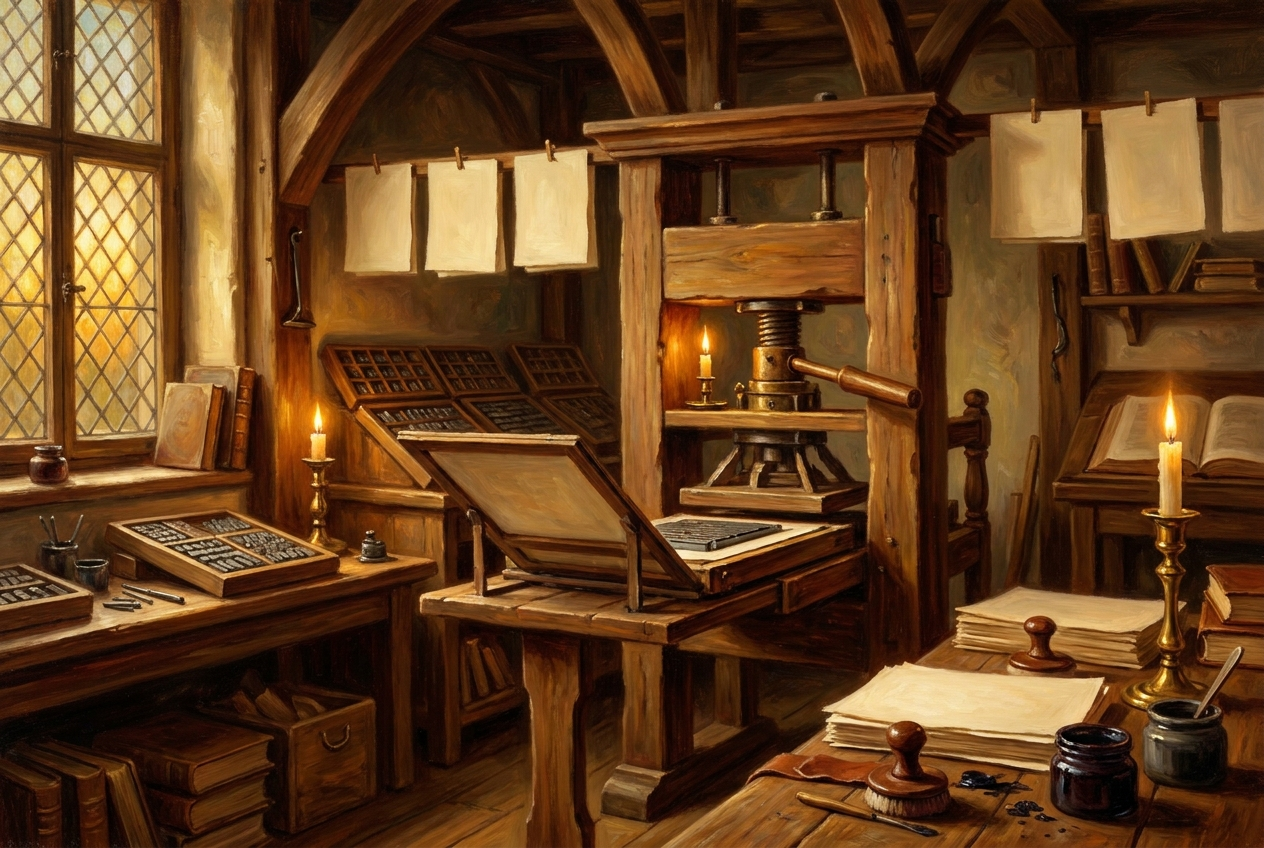
Johannes Gutenberg was a goldsmith in Mainz, and the crucial point about his achievement is that it was metallurgical and mechanical rather than conceptual. The idea of printing from reusable pieces of type was not his. What was missing in Europe was a way to make that idea work at industrial quality.
He solved four problems at once, in the years around 1450.
- An alloy, roughly lead with tin and antimony, that melted at a workable temperature, filled a mould crisply and survived thousands of impressions.
- A hand mould with an adjustable matrix, so identical letters could be cast rapidly and in quantity. This, more than the press itself, is often called his real invention.
- An oil-based ink, closer to a painter's medium than to the water-based inks scribes used, because water-based ink beads and slides off metal.
- A press adapted from the screw presses already used for wine and paper, delivering even pressure across a full forme.
The famous product, the forty-two-line Bible finished in the mid 1450s, was not cheap and was not meant to be. It was a demonstration that a machine could match the finest scribal work. The economics arrived afterwards, as printers spread out of Mainz and discovered that the real money was in small, fast, useful books.
The myth worth retiring
Gutenberg is routinely described as the inventor of printing, and that claim does not survive contact with East Asian history. Woodblock printing was in use in China centuries earlier, and the Diamond Sutra printed in 868 is among the oldest dated printed books that survive. Around 1040 the artisan Bi Sheng is recorded as having made movable type from fired clay.
Korea went further with metal. Bronze type was cast and used there in the thirteenth century, and the Jikji, printed with metal type in 1377, survives as evidence. In the fifteenth century, under King Sejong, Korean printing was state-supported and technically accomplished, and the new Hangul alphabet made typesetting far more tractable than thousands of Chinese characters ever allowed.
So the honest formulation is this. Movable type was invented in East Asia. Gutenberg independently developed a European version of it and, crucially, built the surrounding system that made it commercially explosive in a continent using a small alphabet, paper mills and an existing merchant network. Both halves of that sentence matter, and the usual telling drops the first one.
What actually changed
The price of reading
Within a few decades of 1450, printing shops had appeared in dozens of European cities and the cost of a book fell by an order of magnitude and then kept falling. Paper, cheaper than parchment and already produced in European mills, mattered as much as the press. A student could own texts rather than borrow them. Ownership changes how you read: you annotate, you compare, you keep.
Identical copies
This is the effect people underrate. Every hand copy drifts, and errors accumulate down the generations. Print produced thousands of copies that were the same, which meant a scholar in Basel and a scholar in Kraków could argue about page and line. Cross-referencing, indexes, page numbers, errata sheets and eventually the modern citation all depend on that stability.
Speed
The Reformation is the clearest demonstration. When Martin Luther published his theses in 1517 the dispute spread not as a manuscript controversy among clerics but as a flood of cheap German-language pamphlets, printed fast, illustrated with woodcuts, sold for the price of a meal. His opponents printed too. Europe's first mass media war was conducted in eight-page booklets, and pamphlet culture is why the argument escaped the university.
Reliable data
The new sciences needed something the manuscript world could not supply: tables, diagrams and star positions that were identical in every copy. Copernicus, Vesalius and their successors published into a system where a reader could check a figure against the author's own. Printed observations could be tested, corrected and reprinted, which is most of what a scientific community is.
The parts that were not liberating
It would be a poor history that stopped at progress. Print also industrialised propaganda, and the same presses that carried the Reformation carried witch-hunting manuals and confessional hatred across borders. Censorship regimes grew in response, including the Index of prohibited books. Printers were licensed, monitored and occasionally executed. And print hardened languages: a dialect that got a printing press became a standard, and a dialect that did not began a long decline.
A turning point, not a switch
The press did not end the Middle Ages by itself. It arrived in the same half-century as the fall of Constantinople in 1453, which sent Greek scholars and manuscripts west, and as European voyages that redrew the map. Those events reinforced each other: refugee scholars had texts, printers had presses, and merchants had shipping routes for the resulting books. We follow that convergence chapter by chapter in the collection The Day the Middle Ages Ended, and the siege itself gets its own piece in the fall of Constantinople.
It is a useful case study in how turning points actually work. Nobody in Mainz in 1450 was trying to trigger a religious schism or a scientific revolution. A goldsmith was trying to make a business out of selling books more cheaply than scribes could. The consequences were downstream, distributed and mostly unintended, which is the shape most historical hinges have. If you enjoy standing at those moments and deciding for yourself, our interactive Turning Points feature drops you into a few of them, and it is free to try in a browser. Disclosure: MindSnap is our app.
It also puts the usual counterfactual in perspective. Ask what Europe looks like without the press and you quickly find you cannot hold the answer steady, which is the honest lesson of every exercise in history's greatest what ifs. Empires and eras rarely turn on a single machine, a point we made at length about the fall of Rome.
What you can say with confidence is narrower and more interesting. For about fourteen centuries, the number of copies of an idea was limited by the number of hands willing to write it out. After the 1450s it was limited by demand. Almost everything we now call the modern world happened on the far side of that change.
Frequently asked questions
One snap tomorrow morning.
Two minutes in art, history, psychology, philosophy or economics, then the app tells you you're done.
Get MindSnap on iOSFree daily fact, forever. Pro is $9.99/month or $44.99/year.