How the Dutch Built a Country Below Sea Level

Arts & History Editor
Last updated: August 2026
9 min read
TL;DR
A large share of the Netherlands sits below sea level, and much of it exists because people pumped the water out and kept pumping. The sequence ran from medieval dykes and drainage ditches, to windmills used as pumping engines, to polders enclosed and dried acre by acre, all administered by water boards that elected their own officers centuries before national parliaments existed. The 1953 flood exposed what remained and produced the Delta Works. The habits this bred, collective infrastructure, tolerated risk, pooled capital, are inseparable from the trading republic that followed.
Stand on a road in North Holland and the ships are above you. Not on the horizon: above the line of your eyes, moving along a canal held up by earth banks while the fields on either side lie several metres lower. There is nothing natural about the arrangement. Somebody dug it, somebody drained it, and somebody is still pumping.
Roughly a quarter of the Netherlands lies below sea level, and a much larger share would flood without continuous defence. The country is the single best example in Europe of geography being not inherited but manufactured.
The land that would not stay put
The problem starts with peat. Much of the western Netherlands was waterlogged peat bog, and peat behaves cruelly when drained. Remove the water and the ground oxidises and compacts, so the surface sinks. Farmers who drained a field to make it usable found it lower a generation later, and lower still after that. Drainage created the need for more drainage.
This is the crucial fact that makes Dutch history make sense. The work was never finished, which meant it could never be abandoned. A community that stopped maintaining its ditches did not merely lose a harvest. It lost the ground.
Dykes, and the rule that everyone digs
From roughly the eleventh century, settlers built earth dykes along rivers and the coast and dug ditches inland, draining fields into channels and channels into rivers at low tide through simple one-way sluices. Gravity did the work while the sea was low, and the gates shut when it rose.
A dyke is only as good as its worst maintained section, and its worst section is somebody else's field. This produced an obligation unlike ordinary feudal duty: every landholder along a stretch of dyke owed labour and money to it, and neglect endangered neighbours rather than only the neglecter. Enforcement had to be local, technical, and continuous.
Water boards: the awkwardly old institutions
The answer was the water board, in Dutch the waterschap or hoogheemraadschap, bodies that emerge in the thirteenth century and in several cases still operate today. They levied taxes, inspected dykes, fined the negligent, adjudicated disputes, and chose their own officers from among the landholders they governed.
It is worth being careful here rather than romantic. These were not democracies in the modern sense. Participation was tied to landholding, not to personhood, and the franchise excluded most people who lived on the land. But they were elected, functional, tax-raising public bodies with genuine coercive power, operating for centuries alongside and often independently of princes. When historians look for the roots of Dutch political habits, consensus-seeking, technical committees, negotiated compromise between parties who cannot simply leave, the water boards are the honest starting point.
The logic is unsentimental. When your neighbour's failure drowns your family, you build institutions that make his maintenance your business.
Windmills as engines
Gravity drainage has a hard limit: once the land sits below the water you are draining into, low tide no longer saves you. Solving that required lifting water upward, and from the late fourteenth and fifteenth centuries the Dutch adapted the windmill to do it.
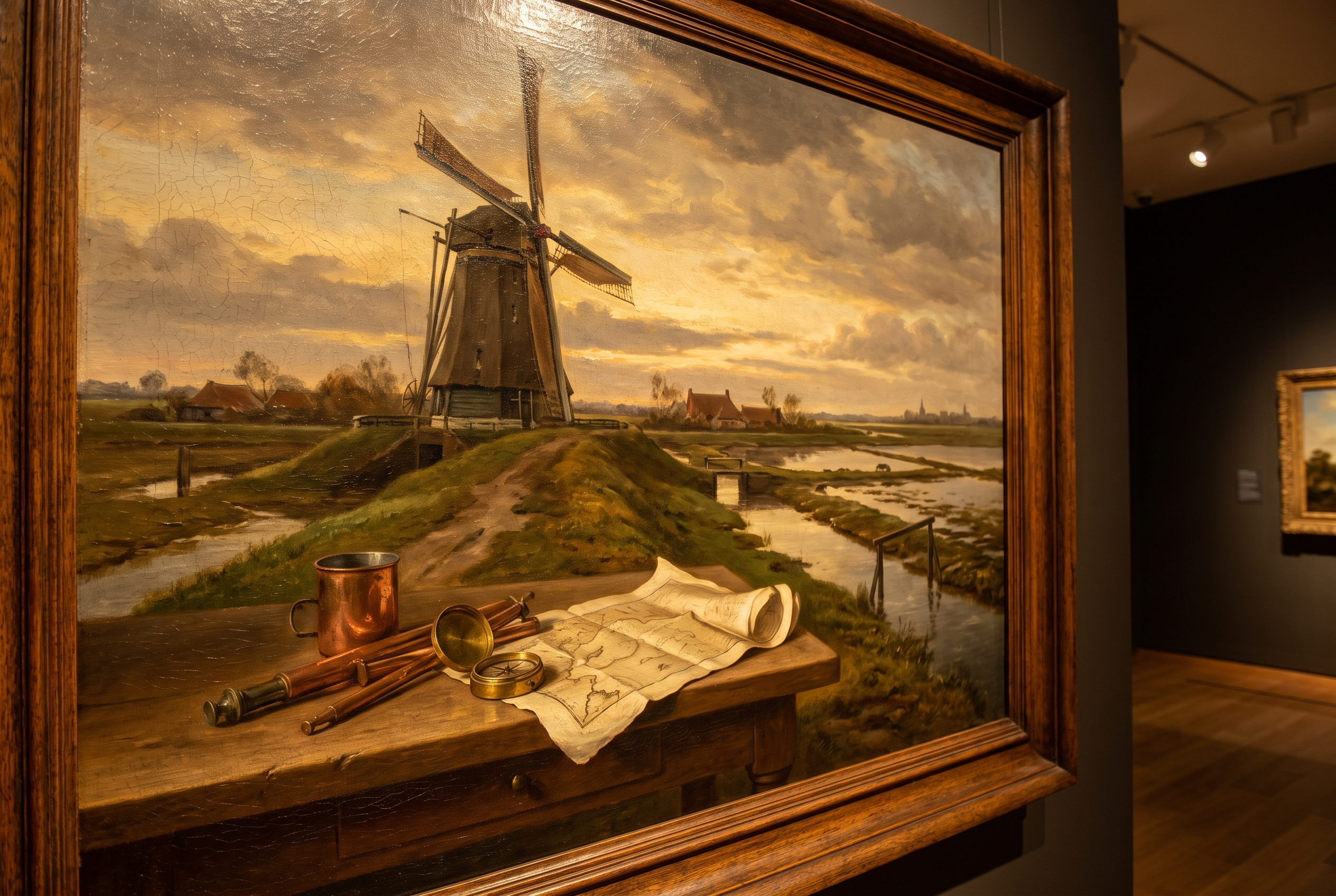
Not for grinding grain: for pumping. A wind-driven scoop wheel or Archimedes screw raised water a couple of metres into a holding basin. One mill's lift was modest, so mills were arranged in chains, each passing water to the next, stepping a lake up to the level of a river. The famous mill landscapes of the Netherlands are not picturesque agriculture. They are the visible remains of a distributed pumping network.
The polder
With pumping available, the ambition changed from defending land to creating it. The method: ring a lake or a stretch of shallow sea with a dyke, dig a canal outside it, install a chain of mills, and pump until the bed appears. The enclosed, drained result is a polder.
Large seventeenth-century projects such as the Beemster drained lakes into geometric farmland that still looks drawn with a ruler. These were investments, financed by consortia of Amsterdam merchants expecting a return on new agricultural land, in the same city and the same decades that produced share trading, marine insurance, and the speculative episode we cover in tulip mania. Draining a lake and buying a share in a voyage were adjacent activities, often undertaken by the same people. Our flagship economics collection Tulip Fever sits inside exactly that world. MindSnap is our app, so treat that as a recommendation with an interest attached.
Reclamation had a cost that was understood at the time and is clearer now. Drained peat keeps sinking, so each generation inherits a deeper bowl and a larger pumping bill. Much of the country's present vulnerability is the compound interest on medieval success.
1953
On the night of 31 January 1953, a severe North Sea storm coincided with spring tides. Water overtopped and breached defences across the south-west of the Netherlands, and more than eighteen hundred people died there, with heavy losses in eastern England and at sea as well. Many defences had been neglected through occupation and post-war scarcity, and warning systems barely existed.
The response was the Delta Works, a decades-long programme of dams, storm surge barriers, and shortened coastline. Its emblem is the Oosterschelde barrier, built with movable gates after protest from fishing communities and ecologists made a solid dam politically impossible. That compromise, a barrier that stands open in ordinary weather and closes against surges, is the water board mentality scaled to a nation: engineering settled by negotiation between parties who all have to live behind the same wall.
Why the plumbing mattered for trade
The link between drainage and commercial power runs through three channels.
- Transport. The same works that drained the land produced a dense canal network, and moving heavy goods by water is far cheaper than by road. A flat wet country became unusually well connected internally.
- Capital and cooperation. Reclamation demanded pooled money, shared risk, and enforceable collective obligation, precisely the habits that later financed voyages, spread marine risk, and staffed the Amsterdam exchange described in the Dutch Golden Age.
- Urban concentration. Poor grain land and excellent water access pushed the Dutch toward buying food abroad and specialising in shipping, finishing, and finance, which is the standard path by which wet flat places become rich, as in why port cities rule the world.
None of this makes hydrology destiny. Plenty of wet regions never built a republic or an exchange. But the causal thread from mud to money is unusually short here, and it runs through institutions rather than through natural advantage.
The idea worth keeping
The Dutch achievement was not a wall. It was the arrangement that keeps a wall maintained for eight hundred years after the people who built it are dead: a body that can tax, inspect, and compel, and that has to answer to the people standing behind the wall.
If you want to feel what those decisions were like from the inside, Turning Points puts you in the room before the outcome is known. You can also browse the wider subject areas on topics.
Frequently asked questions

One snap tomorrow morning.
Two minutes in art, history, psychology, philosophy or economics, then the app tells you you're done.
Get MindSnap on iOSFree daily fact, forever. Pro is $9.99/month or $44.99/year.