Fertilizer Geopolitics Explained: Why Food Power Starts in the Soil

Learning Science Writer
Last updated: August 2026
8 min read
TL;DR
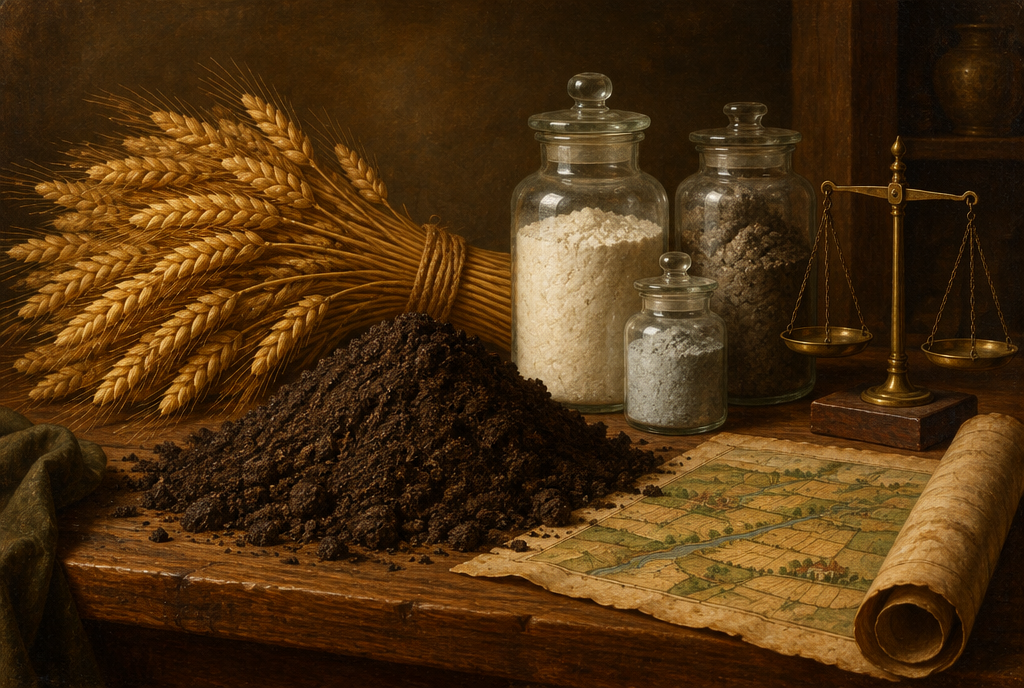
Modern farming depends on three plant nutrients: nitrogen, phosphorus and potassium. Nitrogen can be pulled from the air using the Haber-Bosch process, invented in the early twentieth century, which made synthetic fertilizer possible and is widely credited with supporting the huge growth in world population since. It needs large amounts of energy, usually natural gas, so nitrogen supply is tied to energy supply. Phosphorus and potassium cannot be made from air: they are mined from phosphate rock and potash deposits that are concentrated in a small number of places, with Morocco holding very large phosphate reserves and Canada, Russia and Belarus among the major potash producers. History shows the same pattern repeatedly, from the nineteenth century guano rush onward: whoever controls plant nutrients holds quiet but real leverage over the world's food supply.
When people talk about food security, they usually picture fields of wheat, grain silos or cargo ships crossing the ocean. Those matter. But underneath every harvest sits a less visible layer of power: the nutrients that make the soil productive in the first place.
This explainer looks at that layer structurally. It is about geology, chemistry and historical patterns, not about any current dispute. The aim is to show why a bag of fertilizer is, in its quiet way, a geopolitical object.
The three nutrients behind every harvest
Plants need many elements, but three are required in large quantities and are the backbone of commercial fertilizer. They are usually abbreviated by their chemical symbols as NPK.
- Nitrogen (N): essential for leaf growth and protein. Abundant in the air but not in a form most plants can use directly.
- Phosphorus (P): vital for roots, energy transfer and seeds. Comes mainly from mined phosphate rock.
- Potassium (K): supports water regulation and disease resistance. Comes mainly from mined potash salts.
Each harvest removes some of these nutrients from the soil. Unless they are replaced, yields decline. That simple fact is the root of fertilizer's strategic importance.
Haber-Bosch: turning air into food
For most of history, farmers replaced nitrogen with manure, crop rotation and legumes, whose root bacteria fix nitrogen from the air. These methods worked, but they capped how much food a given piece of land could produce.
In the early twentieth century, the German chemists Fritz Haber and Carl Bosch developed and industrialized a process for combining nitrogen from the air with hydrogen to make ammonia. The Haber-Bosch process made synthetic nitrogen fertilizer possible on an enormous scale. It is widely regarded as one of the most consequential inventions of the modern era, and many researchers credit it with helping support a large share of today's global population.
There is a structural catch. The process is energy intensive, and the hydrogen typically comes from natural gas. That means nitrogen fertilizer is closely linked to energy markets. Regions with abundant, cheap gas tend to be competitive producers, and when energy prices move, fertilizer prices often follow.
Geology decides phosphorus and potassium
Nitrogen can be made anywhere with enough energy. Phosphorus and potassium cannot. They must be dug from the ground, and the ground did not distribute them evenly.
Phosphate rock formed mainly from ancient marine sediments, and economically significant deposits are concentrated in relatively few countries. Morocco, including the territory of Western Sahara, is commonly estimated to hold the largest share of known reserves, with China, the United States and several other countries also important producers.
Potash comes mostly from deposits left behind when ancient seas evaporated. Canada, particularly Saskatchewan, has some of the largest deposits in the world, and Russia and Belarus are also among the major producers. A handful of other countries round out the picture.
| Nutrient | Main source | What shapes supply |
|---|---|---|
| Nitrogen | Air plus energy via Haber-Bosch | Access to cheap energy, usually natural gas |
| Phosphorus | Mined phosphate rock | Geology: reserves concentrated in a few countries |
| Potassium | Mined potash salts | Geology: a few large deposit regions |
The guano rush: a history lesson in bird droppings
The pattern is not new. In the nineteenth century, before Haber-Bosch, one of the world's most prized fertilizers was guano: accumulated seabird droppings, rich in nitrogen and phosphorus, found in vast deposits on dry islands off the coast of Peru.
Guano exports became a major source of revenue for Peru for several decades. Demand was so intense that in 1856 the United States passed the Guano Islands Act, allowing citizens to claim unoccupied islands with guano deposits. Nitrate deposits in the Atacama desert later became part of the tangled causes of the War of the Pacific between Chile, Peru and Bolivia in the late 1800s. Then the deposits ran down and synthetic nitrogen arrived, and the guano era faded almost as quickly as it had begun.
It is a pattern we have seen with other essentials, from salt to spices: control of a scarce input confers power, until technology or new supplies dissolve the monopoly.
Why fertilizer is quiet leverage
Fertilizer rarely makes headlines the way oil does, yet its strategic logic is similar. A few structural features explain why.
- 1It is hard to substitute. There is no alternative element for phosphorus or potassium. Plants simply need them.
- 2Supply is concentrated. When a few regions dominate production, disruptions in any one of them ripple outward.
- 3Timing matters. Fertilizer must be applied in the right season. A shortage at planting time can reduce a harvest months later.
- 4It moves by sea. Bulk fertilizer travels on ships through the same routes that carry grain and energy, exposing it to the vulnerabilities described in our piece on maritime chokepoints.
This is why food power is layered. The great breadbasket regions grow the crops, but their output depends on nutrients often mined or manufactured far away. Water is another layer, explored in our piece on why fresh water shapes geopolitics.
Responses over time
Countries and farmers have responded to these structural pressures in ways that recur across history: diversifying suppliers, building domestic production where geology allows, improving efficiency so less fertilizer is wasted, recycling nutrients from manure and waste, and researching crops that use nutrients better. None of these removes the underlying geography, but each softens its edges.
The takeaway
Fertilizer geopolitics is a reminder that power often lives in unglamorous places. Chemistry turned the air into a nitrogen factory, but it could not move phosphate rock or potash deposits. As long as harvests depend on those nutrients, the map of the soil beneath the soil will remain one of the quiet maps of world power. If structural stories like this interest you, you can explore more of them on our topics page.
Frequently asked questions

One snap tomorrow morning.
Two minutes in art, history, psychology, philosophy or economics, then the app tells you you're done.
Get MindSnap on iOSFree daily fact, forever. Pro is $9.99/month or $44.99/year.