How Did a Trial Work in Ancient Athens? Inside the Court That Condemned Socrates

Arts & History Editor
Last updated: August 2026
10 min read
TL;DR
An Athenian trial was not a courtroom drama with lawyers and a judge. It was a mass meeting: several hundred citizens picked by lot on the morning of the trial, both sides speaking for themselves against a water clock, no rules of evidence to speak of, one show of hands on guilt, and then a second vote choosing between the penalty each side proposed. Socrates was condemned in 399 BC by that machinery, in what was probably a single day.
Picture the scene we think we know. A raised bench, a judge in robes, two advocates trading objections, twelve jurors in a box. Now delete all of it. An Athenian trial had no judge in our sense, no advocates, no cross-examination as a formal procedure, no appeal, and a jury the size of a small theatre audience. What it had instead was lots, water and bronze.
Chosen on the morning, by machine
Any male citizen over thirty could enrol as a potential juror, a dikastes, for the year. Enrolment did not mean serving: it meant entering a pool. On a court day, jurors gathered early and selection happened on the spot using a kleroterion, a slab of stone with columns of narrow slots. Each juror's identity token, a small bronze pinakion inscribed with his name and tribe, was slid into a slot. A tube on the side of the stone held black and white balls, released one at a time, and each ball assigned or dismissed a whole row of tokens at once.
The point was to make the panel unpredictable and unbribable. Nobody, including the litigants, knew until that morning who would hear the case or which court they would sit in. Panels were large by design: 201 or 401 jurors for many private suits, 501 for serious public cases, and occasionally more for matters touching the city itself. Socrates faced a panel usually reckoned at 501.
Jurors were paid a modest daily fee, which mattered enormously. It meant a poor citizen could afford a day in court, which is precisely what made the courts popular institutions rather than gentlemen's clubs. The comic playwrights teased the retired men who lived on jury pay, but the fee is why the system belonged to the whole citizen body.
No lawyers, no judge, no adjournment
Athenian prosecutions in public cases were brought by private citizens, not by a state prosecutor. There was no police force to investigate and no office to decide whether a charge was worth pursuing. If you thought a law had been broken, you brought the case yourself and took the risk, since frivolous prosecutors could be penalised.
Presiding over the court was a magistrate whose role was administrative: he kept order and managed the procedure. He did not instruct the jury on the law, sum up the evidence, or rule on admissibility. The jury decided law and fact together, in one undivided judgement, and its verdict was final. There was nowhere to appeal to, because the panel of citizens already was the sovereign people in miniature.
Litigants spoke for themselves. Wealthy defendants could commission a speech from a professional writer, a logographos, and memorise it, which is how so much Athenian oratory survives as literature. Witnesses appeared to affirm statements rather than to be interrogated at length, and documents were read out by a clerk. Character, reputation, service to the city and the visible presence of one's weeping family were all considered fair material. There was no line between legal argument and appeal to sentiment, because nobody had drawn one.
The water clock
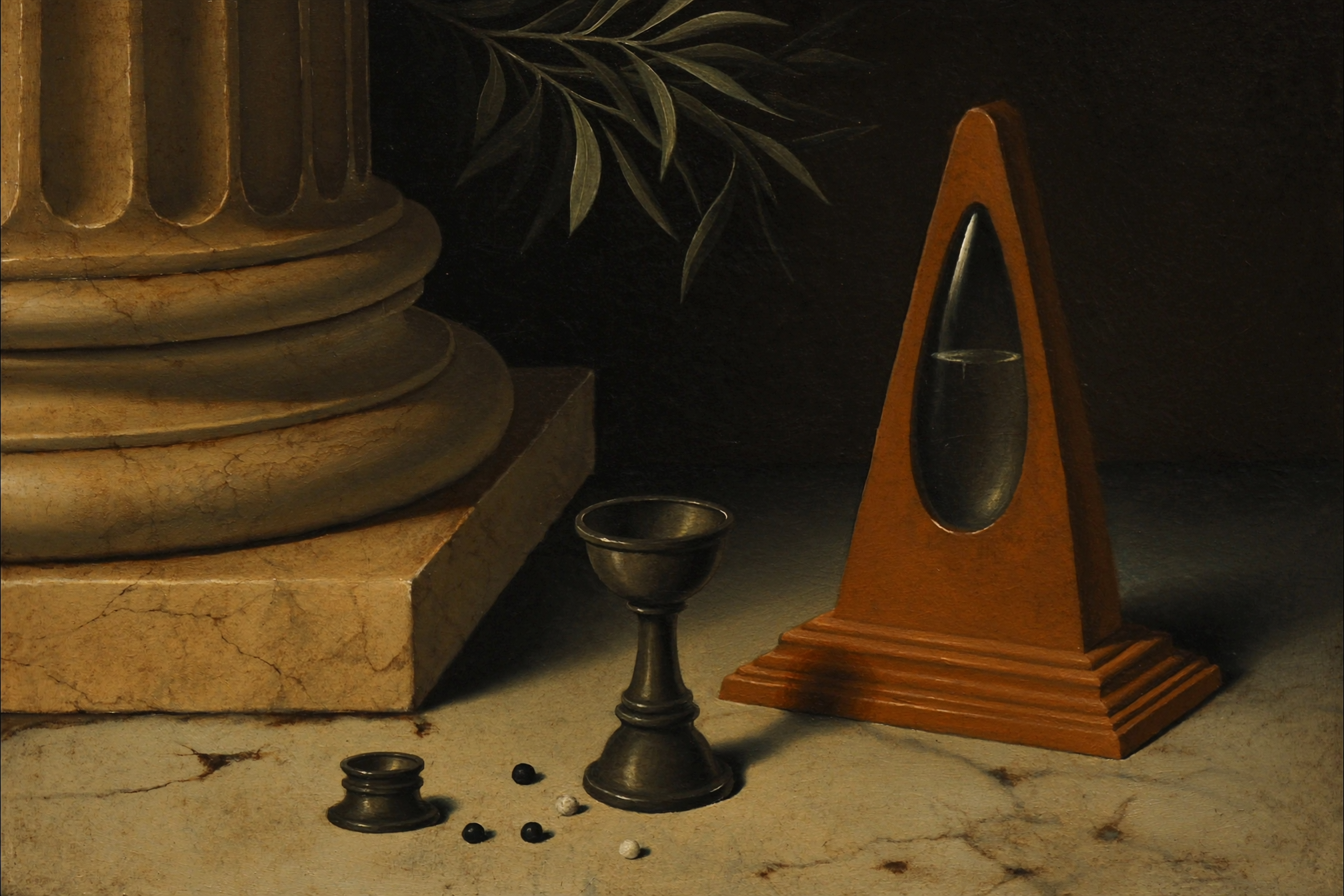
Time was measured by a klepsydra, a clay vessel that drained through a spout at a fixed rate. Each side received an allotted volume of water and spoke until it ran out. The clock was stopped while documents were read, and the man in charge of it had one of the few genuinely powerful minor jobs in the building. There was no extending a case over days, no reserved judgement, no returning after lunch with new material. A trial began and ended in a single sitting, most within a day.
The consequences of that design are worth sitting with. A litigant could not wear down an opponent through delay, which is a real virtue. But nor could anyone slow a case down to think, gather documents, or let a public mood cool, which is a real cost. Athenian justice was fast, cheap, participatory and irreversible.
Two votes, and a bargain about the penalty
Jurors voted by dropping bronze ballots into urns. Each juror received two discs, one pierced and one solid, and covered the centre with his fingers so his choice stayed private as he placed one in the counted urn and discarded the other. The count was public, the choice was not.
In many public cases the penalty was not fixed by statute. After a guilty verdict the prosecutor proposed a punishment and the defendant proposed an alternative, and the jury voted a second time between exactly those two options. It could not invent a third. This produced a peculiar strategic game: a defendant's best move was usually to offer something painful enough to look like an accepted rebuke, so that the jury would not feel obliged to pick the harsher proposal.
399 BC, and one very bad counter-offer
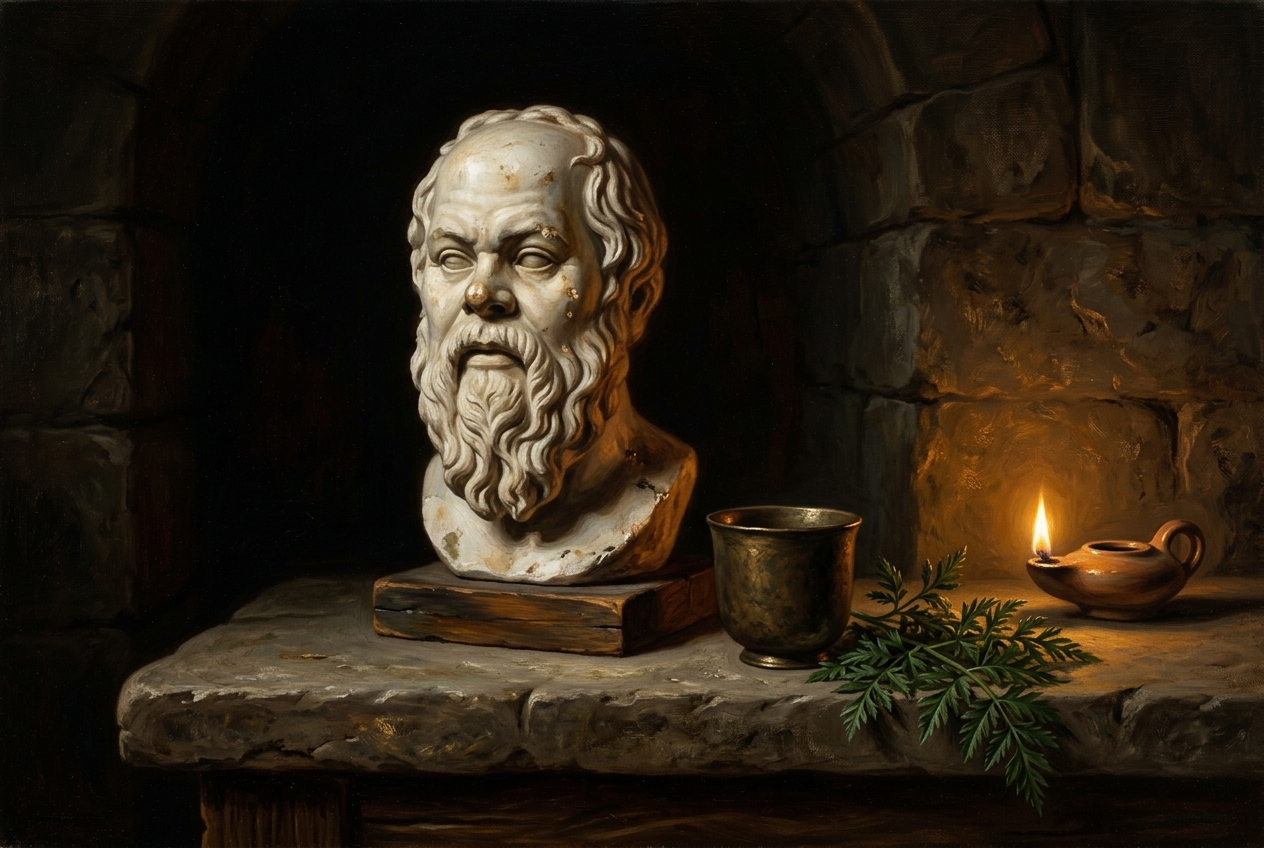
Socrates was tried on charges of impiety and corrupting the young. He was found guilty by a modest margin, and then the second vote arrived. His accusers proposed death. The expected reply was exile or a substantial fine, either of which many jurors would have taken. Instead, as Plato's Apology presents it, Socrates suggested that a man who had spent his life goading the city into thinking clearly deserved to be maintained at public expense, an honour reserved for benefactors such as Olympic victors. He then offered a fine so small it was closer to an insult than a settlement, raised only when friends offered to cover a larger sum.
The second vote went against him by a wider margin than the first, which tells you that some jurors who thought him guilty were nonetheless not seeking his death until the offer arrived. The system did not condemn him twice. It condemned him once, and then he handed it a choice with only one acceptable answer.
We tell that story at length in our story-driven collection The Hemlock Hour, which follows the trial from the charges to the cell, and the method that made him famous is broken down in the Socratic method explained. If you want the shorter account of the verdict itself, see why Socrates was sentenced to death. Making that kind of choice yourself, under the constraints the historical actors faced, is the whole idea behind our Turning Points scenarios, and MindSnap is our own app, so treat that as a recommendation with an interest attached.
| Element | Athens, fifth and fourth century BC | Common modern assumption |
|---|---|---|
| Jury size | 201 to 501 citizens, sometimes more | Around twelve |
| Selection | By lot on the morning, using a kleroterion | Screened in advance |
| Advocates | None; litigants spoke for themselves | Professional lawyers argue |
| Judge | A magistrate managing procedure only | A judge rules on law |
| Timing | One day, measured by water clock | Days or weeks |
| Sentencing | Jury picks between two proposed penalties | Judge sets the sentence |
| Appeal | None | Higher courts review |
Why the misunderstanding matters
Reading the trial as a miscarriage of justice by a court like ours misses what actually happened. There was no institution standing above the crowd to be corrupted, because the crowd was the institution. That is the uncomfortable lesson of 399 BC: the machinery worked exactly as designed, and the design contained no brake.
Athens did not fail to protect Socrates from the people. Athens had built a court in which the people were the only protection there was.
Frequently asked questions

One snap tomorrow morning.
Two minutes in art, history, psychology, philosophy or economics, then the app tells you you're done.
Get MindSnap on iOSFree daily fact, forever. Pro is $9.99/month or $44.99/year.