The Socratic Method Explained: How Asking Questions Became a Superpower

Arts & History Editor
Last updated: August 2026
7 min read

TL;DR
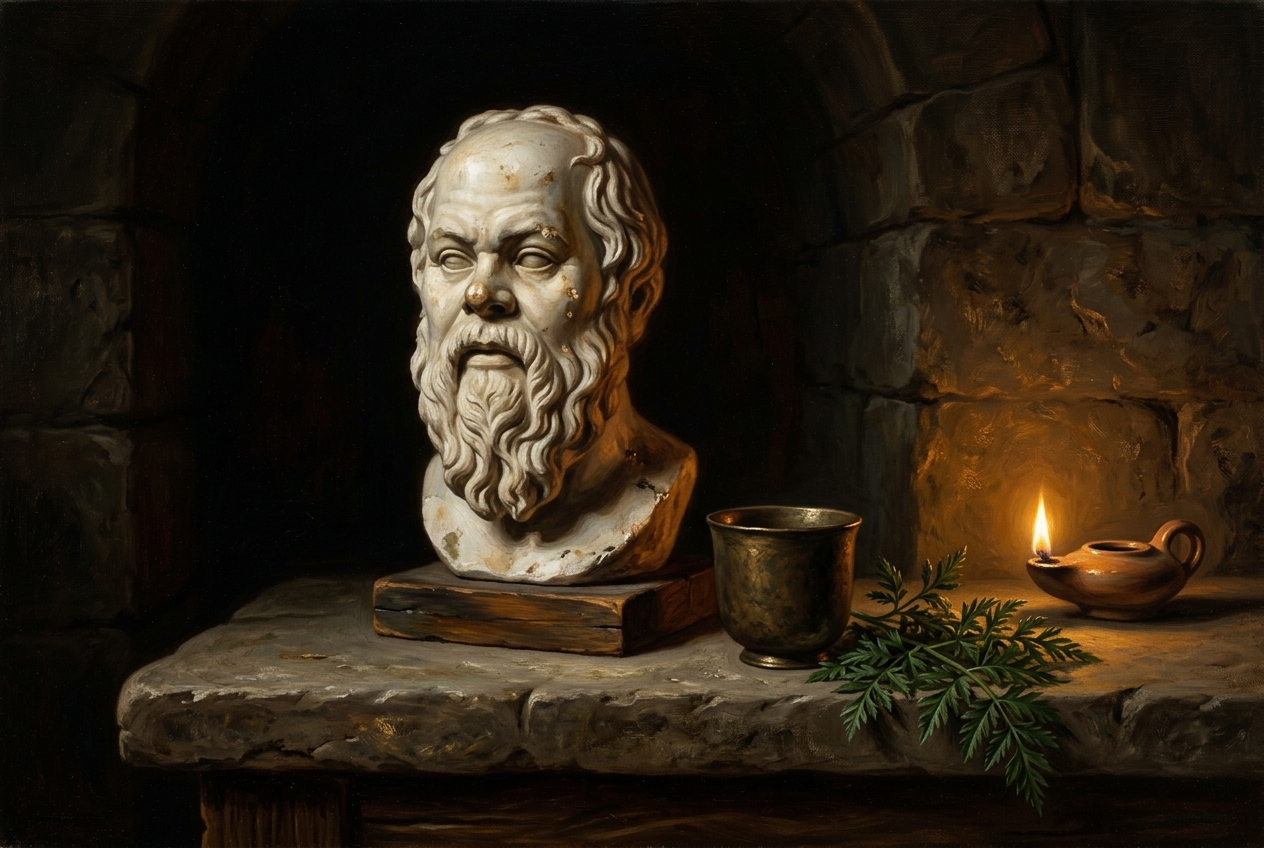
The Socratic method is not gentle discussion and it is not a teacher asking questions with an answer already in mind. In its original form, elenchus, it is a demolition procedure: get someone to state a definition, secure their agreement to a few further claims, then show that their own claims contradict the definition. Socrates practised it in the public spaces of Athens on people with reputations to lose, which is a large part of why the city eventually tried and executed him in 399 BC. It begins from professed ignorance, the claim that the questioner knows nothing worth knowing, and it usually ends without a definition, which was the point rather than a failure. The method survives in the case-method classrooms of law schools, in Socratic questioning within cognitive behavioural therapy, and in any teaching that makes a student defend a claim. Disclosure: MindSnap is our app, and this story is the subject of our Hemlock Hour collection.
There is a version of the Socratic method that gets taught in management seminars, in which asking open questions is a way of drawing out ideas and making people feel heard. It is a perfectly nice technique and it has essentially nothing to do with what Socrates did.
What Socrates did was closer to a controlled demolition, performed in public, on the reputations of people who thought they knew things. That is worth understanding properly, because the original is far stranger and considerably more useful.
Elenchus, the actual procedure
The Greek word is elenchus, meaning examination or refutation, and in the early Platonic dialogues it follows a recognisable shape.
- 1The interlocutor asserts a definition. What is courage? Courage is standing firm in battle.
- 2Socrates asks for agreement on further propositions that seem harmless and obvious. Is it courageous to retreat in order to win later? Yes, obviously.
- 3He shows that these agreed propositions contradict the original definition. So courage is not simply standing firm, since you have just called a retreat courageous.
- 4The interlocutor either revises the definition, at which point the loop repeats, or discovers they cannot say what they were certain of five minutes earlier.
Note who supplies the ammunition. Socrates rarely asserts anything of his own. Every premise in the contradiction came from the other person, which is why the outcome is so hard to escape and so infuriating to experience. You have not been beaten by a rival theory. You have been shown that you never had a theory.
The state this produces has a name too: aporia, meaning impasse or perplexity. The early dialogues characteristically end in it. Nobody defines courage in the Laches. Nobody defines piety in the Euthyphro.
Why the failure is the feature
A modern reader finishes one of these dialogues feeling short-changed, as though the author forgot to write the conclusion. But the Socratic position is that most people walk around with confident opinions they have never examined, and that this is the actual obstacle to knowledge. You cannot fill a vessel that is already full of nonsense.
Hence the professed ignorance, the famous claim that he knew that he did not know. Whether Socrates was sincere about this or wielding it as a rhetorical instrument is a very old argument, and the Greeks had a word for the apparent modesty of it, eironeia, from which we get irony. Probably it was both. Either way it establishes the only honest starting position: if you do not know, say so, and then look.
So aporia is progress. Before it you had a false belief and confidence. After it you have no belief and accuracy about your own state. That is a genuine upgrade, even though it feels like a loss.
How he actually worked
Socrates had no school, no fee and no syllabus. He worked in the agora, the marketplace and civic heart of Athens, and in the gymnasia and the workshops, buttonholing whoever was available: generals on courage, priests on piety, poets on their own poems, craftsmen on their trades. He drew a crowd, frequently of young aristocrats who found the spectacle of eminent men being dismantled extremely entertaining.
Consider how that lands in a small city where reputation was the whole currency. A general publicly unable to define courage does not thank you for the clarification. Multiply that by decades of dedicated practice and the trial of 399 BC starts to look less like a bolt from the sky and more like a bill arriving. The charges were impiety and corrupting the young, the political backdrop after Athens' defeat by Sparta was ugly, and we set out how the case actually came together in why Socrates was sentenced to death.
He was also, by his own account in Plato's Apology, doing this in response to the oracle at Delphi, which had said no man was wiser than Socrates. His interpretation was characteristically awkward: perhaps he was wisest only in knowing that he knew nothing, and the way to test that was to go and question everyone with a reputation for wisdom. He treated a compliment as an assignment.
Where the method lives now
Law schools
The case method associated with American law teaching is the most literal survival. A student is asked to state the holding of a case, then pressed with hypotheticals designed to test whether the stated rule can bear weight. Change one fact, does your rule still hold? The aim is not the right answer but the capacity to hold a position under pressure and notice when it breaks.
Therapy
Cognitive behavioural therapy uses a technique explicitly called Socratic questioning, also known as guided discovery. A therapist does not tell a client that a belief such as everyone thinks I am a failure is irrational. They ask what the evidence for it is, what evidence points the other way, what an alternative reading might be, and what would follow if it were true. The client dismantles the belief with their own material, which is both more durable and more respectful than being contradicted. It is elenchus in a consulting room, minus the audience and the humiliation.
Any teaching that actually works
The everyday descendant is the moment a teacher declines to give an answer and asks you to defend the one you gave. That is unpleasant and it is effective, because producing and defending a claim is a far deeper act than receiving one. It also has a cousin in the study technique of explaining a concept until you find the gap, which we cover in the Feynman technique.
Using it without becoming insufferable
Two honest cautions. Firstly, the method was designed for definitions of abstract concepts and it works badly on questions of fact, where the answer is looked up rather than reasoned out. Secondly, it is easily counterfeited: asking leading questions to steer someone toward a conclusion you already hold is not Socratic, it is a lecture wearing a costume.
On yourself, though, it is close to a free upgrade. Take a view you hold confidently and try four moves.
- Define the key term precisely. Most confident opinions dissolve at this step alone.
- Find a case that fits your definition but that you would not accept as an instance.
- State what evidence would change your mind. If nothing would, you are not holding a belief, you are holding an allegiance.
- Notice the aporia when it comes and resist the urge to fill it immediately with a fresh certainty.
The Stoics later industrialised this habit of self-examination into a daily practice, which is one of the through-lines in our stoicism starter guide.
One last thing about the man
Disclosure since I am about to mention our own product: MindSnap is our app. The whole arc of the questioning, the trial and the refusal to escape is our collection The Hemlock Hour, and if you would rather be examined than read about someone being examined, Turning Points drops you into Athens in 399 BC with the choices he actually faced, including the plea bargain that would have saved him.
Which is the point that should stay with you. Socrates was offered the ordinary human exits, a softer defence, a fine, a quiet exile, and the same method that had made him so unpopular obliged him to refuse each one, because he could not find a consistent argument for taking them. The method was not a debating trick he performed. It was the thing he was willing to die inside.
Frequently asked questions

One snap tomorrow morning.
Two minutes in art, history, psychology, philosophy or economics, then the app tells you you're done.
Get MindSnap on iOSFree daily fact, forever. Pro is $9.99/month or $44.99/year.