Why Was Socrates Sentenced to Death? The Trial Explained

Arts & History Editor
Last updated: August 2026
8 min read
TL;DR
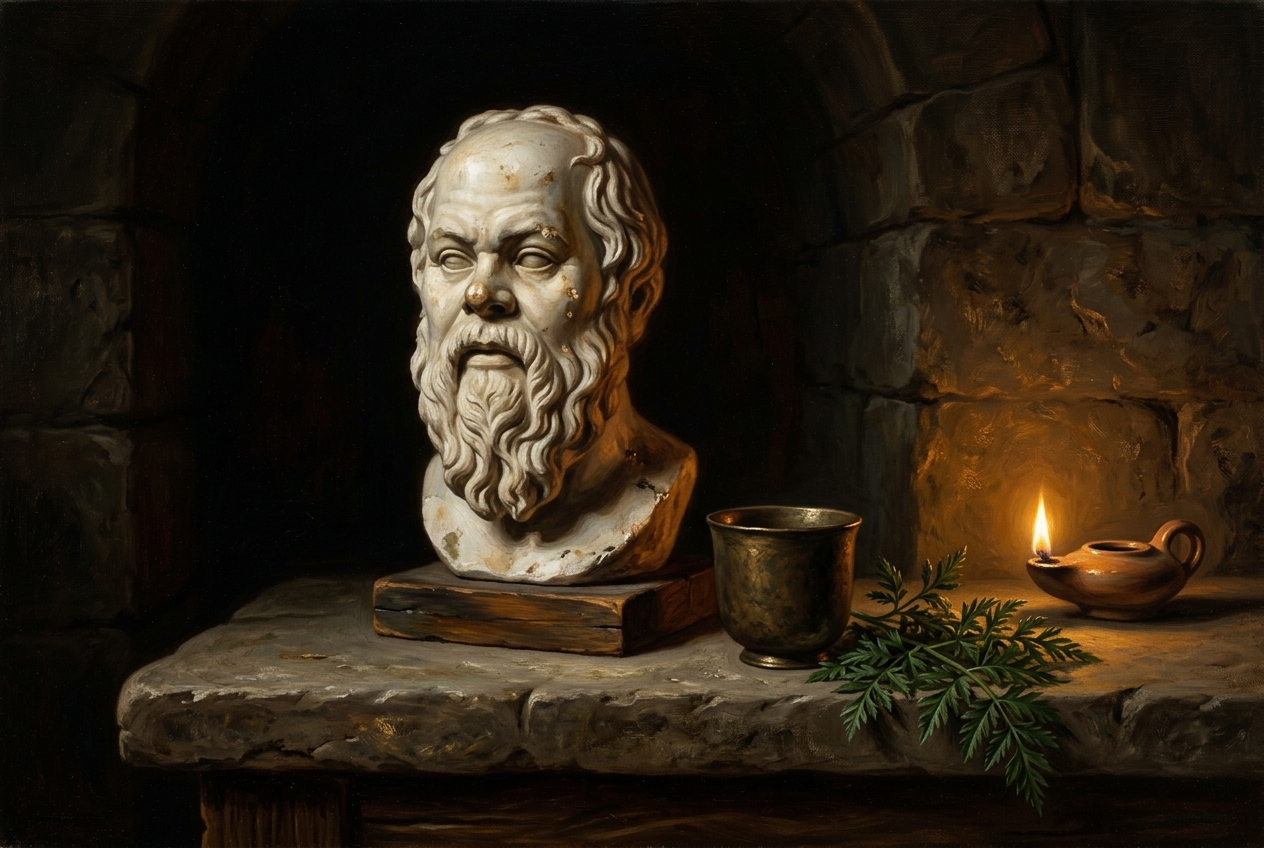
Socrates was tried in Athens in 399 BC on two charges: impiety toward the city's gods and corrupting the young. The legal charges were real, but the pressure behind them was political. Athens had just lost a long war to Sparta, endured the brutal rule of the Thirty Tyrants, and passed an amnesty that made prosecuting men for their politics awkward. Socrates had taught several of those men. A jury of 501 citizens convicted him by a modest margin, then voted for death after he proposed an almost insulting alternative penalty. He refused a plausible escape on principle. Athens did not simply hate philosophy: the vote was close, and it was about loyalty as much as belief.
In the spring of 399 BC an elderly Athenian stonemason's son stood before a jury of his fellow citizens and was told he had a day to persuade them not to kill him. He did not really try. The result has been argued about for twenty-four centuries, and most of what people think they know about it is a simplification.
The simplification is that Athens executed Socrates because Athens feared free thought. That is too flattering to us and too unflattering to them. The trial makes far more sense when you put it back into the year it happened.
The formal charges
Three citizens brought the case: Meletus, who filed it, with Lycon and the politician Anytus behind him. The indictment had two parts.
- Impiety, asebeia: failing to acknowledge the gods the city acknowledged and introducing new divinities of his own.
- Corrupting the young men of Athens.
Both were genuine offences in Athenian law, and neither was as vague as it looks to modern eyes. Athenian religion was not a matter of private belief. It was a set of public acts that bound the community and, people sincerely believed, kept the city safe. A man who talked about a personal divine sign, his daimonion, that advised him privately was not simply eccentric. He was operating outside the shared ritual life that held Athens together.
The second charge was equally practical. Socrates spent his days demonstrating in public that respected Athenians could not defend their own beliefs under questioning. The young men who followed him around enjoyed that enormously. Their fathers, watching sons learn to dismantle received wisdom, drew a different conclusion.
The political backdrop nobody could mention
By 399 BC Athens had had a catastrophic decade. The Peloponnesian War ended in 404 with defeat by Sparta, the long walls pulled down and the fleet gone. Into that vacuum came the Thirty Tyrants, a Spartan-backed oligarchy that ran a campaign of executions and confiscations before democracy was restored after about eight brutal months.
Two names matter for the trial. Critias, the most ruthless of the Thirty, had been in Socrates' circle. So had Alcibiades, the brilliant and treacherous general who defected to Sparta. Socrates had also, by his own account, refused an illegal order from the Thirty, so he was no collaborator. But the association was there, and in a wounded city association is enough.
Here is the part that explains the shape of the indictment. The restored democracy had passed an amnesty covering political acts under the Thirty. You could not straightforwardly prosecute a man for having taught tyrants. You could prosecute him for impiety and for corrupting the youth. The charges were legally real and politically convenient at the same time, and both things can be true.
How the vote actually went
The jury numbered 501 citizens, chosen by lot, large enough to make bribery impractical. There was no judge directing them and no appeal. Prosecution and defence each spoke within a fixed time measured by water clock, then the jury voted at once, without deliberating together.
Socrates was convicted, but not overwhelmingly. Plato's account puts the margin at something like sixty votes, meaning a shift of roughly thirty jurors would have acquitted him. That detail is the single most important corrective to the myth. This was not a city united against philosophy. It was a narrowly divided jury on a bad afternoon.
Then came the second vote, on penalty. Athenian practice let the convicted man propose an alternative to what the prosecution demanded, and juries generally expected something they could accept: exile, a substantial fine, contrition. Socrates suggested that what he really deserved was to be fed at public expense as a civic benefactor, like an Olympic victor. He eventually offered a small fine, raised only because friends including Plato offered to guarantee a larger sum.
The jury voted for death, and by a wider margin than the conviction itself. Some who had voted to acquit him voted to kill him. Read plainly, that means the second vote punished the performance more than the crime.
Why he would not run
Execution was delayed roughly a month because a sacred ship was away on an annual mission to Delos and no executions could take place until it returned. Everyone understood what the delay was for. Prisoners left. Friends were wealthy, guards were bribable, exile was survivable, and nobody expected Athens to hunt him down.
Plato's Crito has Socrates refuse, and the reasoning is consistent rather than theatrical. He had lived seventy years under Athenian law, accepted its protection, raised his children there, and never chosen exile when he could have. To break the verdict now would be to treat the law as binding only when convenient, which would do more damage to the city than his death. You can find the argument unconvincing, and many have, but it is not the argument of a man staging a martyrdom.
What the Phaedo actually describes
The death scene in Plato's Phaedo is calm and clinical. Socrates drinks the cup, is told to walk until his legs feel heavy, then lies down. The attendant presses his feet and asks whether he can feel it. The numbness climbs. Socrates covers his face, uncovers it to make a last remark about a debt owed to Asclepius, and dies as the paralysis reaches the chest.
Modern readers often notice that this is a very peaceful account of poisoning by a plant of the hemlock family, whose effects can be considerably harsher. Plato was writing philosophy, in part, and was probably not in the room. The scene should be read as a portrait of a death consistent with the life, not as a clinical report.
The myth worth dropping
Athens was, by the standards of its world, remarkably tolerant of argument. Socrates had taught in public for decades without prosecution. What changed was not the city's appetite for philosophy but its tolerance for anyone associated with the men who had just torn it apart, at a moment when it could not prosecute that association directly.
If you want the broader Greek intellectual world he came from, our Stoicism starter guide picks up the thread a century later, and philosophy facts that sound made up has more from the same period.
One vote, two histories
Change thirty jurors and Socrates lives, probably teaches for another decade, and possibly never becomes the founding martyr of Western philosophy. Plato's entire project was shaped by watching his teacher killed by a democracy, and that resentment runs through everything he later wrote about how cities should be governed. It is one of the cleanest examples of a narrow decision with enormous downstream weight, which is the sort of thing we collect in history's greatest what-ifs.
Disclosure, since we are about to mention our own product: MindSnap is our app. We tell this story across a collection called The Hemlock Hour, one of five flagship story-driven collections alongside unlimited topics, at two minutes a day. If you would rather stand in the jury yourself and see what the alternative cost, the interactive Turning Points scenario for 399 BC lets you cast the vote and then shows you what actually happened.
He was not killed for asking questions. He was killed for asking them in the wrong year, to a city that had just been humiliated.
Frequently asked questions


One snap tomorrow morning.
Two minutes in art, history, psychology, philosophy or economics, then the app tells you you're done.
Get MindSnap on iOSFree daily fact, forever. Pro is $9.99/month or $44.99/year.