Chapter 2 of 8
The crossword test: recruiting minds, not medals
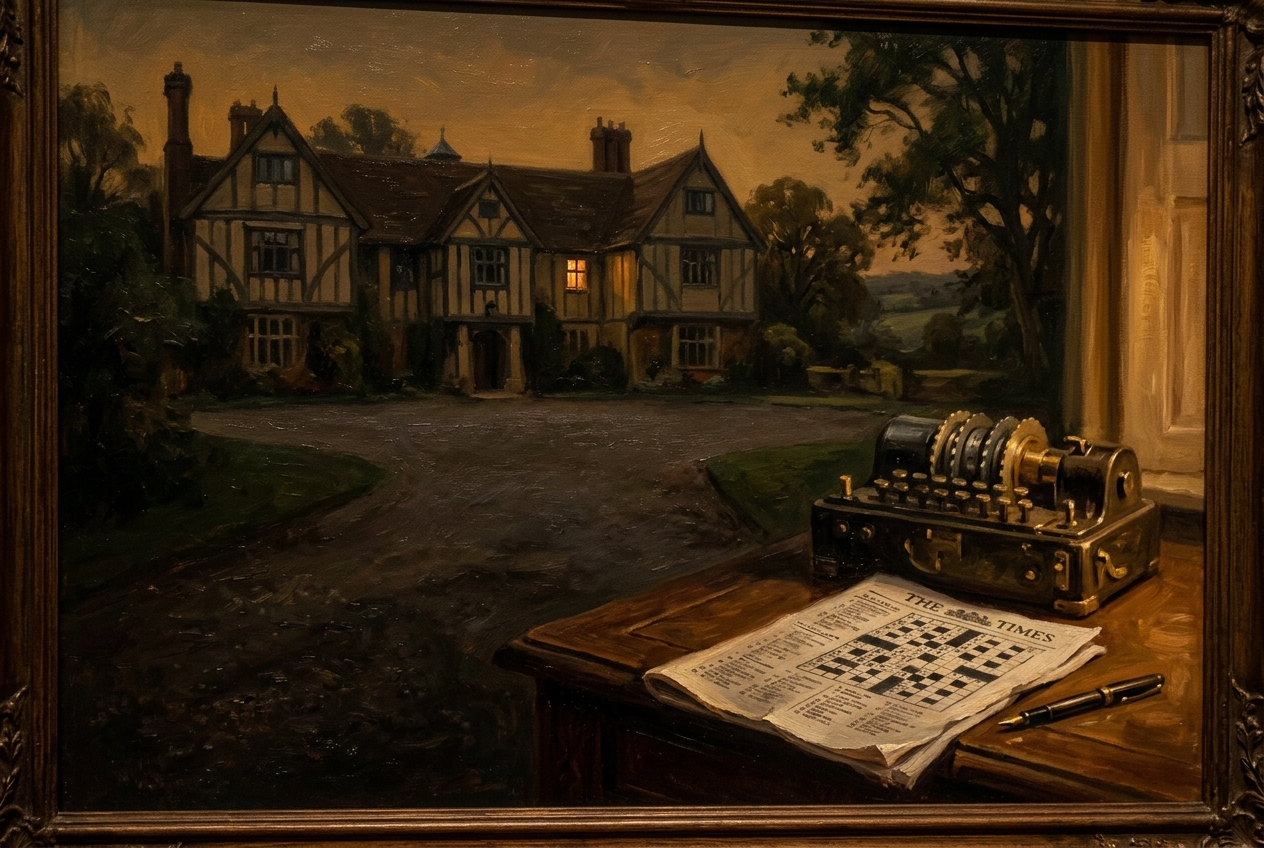
Britain needed people who could hold a pattern in their head under pressure. Rank could not identify them. A twelve-minute crossword, famously, could help.
2 min read
Codebreaking is a strange skill to hire for. It rewards the ability to notice that something is very slightly not random, to hold several competing structures in mind at once, and to keep going for weeks after the obvious approaches have failed. None of that shows up on a service record.
So Bletchley recruited sideways. The early intake came through the personal networks of the senior staff: dons who wrote to promising students, a chess master who suggested other chess masters, a professor who recommended the quiet undergraduate nobody else had noticed. Among the arrivals were mathematicians, classicists, German linguists, papyrologists, several of Britain's strongest chess players, and people whose only qualification was that they were unusually good at puzzles.
The most repeated story is the newspaper competition. In January 1942 the Daily Telegraph, at the prompting of officials, ran a contest challenging readers to complete its crossword in under twelve minutes. Successful solvers were later approached about work of national importance. Several ended up at Bletchley. The story has been retold so often that it now sounds like a myth, but the contest genuinely happened, and it captures something real: the search was for a type of mind, not a type of qualification.
It is worth being honest about what the test measured. A crossword rewards flexible pattern recognition and comfort with ambiguity, which is a genuine part of the work. It does not measure the mathematics that ultimately broke the hardest problems. The people who made the decisive theoretical advances were professional mathematicians and statisticians, not puzzle enthusiasts. The crossword was a net, not a diagnosis.
The consequence was a workforce that looked nothing like a military establishment. A twenty-two-year-old graduate could contradict a naval officer twice his age, because inside the huts the argument was settled by whether your method worked. Bletchley ran on first names, terrible tea, and an unusual tolerance for eccentricity. It also ran, in large part, on the labour of thousands of young women, many from the Women's Royal Naval Service, who operated the machines, maintained the vast card indexes and did the punishing repetitive work without which no theoretical insight would have produced a single readable message.
The organisation was assembled. What it was pointed at was a small portable machine, about the size of a typewriter, that the German armed forces trusted almost completely.
To understand why they trusted it, you have to look inside it.
Keep going
Liked making the call?
MindSnap delivers a 2-minute turning point like this every day, plus a lesson, a quiz and a daily fact.
Free daily fact · price shown up front · cancel in one tap