Chapter 1 of 8
The manor by the railway line
A mock-Tudor country house in Buckinghamshire, bought quietly in 1938, chosen for one unglamorous reason: the trains from Oxford and Cambridge both stopped there.
2 min read
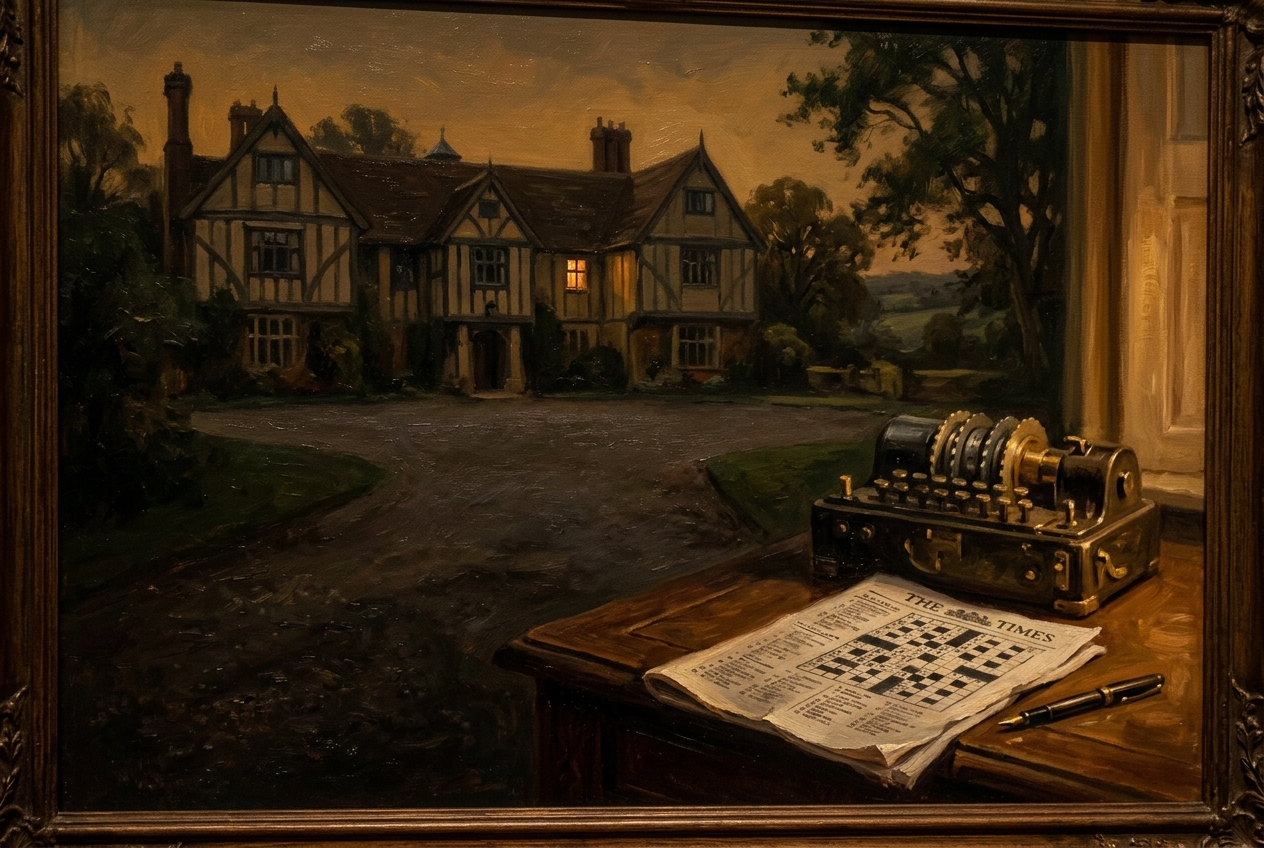
Begin with the building, because the building is the first clue about how the whole operation thought. Bletchley Park is a Victorian country estate in Buckinghamshire, remodelled in the late nineteenth century into an architectural argument with itself: mock-Tudor beams on one wing, a copper dome on another, red brick where you expect stone. Architectural historians have been rude about it for a century. It was never chosen for beauty.
It was chosen for logistics. In 1938 Britain's Government Code and Cypher School, then based in London, needed somewhere to move if bombs started falling on the capital. Bletchley sat on the main railway line from London to the north, and at the junction with the line that linked Oxford and Cambridge. The two universities were where the recruits would come from. A senior officer could be in Whitehall in an hour, and a newly recruited mathematician could arrive from either university without changing trains twice.
The site had one more advantage that mattered more as the war went on: room to build. A country estate has lawns, and lawns can take huts. Over the following years the grounds filled with wooden and then brick blocks, each holding one stage of a production line, until the place looked less like a house and more like a factory with a mansion attached.
The first party arrived in August 1938 under the cover story that they were Captain Ridley's shooting party, a group of gentlemen up from London for the season. The staff at that point numbered in the dozens. By 1945 nearly nine thousand people worked at Bletchley and its outstations, roughly three quarters of them women, most of them operating machines and running indexes rather than solving puzzles, and almost none of them permitted to know what the person in the next hut was doing.
That secrecy was structural, not decorative. Bletchley's product was intelligence derived from reading enemy signals, and the value of that product collapsed the instant the enemy suspected it existed. So the organisation was designed as a set of sealed compartments, with a small number of senior figures able to see across them. It is one reason so little leaked, and one reason the site's own veterans often learned only decades later what they had been part of.
The work itself was mathematical, linguistic and industrial in roughly equal measure. But before any of it could start, the people had to be found, and Britain's peacetime civil service had no reliable way to identify a mind that was good at this particular thing.
So the recruiters went looking in an unusual place: the puzzle pages of a newspaper.
Keep going
Liked making the call?
MindSnap delivers a 2-minute turning point like this every day, plus a lesson, a quiz and a daily fact.
Free daily fact · price shown up front · cancel in one tap