Why Does a Week Have Seven Days? The Oldest Habit You Never Question

Curiosity Columnist
Last updated: August 2026
8 min read
TL;DR
A day is one rotation, a year is one orbit, a month roughly tracks the moon. The week matches nothing in the sky. It comes from Babylonian moon-quartering and the seven wandering lights ancient astronomers could see, then travelled through Rome into the day names we still use. Revolutionary France and the Soviet Union both tried to abolish it, and both gave up.
The one unit with no excuse
Almost every piece of the calendar can point to something in the sky and say: that is why. A day is one spin of the Earth. A year is one lap around the sun. A month is a slightly untidy nod to the moon's cycle of roughly twenty nine and a half days.
And then there is the week. Seven days corresponds to no rotation, no orbit, nothing. It does not divide evenly into a month, and it does not divide evenly into a year, which is why your birthday drifts around the days of the week and why the calendar refuses to repeat neatly. It is the single most rigid unit in your life and it is entirely a human invention, still running after several thousand years.
Babylon, and the quarter moon
The trail leads to Mesopotamia. Babylonian astronomers watched the moon carefully and noticed it hits four obvious milestones: new, first quarter, full, last quarter. Split the lunar cycle by those markers and each piece lands at roughly seven and a bit days.
Seven was also a number Babylonian culture treated with real weight, appearing repeatedly in religious practice and in the days singled out as unlucky or unsuitable for certain activities. A tidy quarter-moon interval and a number already loaded with meaning made for a durable pairing.
The lunar tie was never perfect, which matters. Four sevens make twenty eight, and the moon takes about a day and a half longer. Ancient calendars patched this by occasionally stretching a period, until eventually the week simply detached from the moon and started running continuously, ignoring months entirely. That divorce is why we now have weeks that stride across the ends of months without pausing.
Seven lights that would not stay still
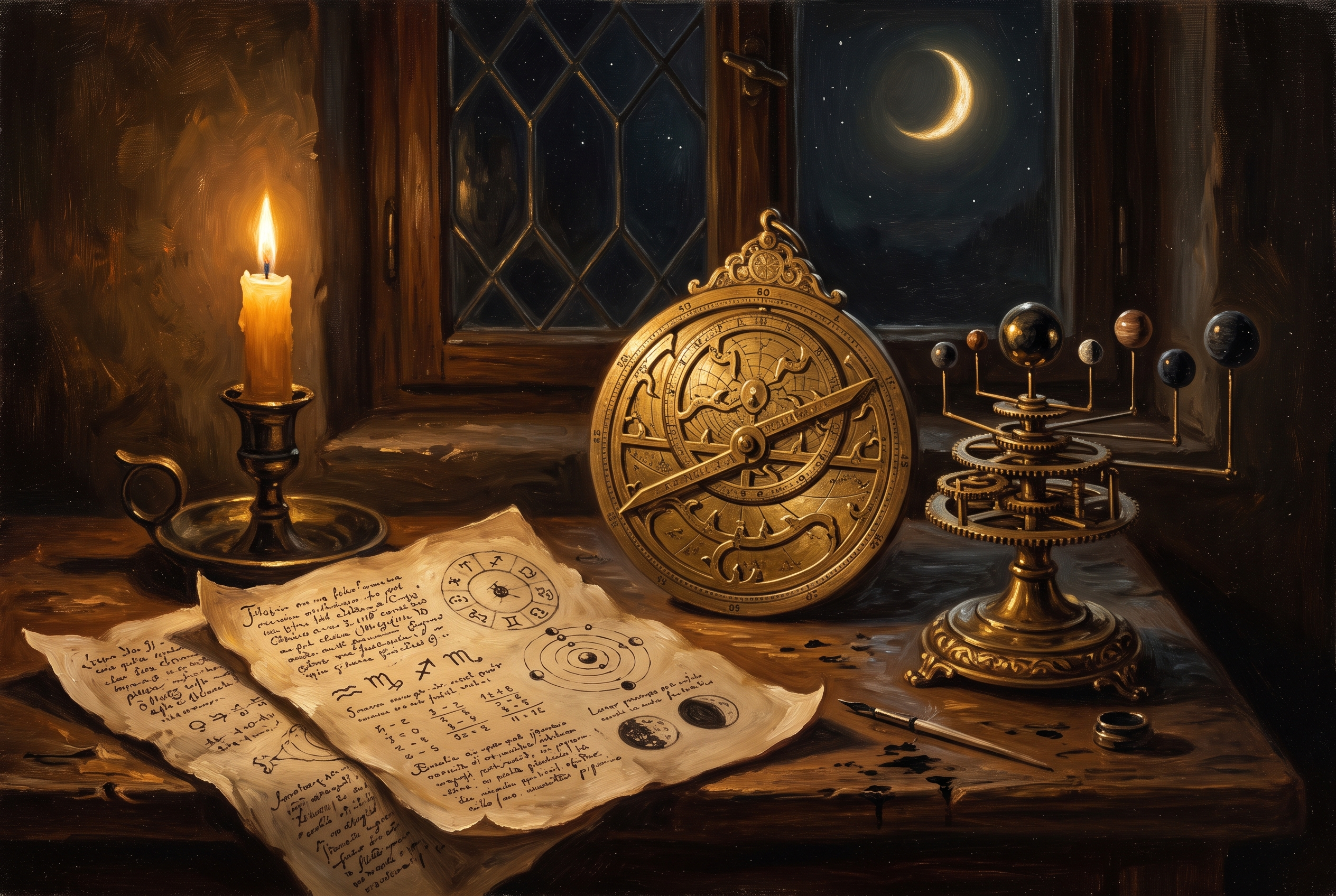
Here is my favourite part. Look up with no telescope and no light pollution, and note everything that moves against the fixed stars. You get exactly seven: the Sun, the Moon, Mercury, Venus, Mars, Jupiter and Saturn. The Greeks called them planetai, the wanderers.
Seven wanderers, seven days. Once those two sevens met, the week acquired a structure that felt cosmically justified rather than merely conventional, and each day got a ruling body.
The planetary hour trick
The ordering is the clever bit, and it is worth walking through slowly because it explains something that otherwise looks random.
Hellenistic astrologers ranked the seven bodies by apparent orbital speed, slowest to fastest: Saturn, Jupiter, Mars, Sun, Venus, Mercury, Moon. Then they assigned each hour of the day to the next body in that sequence, cycling round and round. A day's name came from whichever body ruled its first hour.
Twenty four hours divided by seven leaves a remainder of three. So starting a day with Saturn, you count three positions onward and land on the Sun for the next day's first hour. Three more brings you to the Moon, then Mars, Mercury, Jupiter, Venus. That gives Saturday, Sunday, Monday, Tuesday, Wednesday, Thursday, Friday: our exact week order, generated by arithmetic on a list sorted by orbital speed.
The day names are a fossil record
The Roman Empire took up the planetary week, and by the fourth century it was firmly established in civil life, with Constantine formally recognising the day of the Sun as a day of rest in 321. Then the names went travelling, and the languages of Europe preserved them in two different ways.
The Romance languages kept the planets almost intact. French gives mardi for Mars, mercredi for Mercury, jeudi for Jupiter, vendredi for Venus. Italian and Spanish run the same pattern. Weekend days shifted under Christian influence, which is why French has dimanche, the Lord's day, rather than a day of the Sun.
The Germanic languages did something more interesting. They translated the gods rather than the names, substituting local equivalents for Roman ones. Mars, god of war, became Tiw, giving Tuesday. Mercury became Woden, giving Wednesday. Jupiter, the thunderer, became Thor, giving Thursday. Venus became Frige, giving Friday. Saturn had no obvious counterpart, so Saturday kept its Roman owner and sits in modern English as an untranslated survivor.
- Saturday: Saturn, the only Roman god left standing in the English week.
- Sunday and Monday: the Sun and the Moon, unchanged in both language families.
- Tuesday to Friday: Roman planets in French and Spanish, Norse gods in English.
- The Portuguese exception: numbered weekdays, segunda-feira and so on, sidestepping the planets entirely.
If you enjoy this sort of thing living inside ordinary vocabulary, there is more of it in everyday words with surprising origins.
Two serious attempts to kill the week
Nothing this arbitrary goes unchallenged. Twice, governments with genuine power tried to replace the seven day week, and twice they lost.
Revolutionary France went first. The republican calendar of 1793 was beautifully rational: twelve months of thirty days, each month divided into three decades of ten days, with five or six extra days at the end of the year. Days were renamed and decimal time was proposed alongside it.
The arithmetic was flawless and the human cost was not. Workers went from one rest day in seven to one in ten, a change nobody had asked for. The decade also cut across religious observance in a way that guaranteed resistance. It limped along and Napoleon abolished it at the start of 1806, roughly twelve years in.
The Soviet Union tried the other direction in 1929, introducing a five day continuous work week with staggered rest days so factories never stopped. Each worker got a colour-coded day off. It worked on paper and fell apart in practice, because families and friends were now off on different days and nothing social could be scheduled. A six day version followed, and in 1940 the seven day week returned.
Why seven actually stuck
Both failures point at the same answer, and it is not tradition or superstition. Seven days happens to be a rhythm people can live inside: long enough that a rest day feels earned, short enough that the wait is bearable, and shared widely enough that everyone's week lines up.
That last point is what killed the Soviet experiment. A calendar's value is largely coordination, and a superior calendar that nobody else uses is worse than a slightly silly one that everybody does. Seven survived because it was already synchronised across most of the world, and because it fit human tolerance for effort and pause.
There is a small lesson buried in it for anyone building a habit. The week works not because it is optimal but because it is repeatable, and it is repeatable because the demand it makes is modest. That is also why a two minute daily lesson tends to outlast an ambitious weekend study plan, which is roughly the whole design premise of MindSnap, our app.
Meanwhile the next time someone asks a genuinely unanswerable question at dinner, you have a good one: nothing in the sky takes seven days. We just kept doing it. There are more of those in two minute dinner party facts, and if you like history that turns on an accident rather than a plan, try accidental discoveries that changed the world. Or go browsing by subject on the topics page.
- Keep reading: Everyday Words with Surprising Origins
- Keep reading: Accidental Discoveries That Changed the World
- Keep reading: Two Minute Dinner Party Facts
Frequently asked questions


One snap tomorrow morning.
Two minutes in art, history, psychology, philosophy or economics, then the app tells you you're done.
Get MindSnap on iOSFree daily fact, forever. Pro is $9.99/month or $44.99/year.