Who Owns Antarctica? The Treaty That Froze a Continent's Borders

Learning Science Writer
Last updated: August 2026
9 min read
TL;DR
Seven countries made territorial claims to Antarctica in the first half of the twentieth century, three of them overlapping on the same peninsula. The 1959 Antarctic Treaty did not resolve those claims. It set them aside, banned military activity, guaranteed freedom of scientific research and created an inspection regime, and a 1991 protocol prohibited mineral resource activity. The result is one of the clearest working examples of how the world governs a space nobody owns.
A continent with lines drawn on it
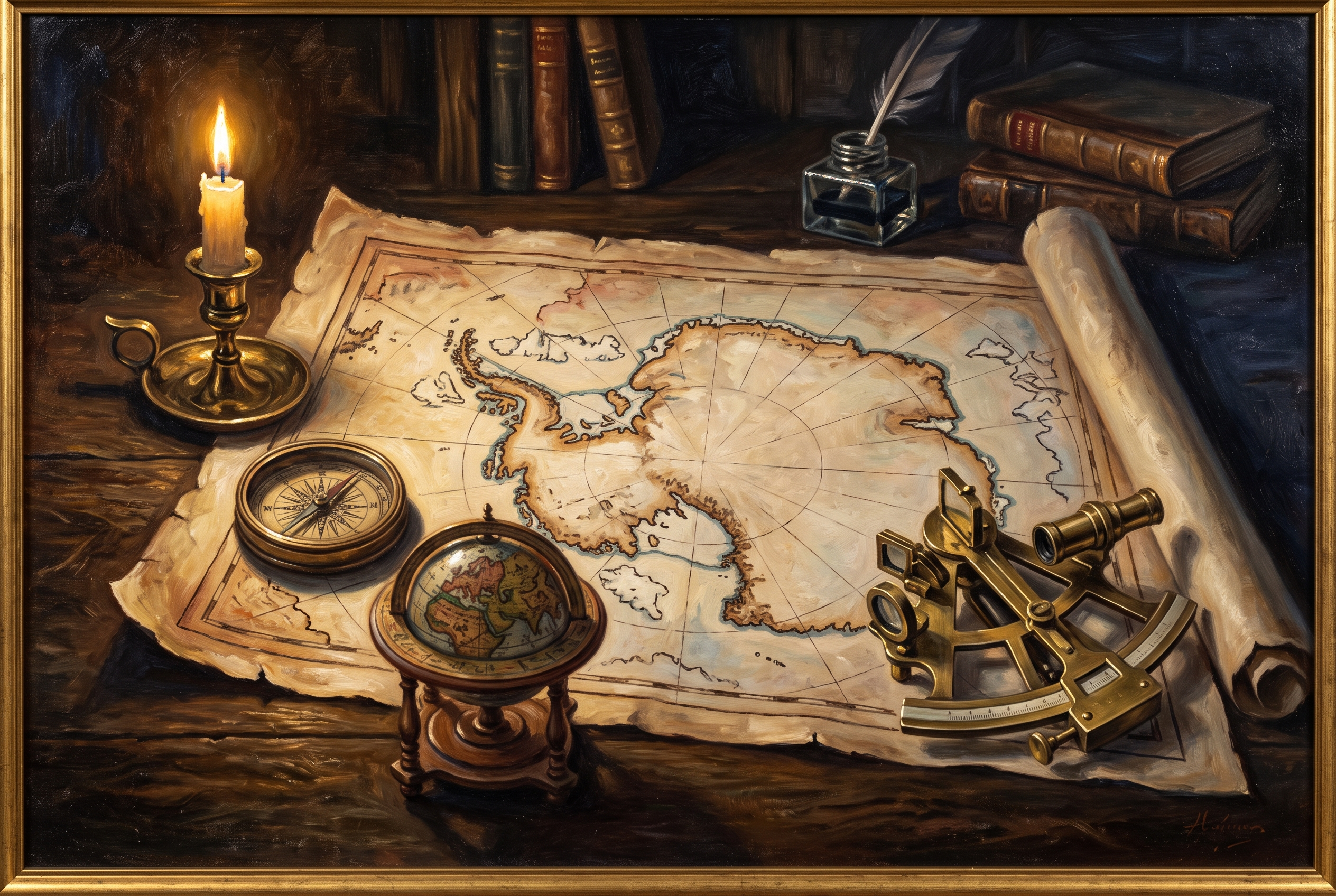
Look at a mid-century map of Antarctica and you see something that looks like a sliced pie. Wedges run from the coast to the South Pole, each labelled with a country's name. Seven states asserted sovereignty over sectors of the continent: the United Kingdom, New Zealand, France, Norway, Australia, Chile and Argentina.
Most of those wedges follow lines of longitude converging at the Pole, a convention that made cartographic sense and human sense of almost nothing, since no one lived there. Norway's claim is the exception, deliberately left without a defined southern limit. And on the Antarctic Peninsula, the part nearest South America, the British, Chilean and Argentine claims overlap one another, which through the 1940s produced exactly the sort of friction you would expect: rival bases, flags removed and replaced, and at least one exchange of warning shots.
Notably, two of the states with the largest Antarctic presence, the United States and the Soviet Union, never made a claim. Both also declined to recognise anyone else's, while reserving their own basis for a future claim. That combination, overlapping assertions plus two major powers refusing the whole framework, is the problem the treaty had to solve.
How the claims were justified
The legal arguments came in a few recognisable flavours, and understanding them explains why none of them settled anything.
- Discovery and exploration: being first to sight, land on or map a coast.
- Effective occupation: maintaining bases, post offices and administrative acts in the sector.
- The sector principle: drawing meridians from a claimed coastline to the Pole.
- Proximity and inheritance: geographical nearness, or succession from a former colonial power's claims.
Each argument favours whoever is making it. Chile and Argentina lean on proximity and Spanish inheritance; the United Kingdom leans on discovery and continuous administration; Australia and New Zealand inherited British exploration claims. Since international law offers no ranking of these principles for uninhabited polar territory, the claims simply sat there, unresolvable by argument.
1957: science before politics
The way out came from an unexpected direction. The International Geophysical Year of 1957 to 1958 brought twelve countries to Antarctica for a coordinated research programme, building more than forty stations across the continent. Scientists from states that did not recognise each other's claims shared logistics, data and, in places, buildings.
It worked well enough that dismantling it looked absurd. Negotiations opened in Washington and the Antarctic Treaty was signed in 1959 by the twelve participating states, entering into force in 1961. It is a short document, and its cleverness lies in what it refuses to decide.
What the treaty actually does
| Provision | What it means in practice |
|---|---|
| Peaceful use only | No military bases, manoeuvres or weapons testing. Military logistics and personnel may support science. |
| Claims set aside | No act while the treaty is in force strengthens, weakens or creates a claim. Existing claims are neither recognised nor renounced. |
| Freedom of science | Research anywhere on the continent, with observations and results freely exchanged. |
| Inspection | Any consultative party may inspect any station, ship or installation at any time, with no notice required. |
| No nuclear activity | Nuclear explosions and disposal of radioactive waste are prohibited. |
| Consultative parties | Original signatories plus states conducting substantial Antarctic research decide by consensus at regular meetings. |
Article IV, the provision that freezes the claims, is the hinge of the whole arrangement. It lets a Chilean scientist and a British scientist work on the same glacier without either government conceding a millimetre of its legal position. Nobody had to lose an argument for the system to function.
The inspection clause deserves attention too. Unrestricted, no-notice access to any facility was an extraordinary transparency commitment in 1959, at the height of the Cold War, and it has been exercised many times since.
1991: the mining question
The treaty left resources unaddressed, and by the 1980s that gap mattered. A negotiated minerals convention was signed in 1988, then collapsed when Australia and France refused to ratify it under substantial public and environmental pressure.
What replaced it went considerably further. The 1991 Protocol on Environmental Protection, generally called the Madrid Protocol, designates Antarctica as a natural reserve devoted to peace and science and prohibits mineral resource activity other than scientific research. It entered into force in 1998. The prohibition has no automatic expiry, though a review process becomes available after fifty years from entry into force, and any change would require a demanding level of agreement among the consultative parties.
Why the continent matters structurally
Set aside the wedges on the map and the reasons states keep spending money there become clearer.
- Freshwater: the ice sheet holds the large majority of the planet's fresh water, which is why its behaviour drives global sea level projections.
- Fisheries: the Southern Ocean supports commercially significant stocks, managed under a separate convention with its own quota and monitoring rules.
- Scientific value: ice cores provide a long, continuous atmospheric record, and the isolation and cold suit astronomy, glaciology and biology that cannot be done elsewhere.
- Precedent: the treaty is a functioning template for governing territory outside national sovereignty, and its language influenced later regimes for other shared spaces.
The pattern: governing what nobody owns
Antarctica belongs to a small family of legal spaces where sovereignty was deliberately parked rather than allocated. The clearest parallel is the ocean, where a layered system of territorial waters, exclusive economic zones and high seas divides rights without dividing the water itself, a structure I walked through in Who Owns the Sea.
The Arctic is the instructive contrast. It is an ocean surrounded by sovereign states rather than a landmass surrounded by ocean, so coastal states hold real claims under the law of the sea and there is no equivalent treaty freezing them. That structural difference, not any difference in temperament, is why the two poles are governed so differently, and it shapes the questions raised by changing Arctic shipping routes.
If you want the general habit of reading these situations from the map rather than the headlines, that is the subject of how to read a geopolitical map. The Antarctic case is the cleanest illustration of the principle: what a map shows you is a claim, not a fact.
So who owns it?
Legally, nobody, and the treaty's achievement is that this remains a comfortable answer rather than a contested one. Seven claims exist on paper, three overlap, most states recognise none of them, and the parties agreed to behave as though the question were not urgent. Sixty-plus years of continuous scientific cooperation on a continent that has never had a war is the return on that agreement.
For readers who like this kind of structural history, the decision-driven Turning Points scenarios in MindSnap, which is our app, work through moments where the map was about to change and the outcome was genuinely open.
- Keep reading: Who Owns the Sea
- Keep reading: Arctic Shipping Routes Explained
- Keep reading: How to Read a Geopolitical Map
Frequently asked questions


One snap tomorrow morning.
Two minutes in art, history, psychology, philosophy or economics, then the app tells you you're done.
Get MindSnap on iOSFree daily fact, forever. Pro is $9.99/month or $44.99/year.