What Is a Tronie? The Dutch Portrait That Is Not a Portrait

Arts & History Editor
Last updated: August 2026
7 min read

TL;DR
A tronie, from an old Dutch word for face, is a painting of a head or bust that is not a portrait of a specific, paying sitter. Dutch Golden Age painters made tronies to explore expression, character types, exotic costume and the fall of light, and sold them on the open market. Vermeer's Girl with a Pearl Earring is usually classed as a tronie, as are many of Rembrandt's character heads of old men, soldiers and figures in fanciful dress. Tronies let painters sell affordable works, practise effects like chiaroscuro and reuse models. Knowing the genre changes the question from who is this to what is this face doing.
Stand in front of Vermeer's Girl with a Pearl Earring and the first question most people ask is: who was she? Novels and a film have tried to answer it. Art historians, for the most part, have a less romantic reply. She was probably never meant to be anyone in particular. The painting belongs to a genre called the tronie, and once you know that word, a whole corner of Dutch art starts to look different.
What the word means
Tronie is an old Dutch word that roughly meant face, head or expression. In the inventories and sale records of the seventeenth century Dutch Republic, it appears again and again to describe a particular kind of picture: a head, or a head and shoulders, of a figure who is not being recorded as an individual.
That is the key distinction. A portrait is a likeness of a specific person, usually commissioned and paid for by that person or their family, and meant to say something about their identity, status and character. A tronie is a study of a type, an expression or an effect. The model might be a real person, often a relative, an apprentice or the painter himself, but the picture is not about them.
What tronies show
Tronies tend to fall into a few recognisable families, though painters mixed them freely.
- Character types: the wise old man, the young soldier, the laughing peasant, the scholar.
- Expressions: surprise, laughter, melancholy, concentration, a face caught mid-turn.
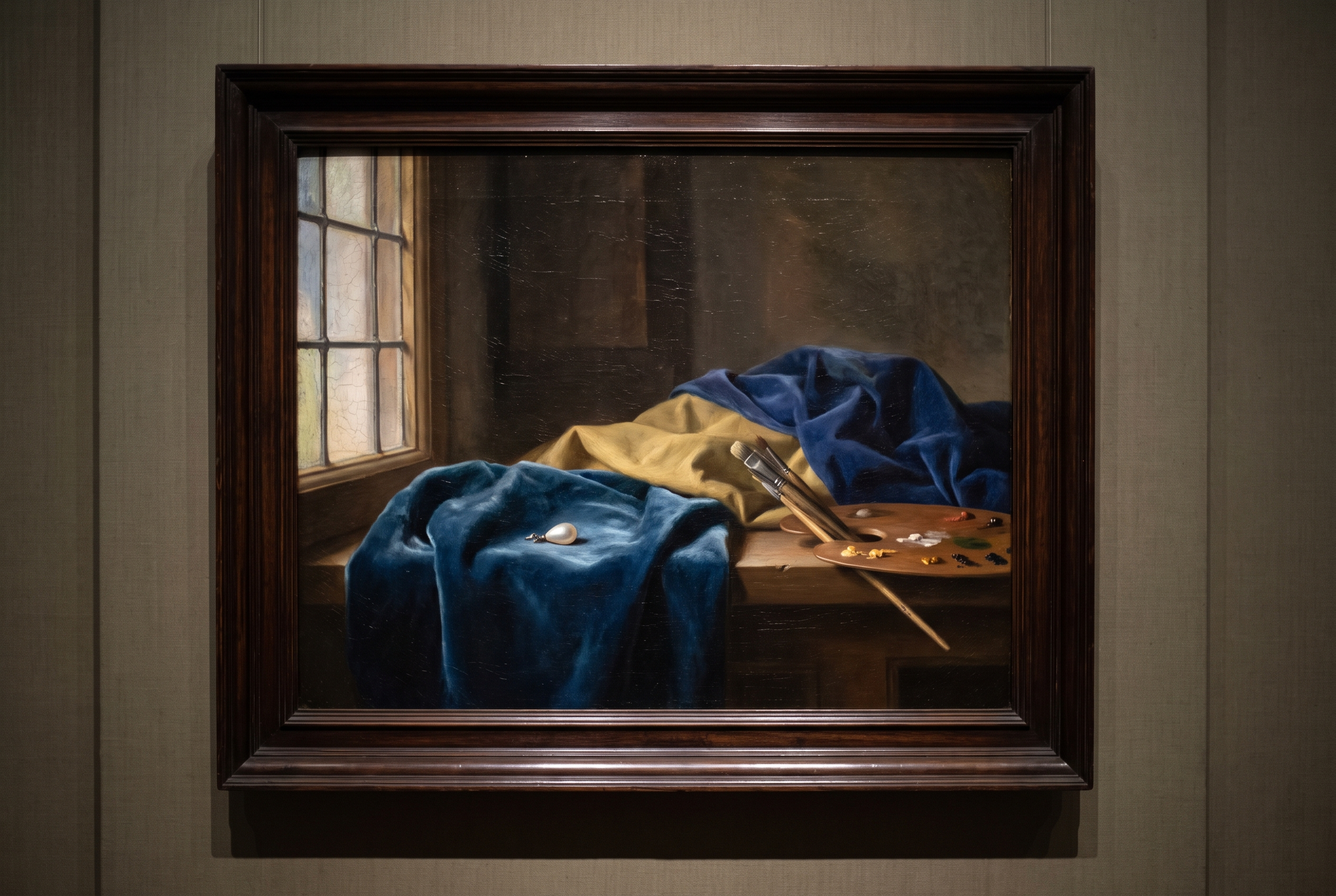
- Costume: turbans, plumed berets, gorgets of armour, furs and jewellery that no ordinary Dutch burgher wore to the market.
- Light: faces modelled by a single strong source, half in shadow, catching reflections on skin, metal and pearl.
Exotic or theatrical dress was a large part of the appeal. A turban or an old-fashioned costume took the figure out of everyday Delft or Amsterdam and into a vaguer, more imaginative world, closer to history painting than to a record of a neighbour.
Why Girl with a Pearl Earring is a tronie
Vermeer's painting, made around 1665, has many tronie hallmarks. The background is plain and dark, giving no setting and no clue to social status. The girl wears a blue and yellow turban, not something a Dutch girl of the period would ordinarily wear. The oversized pearl, which some scholars think may be glass or tin rather than a real pearl, is there to catch light. And the pose, looking back over her shoulder with lips slightly parted, is about a fleeting moment of expression rather than a formal likeness.
There is no surviving record of a commission, and the identity of the model is unknown. That gap is exactly what you would expect from a tronie, and part of why the picture has become a screen for so many stories. We look more closely at what makes it so magnetic in why Girl with a Pearl Earring is so famous.
Rembrandt and the character head
Rembrandt was one of the great makers of tronies, especially early in his career in Leiden and Amsterdam. He painted and etched old men with lined faces and wispy beards, figures in gorgets and feathered caps, and women in rich, imaginative dress. Some of his most famous self-images are best understood the same way: not formal self-portraits meant to record his status, but studies in which he used his own face as a convenient model for expressions and costumes.
That distinction is debated case by case, and scholars sometimes disagree over whether a given Rembrandt head is a tronie or a portrait. But the general point holds. When Rembrandt pulled faces in a mirror or dressed up in an oriental cap, he was often practising, and selling, character rather than recording identity. For the longer view of his lifelong habit of painting himself, see why Rembrandt painted so many self-portraits.
What tronies did for painters
They sold on the open market
The Dutch Republic had an unusually broad art market. Paintings were bought not only by courts and churches but by merchants, craftsmen and ordinary households. Tronies suited this market well. They did not need a commission, they could be painted on speculation, and they were often smaller and cheaper than large history paintings, making them an affordable way to own a picture by a known hand.
They were a workshop for technique
A single head, lit by a single window, is an ideal laboratory. Painters could experiment with the transitions from bright highlight to deep shadow, the texture of wrinkled skin, the glint on metal, without the demands of a complex composition or a fussy client. Many tronies are virtuoso displays of chiaroscuro, the dramatic play of light and dark explained in chiaroscuro explained.
They made models reusable
Because a tronie was not about its sitter, the same model could appear as a soldier one week and a biblical figure the next. Studios kept costumes and props for exactly this purpose. Tronies could also serve as stock studies, faces a painter or his pupils might later adapt into a larger narrative scene.
How knowing the genre changes how you look
Once you know a picture is a tronie, the most useful questions shift. Instead of asking who the person was, which often has no answer, you can ask what the painter was trying to do. What expression is being captured? How does the light fall, and where does the shadow swallow detail? What does the costume suggest: wisdom, exoticism, martial pride, youth? Is the picture about a moment, such as a glance or a half-spoken word?
These are clues, not rules, and labels in museums are sometimes revised as research continues. But looking with these questions in mind turns a mysterious face into a readable piece of craft, which is the habit at the heart of how to read a painting.
Seeing tronies in context
Disclosure: MindSnap is our app. Its Rembrandt's Shadow collection, one of five flagship story collections alongside unlimited further topics, follows Rembrandt from a miller's son in Leiden to his late self-portraits, and looks at how he used light, character and his own face. If tronies have caught your interest, Rembrandt's Shadow is a short, story-driven way to see the genre inside one painter's life.
A portrait asks you to remember a person. A tronie asks you to notice a face.
Frequently asked questions
One snap tomorrow morning.
Two minutes in art, history, psychology, philosophy or economics, then the app tells you you're done.
Get MindSnap on iOSFree daily fact, forever. Pro is $9.99/month or $44.99/year.